That's the part most people never see. But it's the part that determines whether a turbine survives 25 years of relentless wind loading or fails early.
Wind turbine builders and OEMs face a specific challenge: finding fabrication partners who understand tight tolerances, structural safety codes, and production schedules that don't bend for anyone. A single megawatt of wind capacity requires roughly 110 metric tonnes of steel, according to the European Commission's Joint Research Centre, once foundations are included. This guide breaks down the materials, processes, and fabrication decisions behind that number.
Key Takeaways
- Steel makes up 66-79% of turbine mass, dwarfing aluminum and copper combined
- U.S. wind power supplied 10.5% of utility-scale electricity generation in 2025
- Offshore towers require steel plate up to 150 mm thick, far exceeding onshore gauges
- Spiral welding lets fabricators build tower cylinders near the project site, avoiding transport limits
- Fabrication precision directly determines turbine safety, efficiency, and service life
The Growing Demand for Wind Energy (and Why Fabrication Matters)
Wind isn't a niche energy source anymore. It supplied 10.5% of U.S. utility-scale electricity generation in 2025, according to the U.S. Energy Information Administration. That share keeps climbing as older fossil plants retire and utilities lock in long-term wind contracts.
Money is following the trend, with U.S. wind capacity additions representing roughly $10.8 billion in investment in 2023 alone. The payoff isn't just economic, either: global wind deployment avoided an estimated 900 million metric tons of CO2 emissions in 2024, according to the International Energy Agency.
Here's the connection builders can't ignore:
- More turbines means more towers, hubs, and nacelle frames to fabricate
- Taller, more powerful turbines require heavier steel plate and tighter welding tolerances
- Production schedules are getting more aggressive as demand accelerates
Fabrication capacity is the bottleneck that determines how fast these projects actually get built.
The Critical Role of Metal Fabrication in Wind Turbine Construction
Strip away the marketing images of spinning blades against a blue sky, and what's left is a structural engineering problem. Towers, nacelle frames, hubs, and blade spar caps all begin as flat steel plate that must be cut, rolled, and welded to exacting specifications.
Even composite blades aren't fully composite. Internal metal or carbon spars carry the structural load, and those spars still demand fabrication-grade precision, not a hobbyist welder's guesswork.
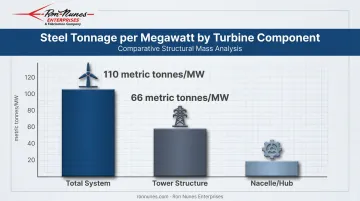
The numbers explain why. Independent research puts total steel intensity for a typical land-based turbine at:
- 110 metric tonnes per megawatt across the entire system
- 66 tonnes per megawatt in the tower structure alone
- Additional tonnage in the nacelle frame and hub casting, not included above
Why Spiral Welding Matters
Fabricators building tower sections face a real physical constraint: transporting a factory-rolled cylinder wide enough for a modern tower is expensive and sometimes impossible on standard roads.
Spiral welding solves this. A wide steel sheet feeds in at an angle, curls continuously into a cylindrical shape, and gets welded along the resulting helical seam. The Department of Energy documented this approach through Keystone Tower Systems, which built mobile spiral-welding rigs near project sites rather than shipping finished cylinders from a distant factory.
Structural loads make this precision non-negotiable. Towers reach hundreds of feet in height and absorb constant cyclical stress from wind gusts, day after day, for decades.
A weld defect that seems minor on paper can turn into a fatigue crack after ten years of vibration. Rigorous quality control determines whether a turbine survives its full 20-year service life or fails early.
Materials That Power Wind Turbine Fabrication
Not every metal in a turbine does the same job. Builders need to know which material goes where, and why substitutions aren't simple.
Steel: The Backbone of Wind Towers
Steel accounts for 66% to 79% of total turbine mass, according to the U.S. Geological Survey. That dominance comes down to strength-to-cost ratio. No other structural material delivers comparable load-bearing performance at a comparable price point, especially at the plate thicknesses towers require.
Aluminum and Lightweight Alloys
Aluminum shows up in cables, tower and nacelle components, climbing equipment, and lightning-protection hardware, but it stays a small player. Research from the National Renewable Energy Laboratory puts aluminum at just 0% to 2% of turbine mass. It's useful where weight matters, but it can't replace steel's structural role in a tower wall.
Copper and Composite Materials
Copper makes up roughly 1% of turbine mass, yet it's irreplaceable. Generator windings, transformers, tower wiring, and grounding systems all depend on copper's conductivity to minimize energy loss and manage electrical safety across a structure that's essentially a giant lightning rod.
Blades take a different materials approach entirely. Fiberglass, resin, and increasingly carbon fiber form the outer shell, but internal metal spars and root hardware still require the same fabrication rigor as tower components, just at a different scale.
Essential Metal Fabrication Processes for Turbine Components
Turbine fabrication runs through a consistent sequence of processes, each demanding its own tolerance standards.
- Laser cutting and shearing produce precise flat steel plates for tower cans, brackets, and mounting hardwarebrackets, mounting plates, and structural supports for nacelles and tower bases, holding tight tolerances across production runs
- Welding techniques, including submerged arc welding, join thick steel plates into rolled tower cans and blade spar structures. Submerged arc welding delivers high deposition rates, ideal for long, repetitive seams
- Finishing and coating protect steel from corrosion, essential for offshore towers exposed to constant saltwater and salt-laden coastal air
- Assembly and quality inspection confirm every component meets tolerance and structural standards before it ever leaves the shop floor
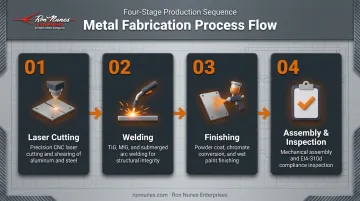
Each step feeds into the next. A punching error at step two becomes an assembly problem at step five, and a welding defect that skips inspection becomes a field failure years later. That's why fabricators serving wind energy treat inspection as a checkpoint at every stage, not just a final signature before shipment.
Onshore vs Offshore Wind Towers: Different Fabrication Demands
Onshore and offshore towers might look similar from a distance, but they're built to entirely different specifications.
| Factor | Onshore Towers | Offshore Towers |
|---|---|---|
| Steel plate thickness | Typically 10-60 mm | Can reach up to 150 mm |
| Foundation type | Ground-anchored | Monopile or floating substructure |
| Fabrication complexity | Lower | Higher |
| Substructure steel intensity | Not applicable | Monopile roughly 144.5 tonnes/MW |
That extra plate thickness and foundation complexity translate directly into higher fabrication costs and longer lead times, since heavier steel demands more powerful cutting, forming, and welding equipment throughout the shop.
Both categories share one trend, though: turbines keep growing taller and more powerful. The U.S. Department of Energy's Land-Based Wind Market Report shows average U.S. land-based turbine capacity hit 3.4 MW in 2023, up 375% from the late 1990s. Hub heights have climbed alongside it. That growth pushes demand toward heavier-gauge plate and more precise fabrication across the entire industry, not just offshore.
Choosing the Right Metal Fabrication Partner for Wind and Renewable Energy Projects
Wind projects don't tolerate fabrication bottlenecks. A tower section stuck in a queue at one shop while brackets wait at another shop creates delays that ripple through an entire installation schedule.
Full-service fabrication under one roof solves that problem. When cutting, shearing, forming, welding, assembly, and finishing all happen in-house, there's no handoff delay between vendors and no coordination gap where parts get lost in transit between shops.
Fast, reliable turnaround matters just as much as capability. Large infrastructure projects run on schedules measured in weeks, not "whenever it's convenient."
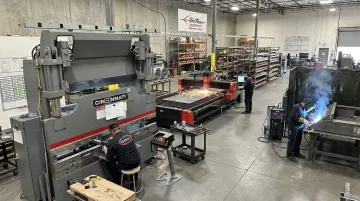
Ron Nunes Enterprises illustrates what to look for, even though the company doesn't build turbine towers itself. Based in Livermore, California, it has run a full-service metal fabrication operation since 1969. Its client base spans sectors that share wind energy's exact demands: tight tolerances, structural reliability, and zero tolerance for shortcuts.
Its track record includes:
- Over 55 years supplying precision metal fabrication to defense, nuclear research, telecommunications, and transportation sectors
- In-house laser cutting, N/C punching, press brake forming, welding, and MIL-spec finishing under one roof
- Guaranteed shipment within 3 working days for stock items and 15 working days for custom fabricated orders
- Caltrans Certified DBE status as a minority-owned business, relevant for projects with supplier diversity requirements
For wind builders evaluating any fabrication partner, the checklist looks like this:
- Vertically integrated capability spanning cutting, forming, welding, and finishing
- Documented turnaround commitments, not vague promises
- Decades of experience in precision-critical industries
Frequently Asked Questions
How expensive is it to build a windmill?
Costs vary widely by scale. Utility-scale land-based projects run around $1,968 per kW installed, while small distributed residential turbines can cost as much as $8,665 per kW, according to NREL's 2024 cost review.
How are windmills manufactured?
Manufacturing moves through foundation, tower, nacelle, and blade stages. Fabricators roll and weld steel plate into tower cans, machine cast hub components, and mold blades around internal metal spars, with precision welding tying every stage together.
What metal is used to build wind turbines?
Steel dominates, making up 66% to 79% of total turbine mass. Smaller amounts of aluminum, copper, and cast iron handle electrical systems, lightweight components, and specific structural hardware.
How much steel does a single wind turbine require?
Roughly 110 metric tonnes per megawatt of capacity, including the foundation. Towers alone account for about 66 tonnes per megawatt in a typical land-based system.
What is the average lifespan of a wind turbine?
Most cost models assume a 25-year project life, while the Department of Energy cites an expected service life of about 30 years. Fabrication quality, particularly weld integrity, directly affects whether a turbine reaches that upper range.
Are wind turbine components recyclable?
Roughly 90% of total wind turbine mass is recyclable, largely because steel and metal components feed into established recycling pathways. Composite blades remain the harder stream, since their fiber-reinforced construction resists easy separation.