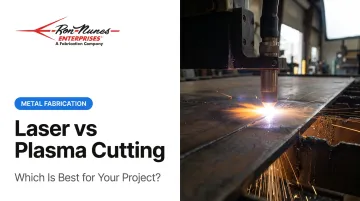
Both laser and plasma cutting are proven CNC-guided processes, but they operate on entirely different principles and suit different project profiles. This guide breaks down how each works, where each excels, and how to match the right process to your specific material, thickness, and tolerance requirements.
Key Takeaways
- Choose laser cutting for tight tolerances (~±0.1–0.2 mm) on thin-to-medium sheet metal
- Choose plasma cutting when thickness exceeds ~16 mm or capital cost is a constraint
- Treat the 12–16 mm range as a crossover zone, not a fixed cutoff—both methods compete here
- Confirm material conductivity first: plasma only works on electrically conductive metals
- Factor in finishing costs—laser-cut parts typically require less secondary processing, shifting the true cost comparison
Laser vs. Plasma Cutting: Quick Comparison
Use this table to match your project's material, thickness, and tolerance requirements to the right process at a glance.
| Factor | Laser Cutting | HD Plasma Cutting |
|---|---|---|
| Typical tolerance | ~±0.1–0.2 mm | ~±0.5 mm |
| Kerf width | ~0.2–0.4 mm | ~1.5–5 mm |
| Max thickness | Up to 40–60 mm (high-power fiber) | Up to 45 mm optimal; 80 mm severance |
| Material range | Metals, plastics, ceramics, composites | Electrically conductive metals only |
| Speed advantage | Thinner stock (<10 mm) | Thicker stock (12 mm+, varies by power) |
| Capital cost | Higher | 2–5x lower than laser |
| Post-processing | Minimal secondary finishing | May require deburring or edge cleanup |
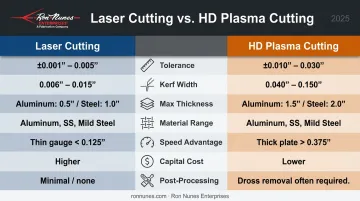
Note on tolerances: These figures are planning references, not guaranteed universal specifications. Include your required tolerance on the RFQ and confirm it with your fabricator for the specific alloy, thickness, and feature geometry.
What Is Laser Cutting?
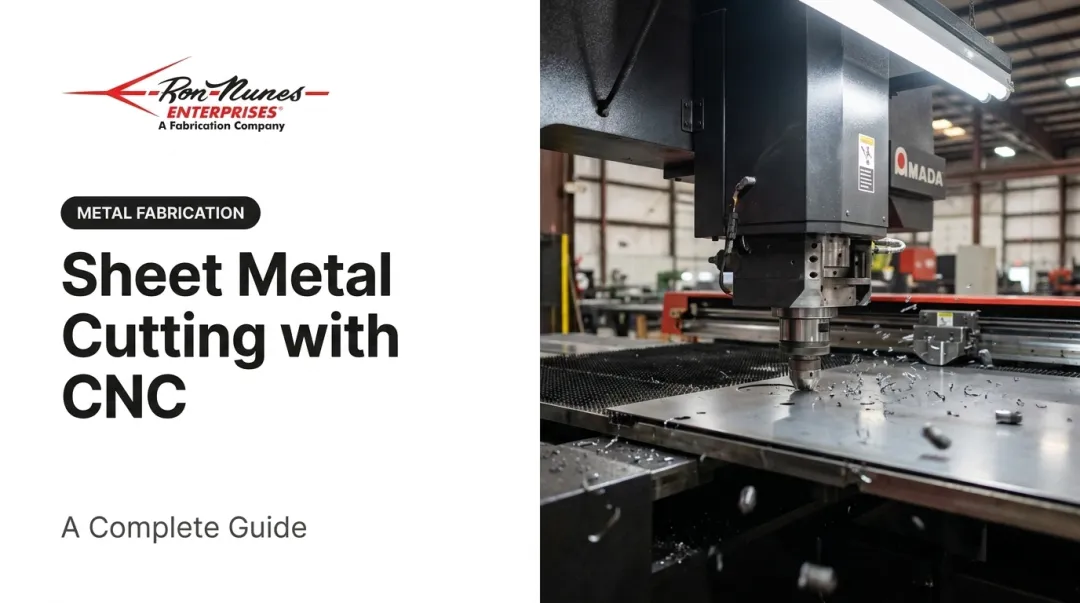
Laser cutting uses a CNC-guided focused light beam to melt, vaporize, or burn through material along a programmed path. Two architectures dominate metal fabrication:
- CO2 lasers operate at 10.6 µm wavelength, use a mirror-guided beam path, and suit non-metals and certain metals well—though they struggle with highly reflective alloys
- Fiber lasers operate at 1,007–1,070 nm, achieve over 40% wall-plug efficiency, and use a mirror-free monolithic fiber path that handles reflective metals (aluminum, copper, brass) more effectively with lower optical maintenance
Current high-power fiber systems—such as TRUMPF's 24 kW TruLaser platform—cut mild steel and aluminum at standard thicknesses up to 40 mm, with specialized configurations reaching 60 mm. The old ceiling of 19 mm is well behind what modern equipment delivers.
Why Manufacturers Choose Laser
- Narrow kerf (~0.2–0.4 mm) preserves more material and enables finer detail
- Minimal heat-affected zone (HAZ)—typically smaller than plasma, though exact figures depend on material and thickness
- No tool wear—no retooling between complex profiles
- Parts can go directly to assembly without secondary finishing, thanks to tight dimensional tolerances
Laser cutting does have constraints worth noting: it's less cost-effective on very thick metals at lower power levels, and CO2 systems still face absorption challenges on raw aluminum and copper without fiber architecture. Those trade-offs narrow the field of ideal applications considerably.
Where Laser Cutting Delivers the Highest Value
Laser cutting is the default choice for precision sheet metal components where dimensional accuracy is non-negotiable: electronics enclosures, rack mount chassis panels, medical device housings, defense system brackets, and semiconductor equipment frames.
Ron Nunes Enterprises has served these sectors for over 55 years from its Livermore, California facility. Laser cutting is a core in-house capability, applied to steel, stainless steel, and aluminum across defense, semiconductor, and medical programs that require consistent edge quality and part-to-part repeatability.
What Is Plasma Cutting?
Plasma cutting superheats a gas—typically nitrogen, oxygen, or compressed air—to a plasma state using an electrical arc. That superheated arc melts through electrically conductive metals. The process is fast, powerful, and well-suited to heavy plate work.
Gas selection affects both edge quality and metallurgy:
- Oxygen with air shield — best mild-steel quality and productivity
- Compressed air — versatile and lower-cost across mild steel, stainless, and aluminum
- Nitrogen — recommended for stainless and aluminum under 12 mm
- Argon-hydrogen with nitrogen shield — preferred for stainless and aluminum over 12 mm when surface finish matters
High-Definition Plasma Changes the Precision Conversation
Standard plasma has a reputation for rough edges and wide kerf. Modern HD and X-Definition systems narrow that gap considerably. According to Hypertherm, the XPR300 maintains ISO 9013 tolerance Classes 1–2 and its True Hole process produces bolt-ready mild-steel holes down to a 1:1 diameter-to-thickness ratio across 3–25 mm plate.
In one documented case, R.M.P. Products improved bolt-hole tolerance from 1–1.2 mm to 0.5 mm using an XPR300—at 3x the previous throughput.
Ron Nunes Enterprises runs a Komatsu Rasor Fine Plasma High Definition system, handling plate work in aluminum, stainless steel, and mild steel where HD-class tolerances are required.
Plasma's Real Limitations
- Wider kerf (~1.5–5 mm depending on amperage and thickness) means less material efficiency and coarser feature detail
- Cannot cut non-conductive materials—rules it out for any multi-material fabrication
- Edge bevel and HAZ are larger than laser, which can require additional finishing before surface coatings like MIL-C-5541E chromate conversion are applied
Where Plasma Makes Sense
Plasma cutting is the practical choice for structural steel fabrication, heavy equipment components, shipbuilding, and construction hardware. These are applications where material thickness exceeds the cost-effective range of laser cutting and tighter edge-finish tolerances aren't required.
Which Cutting Method Is Right for Your Project?
Four variables drive the decision for most fabrication projects:
- Material type: Plasma only works on conductive metals — non-metals require laser
- Material thickness: The crossover zone sits between 12–16 mm, per AWS industry analysis
- Tolerances and edge quality: Parts going directly to assembly typically need laser-quality edges
- Total cost of ownership: Factor in capital cost, operating cost, and post-processing finishing labor together
Thickness as a Practical Guide
- Under 10 mm: Laser cutting is typically faster, more precise, and more material-efficient
- 12–16 mm: Evaluate both processes; plasma's lower operating cost starts to become meaningful but depends on part density, assist gas pricing, and finishing requirements
- Above 16–25 mm: Plasma cutting generally offers better throughput and lower cost-per-cut on conductive metals
- Above 25 mm: High-power fiber lasers now reach this range, but plasma remains compelling for large-bed, high-volume structural work
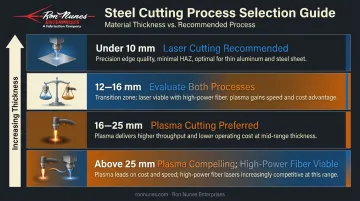
These thresholds are starting points for evaluation, not hard cutoffs. A 15 kW fiber laser can outrun 300 A plasma at certain thicknesses — power rating, assist gas selection, and quality targets all shift the equation.
Once you've mapped your thickness range, the following application criteria help finalize the choice.
Situational Recommendations
Choose laser cutting when:
- Parts require tolerances tighter than ±0.5 mm
- Complex geometries, small holes, or intricate cutouts are involved
- Material is thin-to-medium gauge going directly to assembly
- Multi-material work includes non-metals
- Post-processing costs need to be minimized
Choose plasma cutting when:
- Material is thick conductive metal (generally 12 mm+)
- Part geometry is straightforward
- Budget constraints favor lower capital and operating costs
- High throughput on structural components takes priority over edge finish
Real-World Applications: When the Choice Matters
Consider a defense contractor ordering custom chassis panels for a rack-mounted electronics system. The panels are 3 mm 6061-T6 aluminum with tight hole patterns for connector pass-throughs and hardware inserts. Tolerances need to hold across a production run of several hundred units.
Here, plasma cutting is a poor fit—kerf width alone would compromise hole accuracy, and any bevel or HAZ cleanup would add labor before MIL-C-5541E chromate conversion could be applied. Laser cutting delivers the part in production-ready condition with consistent edge quality across the full run.
Contrast that with a structural bracket for heavy industrial equipment: 20 mm mild steel, simple profile, no tight hole tolerances. Running that on a laser at low power is slow and expensive. Plasma cutting handles it faster at a fraction of the operating cost.
Two scenarios, two clear answers:
- Tight-tolerance aluminum panels (defense, medical, semiconductor): laser cutting for clean edges and production-ready parts
- Heavy mild steel structural work (industrial brackets, frames): HD plasma for speed and cost efficiency
- Precision-adjacent HD plasma work: hole tolerances down to 0.5 mm are achievable, as R.M.P. Products found after upgrading their system for nuclear and structural fabrication—with 3x throughput over their previous process
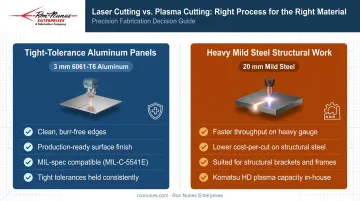
These scenarios reflect the same decisions Ron Nunes Enterprises works through with customers daily. With over 55 years applying both laser and HD plasma cutting across defense, semiconductor, medical, and telecom projects, the right answer usually comes down to material, thickness, tolerance, and volume. If you're unsure which process fits your specific project, contact the team at sales@ronnunes.com or call 1-877-800-7225 to discuss the details.
Conclusion
Neither process wins universally. Laser cutting earns its place when precision, tight tolerances, and minimal post-processing are the priority—especially in regulated sectors where part accuracy directly affects downstream reliability. Plasma cutting remains a cost-effective workhorse for thick conductive metals and structural applications where speed and budget matter more than edge finish.
Base your decision on the specifics of each job:
- Material type — laser suits non-conductive and thin sheet; plasma handles conductive metals across a wider thickness range
- Thickness range — plasma gains a clear speed advantage beyond ½ inch; laser dominates below that threshold
- Required tolerances — tight-tolerance or cosmetic parts favor laser; structural and load-bearing parts rarely need that precision
- Total production cost — factor in setup, consumables, post-processing, and scrap rate, not just machine time
Match the process to the part. The right choice is the one that meets your spec at the lowest total cost.
Frequently Asked Questions
Is laser cutting better than plasma cutting?
Neither is universally better. Laser excels for thin materials requiring high precision and clean edges; plasma is more effective and cost-efficient for thick conductive metals. The right choice depends on material type, thickness, and tolerance requirements.
How fast is plasma cutting compared to laser cutting?
Plasma is generally faster on thick metals above ~10 mm, though laser power matters: a 15 kW fiber laser can outpace 300 A plasma at some thicknesses. On thin sheet metal, laser cutting is typically faster and produces better edge quality.
What materials can laser cutting cut that plasma cannot?
Laser cutting works on non-conductive materials including plastics, wood, ceramics, and composites. Plasma cutting is restricted to electrically conductive metals like steel, aluminum, stainless steel, and copper.
Which cutting method is more cost-effective for thick metals?
Plasma cutting is generally more cost-effective above 12–16 mm due to lower capital cost, faster cut speeds on heavy stock, and lower cost-per-meter. The exact crossover depends on part complexity, finishing requirements, and annual volume.
What tolerances can laser cutting achieve vs. plasma cutting?
Laser cutting typically achieves tolerances around ±0.1–0.2 mm; plasma generally holds ±0.5 mm under comparable conditions, though HD systems can improve on this for specific geometries.
Can plasma cutting be used for precision defense or medical parts?
HD plasma systems now hold tighter tolerances than older equipment, but laser cutting remains the preferred method for defense, medical, and semiconductor applications where minimal HAZ and clean edges are required without secondary rework.