Yet for engineers, procurement teams, and fabricators, understanding how welding works and which process to specify matters enormously. Pick the wrong process for the material or application, and you get porosity, distortion, or joints that fail under load.
This guide covers what welding actually is, how the core processes work, the five basic joint types, and what safety requirements apply — giving you a working foundation for smarter fabrication decisions.
Key Takeaways
- Welding permanently joins materials — primarily metals — by applying heat, pressure, or both to fuse them together
- The four dominant industrial processes are MIG (GMAW), TIG (GTAW), Stick (SMAW), and Flux-Cored Arc Welding (FCAW)
- Weld joints fall into five configurations: butt, lap, T-joint, corner, and edge
- Process selection depends on material type, thickness, environment, production speed, and quality requirements
- Proper PPE — helmet, gloves, flame-resistant clothing, and ventilation — prevents burns, fume exposure, and arc eye
What is Welding? Definition and Key Terms
Welding is a fabrication process that permanently joins two or more materials — most commonly metals or thermoplastics — by applying heat, pressure, or both. The joint faces melt together, forming a weld pool that solidifies as it cools into a continuous bond.
That's the key distinction from brazing and soldering, which use a filler metal at lower temperatures without melting the base material. Per AWS standards, brazing uses a filler with a liquidus above 840°F (450°C), while soldering stays at or below that threshold. Welded joints are generally stronger because the base material itself becomes part of the bond.
Core Terminology
Key terms that come up across every welding process:
- Parent material — the base metal being joined
- Filler material / consumable — material added to build up the weld pool
- Weld pool — the molten area where fusion occurs
- Weldment — the finished welded assembly
- Homogeneous vs. heterogeneous welds — whether the filler metal is similar or dissimilar in composition to the parent material
Welders can also run some processes autogenously — without any added filler — when the joint fit-up is tight enough. TIG welding on thin, closely fitted sections and certain laser welding applications fall into this category.
A Brief Historical Note
Pressure welding dates to the Bronze Age; forge welding to the Iron Age. The modern arc welding era accelerated through both World Wars, driven by demand for rapid ship and equipment production. The American Welding Society formed in 1919, directly in response to demands for standardized welding practices after World War I.
How Does Welding Work?
Two primary mechanisms underlie virtually every welding process.
Fusion welding applies enough heat to melt the base materials at the joint. The molten weld pool cools and solidifies into a bond that, when done correctly, can match or exceed the original material's strength. MIG, TIG, Stick, FCAW, laser, and electron beam welding all operate on this principle.
Solid-state welding bonds materials below their melting point using pressure, friction, diffusion, or a combination — no bulk melting required. Friction stir welding is one of the most widely used examples.
Why Shielding Matters
Molten metal is chemically reactive. Oxygen and nitrogen absorbed from the atmosphere cause oxidation and porosity, weakening the finished weld. Every serious welding process addresses this with one of two shielding strategies:
- Shielding gas (argon-based or mixed gases) delivered from a cylinder — used in MIG and TIG welding
- Flux coatings or flux cores that burn during welding, releasing shielding gas and forming a protective slag layer — used in Stick (SMAW) and FCAW
Electron beam welding bypasses atmospheric shielding altogether by performing the weld inside a vacuum to eliminate atmospheric contamination.
The Role of Filler Metal
Where shielding protects the weld from the outside, filler metal builds it from within — adding volume to the pool and contributing directly to joint strength. Conventional GMAW, SMAW, and FCAW all rely on a consumable electrode that feeds into the pool. TIG welding uses a separate filler rod — or no filler at all on autogenous applications. Welders select filler composition to match or complement the parent material, so the finished joint meets the mechanical properties the application demands.
The 4 Most Common Welding Processes
Dozens of welding processes exist, but four arc welding methods dominate industrial and commercial fabrication. Process selection comes down to material type, thickness, required quality, production speed, and working environment.
Gas Metal Arc Welding (GMAW / MIG Welding)
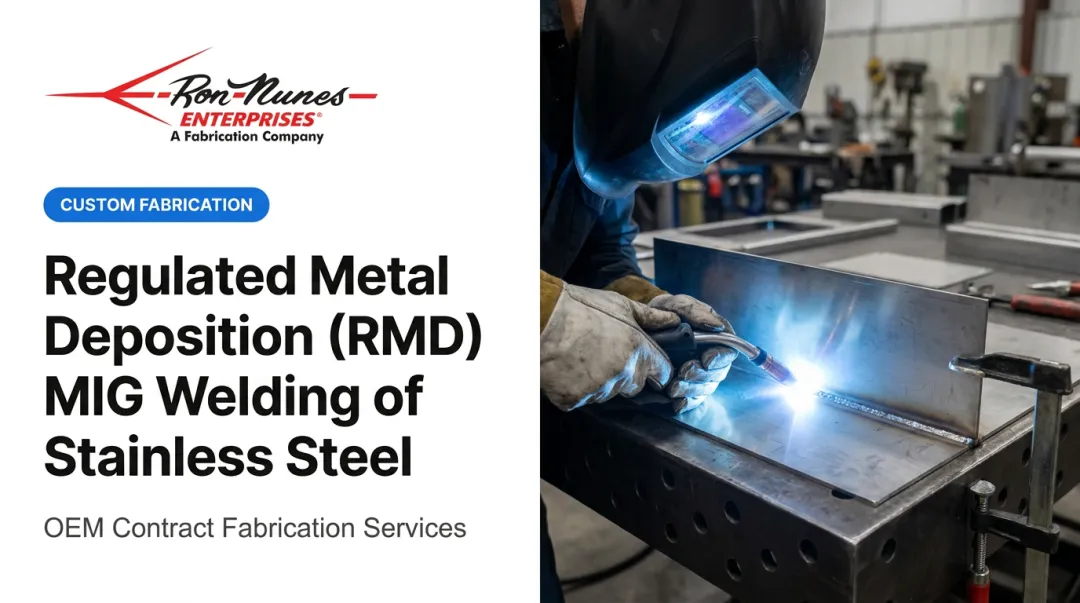
MIG welding feeds a continuous consumable wire electrode through a welding gun while an external shielding gas — typically argon-based — protects the weld pool. It's semi-automatic or fully automated, making it suited for high-volume, fast-cycle fabrication.
Key advantages:
- High travel and deposition speeds
- No slag to remove (unlike Stick)
- Easily automated for consistent production
- Suitable for mild steel, stainless steel, and aluminum
MIG's behavior changes significantly depending on the transfer mode in use:
| Transfer Mode | Characteristics | Best For |
|---|---|---|
| Short-circuit | Low heat, higher spatter risk | Thin material, all positions |
| Globular | Unstable arc, highest spatter | Mainly flat/horizontal; rarely preferred |
| Spray | Fine droplets, low spatter, high heat | Flat/horizontal, thicker sections |
| Pulsed-spray | Controlled droplets, lower average heat | All-position, wider thickness range |
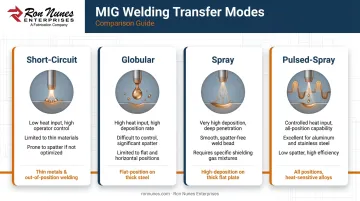
Specifying "MIG" without stating the transfer mode leaves critical variables undefined: each mode produces different heat input, spatter levels, and positional capability.
Gas Tungsten Arc Welding (GTAW / TIG Welding)
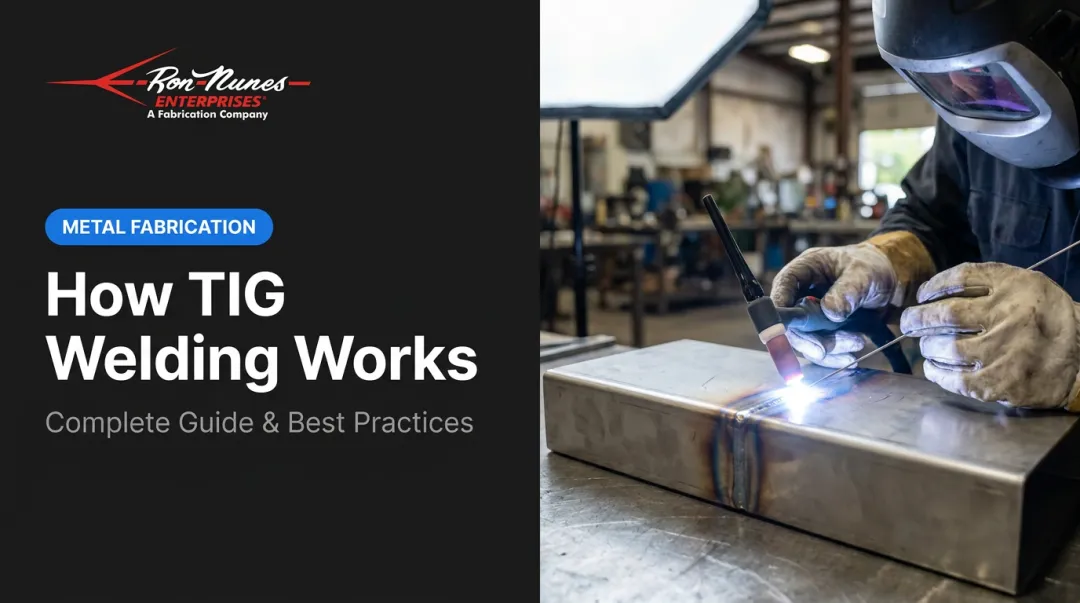
TIG welding uses a non-consumable tungsten electrode, a separate filler rod (or no filler), and an inert shielding gas environment. The arc produces no spatter, and the welder controls heat input precisely — making TIG the preferred process for applications where weld quality, appearance, and integrity cannot be compromised.
TIG is the default choice for:
- Thin-wall sections and precision components
- Stainless steel and aluminum where clean welds matter
- Aerospace components, medical device fabrication, and precision enclosures
- Sanitary and pharmaceutical piping
The tradeoff is speed and skill. TIG is significantly slower than MIG and demands a highly trained operator. That labor cost is justified in applications like medical device housings or aerospace assemblies, where a single cosmetic or structural defect can mean rejection or rework.
Shielded Metal Arc Welding (SMAW / Stick Welding)
Stick welding uses a consumable flux-coated electrode. The arc forms between the rod and the base metal; the flux coating burns off, creating shielding gas and a slag layer that protects the cooling weld.
Why it remains relevant:
- Low equipment cost and simple setup
- Highly portable — no gas cylinder required
- Wind-tolerant, making it practical for outdoor and field work
- Effective on dirty or rusty base metal
Common applications include structural steel, heavy industrial fabrication, pipeline welding, and field repair work. The main limitations are the need to stop and replace electrodes and the slag removal required after each pass.
Flux-Cored Arc Welding (FCAW)
FCAW uses a tubular wire electrode filled with flux powder rather than a solid wire. It combines MIG's continuous-wire productivity with Stick's flux-based shielding, and comes in two variants:
- Gas-shielded FCAW — uses both flux core and external gas; suited for indoor precision work
- Self-shielded FCAW — relies solely on the flux core; tolerates windy outdoor conditions where external gas shielding would be disrupted
FCAW delivers high deposition rates and deep penetration into thick sections, making it a go-to process for heavy construction, shipbuilding, and large structural fabrication.
Specialized Welding Processes and Industry Applications
Beyond the four core arc processes, several specialized methods handle applications where standard welding falls short.
| Process | Mechanism | Key Applications |
|---|---|---|
| Laser Beam Welding (LBW) | Concentrated light melts a narrow joint with minimal heat input | Automotive gears, tailored blanks, precision assemblies |
| Electron Beam Welding (EBW) | High-energy electrons melt metal in vacuum; deep, narrow welds | Aerospace titanium structures, defense components, nuclear hardware |
| Plasma Arc Welding (PAW) | Constricted tungsten arc produces high-energy plasma jet | Precision thin-section work, microelectronics |
| Resistance Spot/Seam Welding | Resistance heating plus electrode force; spot or continuous nuggets | Automotive body assembly, sheet metal fabrication |
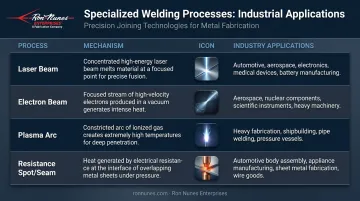
Grand View Research reported the US welding products market at $2.39 billion in 2025, reflecting the scale of welding's role across American manufacturing. Each of these specialized processes found its home in a specific industry — here's where they appear in production today.
Where These Processes Show Up
- Aerospace — EBW and laser welding for titanium and aluminum structures; NASA documented production EBW of Ti-6Al-4V aircraft structures as far back as 1972, and the technology remains central to aerospace and defense fabrication today
- Automotive — Resistance spot welding for body-in-white assembly; laser welding for tailored blanks and transmission components
- Defense and nuclear — EBW for thick-section critical components; precision TIG for structural weldments requiring certified quality
- Shipbuilding — FCAW for high-deposition structural joining
For manufacturers in defense, semiconductor, transportation, and medical — where precision, material integrity, and compliance all carry weight — welding must work within a controlled fabrication system, not as a standalone operation.
Ron Nunes Enterprises has operated TIG, MIG, spot, and stud welding in-house since its founding in 1969 — more than 55 years of continuous production. Welding functions as the fourth step in a sequential workflow: after shearing, N/C punching, and press brake forming, and before finishing and mechanical assembly.
That integration matters. Chassis and enclosure components arrive at the welding station already dimensionally correct, and the completed weldment goes directly to finishing as a unified structure. The company serves semiconductor, defense, medical, and transportation customers with this full-sequence capability, handling both prototype runs and production volumes with Class A/XX certified welders.
Types of Weld Joints Explained
Joint geometry determines how loads transfer through a welded connection, and it's selected based on the materials, the forces the joint must carry, and the welding process being used.
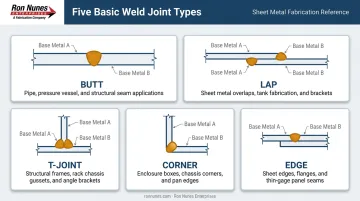
The Five Basic Joint Types
- Butt joint — Two pieces joined edge-to-edge in the same plane; common for plate and pipe work, with groove variations (V-groove, U-groove, double-V) used for thicker sections requiring full penetration
- Lap joint — Overlapping pieces welded along the overlap zone; widely used in sheet metal and structural applications
- T-joint — One member meets another at approximately 90 degrees within its span; typical in structural frames and brackets
- Corner joint — Two pieces meeting at their edges to form an L-shape; used in boxes, enclosures, and frames
- Edge joint — Parallel members with adjacent edges joined; less common, typically for thin sheet or flange connections
Understanding the Weld Zones
A completed weld has three distinct regions that affect how it performs:
- Fusion zone — where filler metal was deposited and full fusion occurred
- Heat-affected zone (HAZ) — surrounding material whose microstructure was altered by heat without melting; grain growth, phase changes, or residual stress can develop here
- Base material — unaffected parent metal beyond the HAZ
The HAZ warrants close attention in high-stress or high-temperature applications. Its behavior depends on the alloy, heat input, weld strength mismatch, and service conditions — so it remains a key factor in design regardless of application.
Weld Quality Assurance
Weld integrity is verified through two categories of testing:
- Destructive testing — bend tests, tensile tests, cross-section macro examinations
- Non-destructive testing (NDT) — radiographic (X-ray) inspection, ultrasonic testing, visual inspection
AWS D1.1/D1.1M:2020 governs welding procedures, inspection requirements, and radiographic and ultrasonic testing for structural steel weldments. Inspector qualifications are governed separately under AWS QC1.
Welding Safety Basics
Welding produces multiple simultaneous hazards. Each requires a specific control measure — general awareness isn't enough.
Primary Hazards
- UV and infrared radiation — causes arc eye (photokeratitis) and skin burns from even brief unprotected exposure
- Toxic fumes — metal oxides, carbon monoxide, and when welding stainless steel, hexavalent chromium (Cr(VI)); OSHA's Cr(VI) PEL is 5 micrograms/m³ as an 8-hour TWA
- Electric shock — particularly relevant in wet or confined environments
- Fire and explosion — from open arcs near combustibles or compressed gas cylinders
- Noise — MIG welding can reach 95–102 dBA; OSHA's hearing conservation action level is 85 dBA over 8 hours, with a PEL of 90 dBA
Essential PPE and Controls
- Welding helmet with a UV-rated auto-darkening lens at the correct filter shade for the process and amperage — OSHA shade tables run from 7 to 11 for common arc processes
- Heavy leather gloves and flame-resistant clothing — avoid synthetic fabrics that melt on contact
- Ventilation — OSHA 29 CFR 1910.252 requires mechanical ventilation at a minimum of 2,000 cfm per welder when workspace conditions fall below specified thresholds
- Respiratory protection — if engineering controls don't adequately reduce fume levels, OSHA 1910.134 requires a written program, medical evaluation, fit testing, and NIOSH-certified respirators
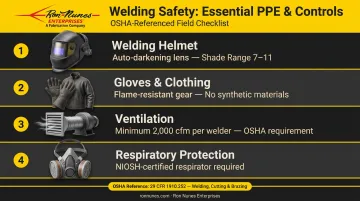
The specific hazard profile changes by process — Stick and FCAW generate more fume and slag, while MIG at spray transfer produces higher noise and UV output. PPE selection should reflect the actual process being run.
Frequently Asked Questions
What is welding?
Welding is a fabrication process that permanently joins materials (typically metals or thermoplastics) by applying heat, pressure, or both. Unlike bolting or adhesive bonding, a weld becomes part of the base material itself.
What is the difference between MIG and TIG welding?
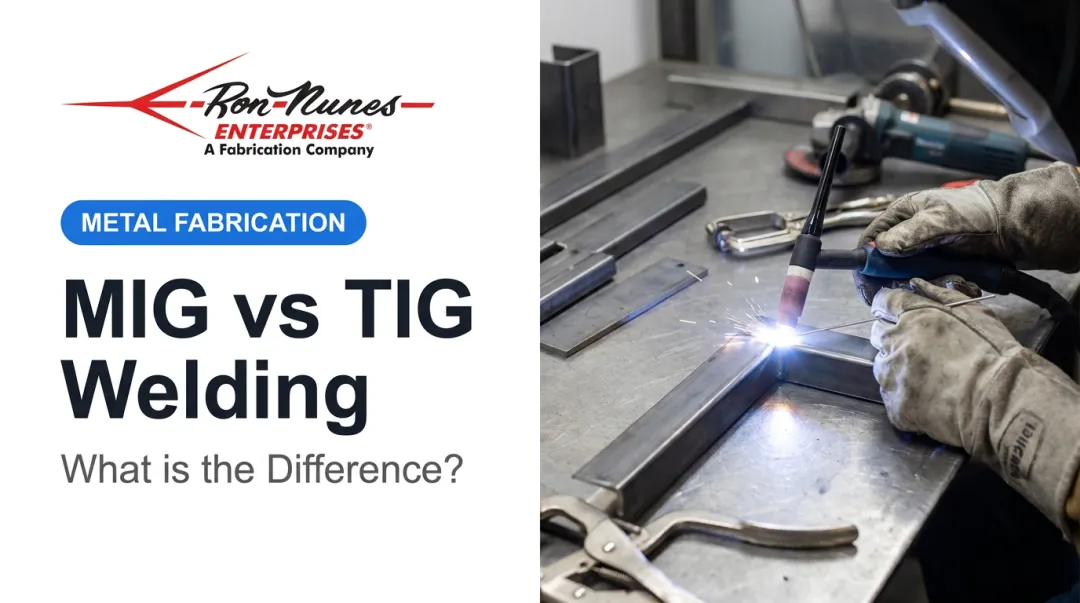
MIG uses a continuously fed consumable wire electrode for faster, higher-volume welding of thicker materials and is easily automated. TIG uses a non-consumable tungsten electrode for slower, more precise welds on thin sections or high-specification applications requiring tight tolerances and clean aesthetics.
What are the main types of weld joints?
The five basic types are butt, lap, T-joint, corner, and edge joints. Joint selection depends on the material geometry, the loads the connection must carry, and the welding process being used.
What materials can be welded?
Welding is most commonly applied to metals — carbon steel, stainless steel, aluminum, titanium, and others — and thermoplastics. Thermoset plastics cannot be welded because they don't re-melt once cured.
How is welding different from soldering and brazing?
Welding melts the base metal itself to create the joint. Soldering and brazing use a filler metal at lower temperatures without melting the parent material, making welded joints generally stronger than soldered or brazed connections.
What safety equipment is required for welding?
At minimum, welders need:
- A welding helmet with the correct UV-rated filter shade
- Flame-resistant gloves and clothing
- Adequate ventilation or local exhaust fume extraction
- Respiratory protection where ventilation alone can't control fume exposure