Introduction
Engineers and procurement teams face a persistent tension when specifying sheet metal parts: how do you get consistent geometry at volume without paying laser-cutting prices for every hole in a mounting rail?
CNC turret punching addresses that problem directly. For parts with dense, repeatable features — hole arrays, mounting slots, knockout patterns — it delivers speed and per-part economics that other processes rarely match at scale.
This guide walks through what a CNC turret punch is, how it works step by step, its key advantages, how it compares to laser cutting, which industries depend on it, and what to look for when choosing a fabrication partner.
Key Takeaways
- CNC turret punches use rotating, interchangeable tool sets to produce holes, slots, and formed features with high repeatability
- Published machine speeds reach 900–1,600 strokes per minute, though actual part output depends on nest complexity and tool changes
- Turret punching is the stronger choice for medium-to-high volume, feature-dense parts; laser cutting is better suited for complex contours and one-off prototypes
- Inline forming (louvers, embosses, countersinks) is a distinct advantage: laser cutting alone cannot produce these features
- Typical positional accuracy runs ±0.1 mm, though actual tolerances depend on tooling condition, material, and feature placement
What Is a CNC Turret Punch?
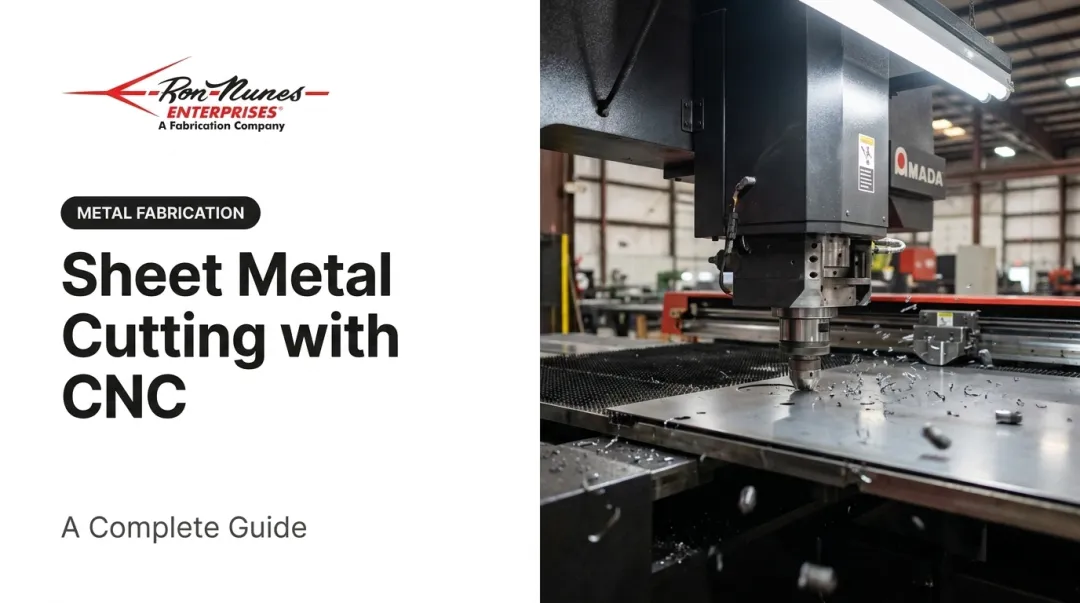
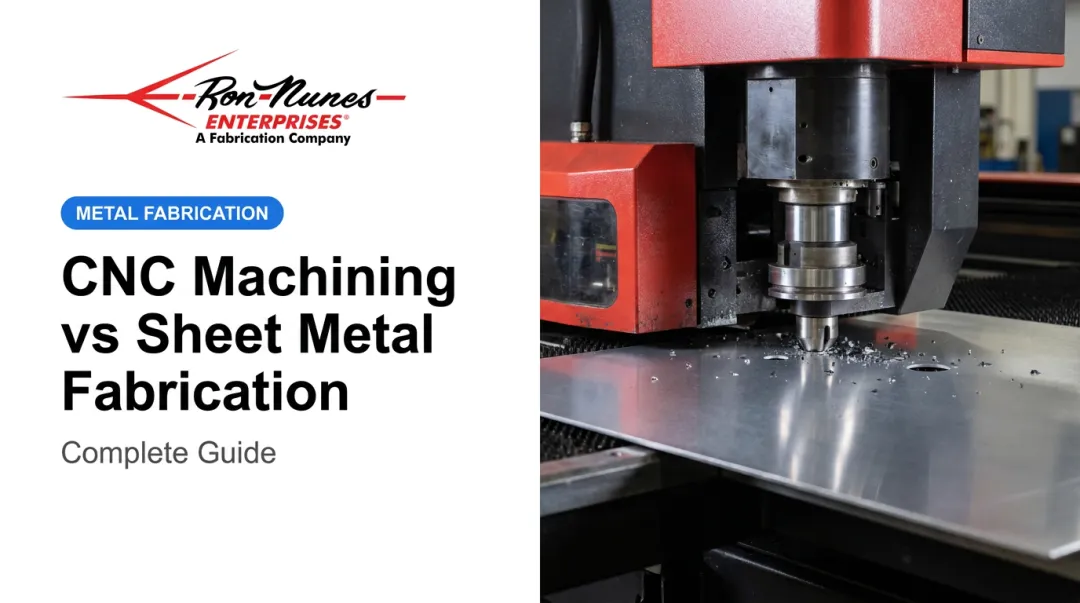
A CNC turret punch press is a computer-controlled sheet metal fabrication machine. Its rotating turret holds multiple interchangeable punch-and-die sets; the CNC control positions the sheet precisely and commands the ram to strike, shearing out the desired shape. CNC (Computer Numerical Control) means the machine follows a pre-programmed instruction sequence rather than manual operator input.
Key Structural Components
| Component | Role |
|---|---|
| Rotating turret | Holds 44–58 punch-and-die sets (varies by model); indexes to align the correct tool |
| CNC control system | Reads the NC program; coordinates all axis movements and tool selection |
| Servo-driven X/Y worktable | Positions the sheet beneath the tooling to the programmed coordinate |
| Hydraulic or electric servo drive | Generates the ram's striking force |
| Clamps and hold-downs | Secure the sheet against movement during punching to maintain dimensional accuracy |
Consistent fixturing is foundational to repeatability. Any sheet movement between hits translates directly into hole position error across a production run.
CNC vs. Manual Turret Punches
Manual turret presses require the operator to select tools and reposition the sheet by hand — slow, inconsistent, and impractical for volume work. CNC versions run automated programs that repeat the same sequence identically, producing consistent results across every part in a run.
Compatible Materials
CNC turret punching works best with ductile sheet metals:
- Mild steel — the most common; punches cleanly across a wide gauge range
- Stainless steel — thinner gauges preferred; harder alloys increase tool wear
- Aluminum — highly suitable; alloys like 6061-T6 and 5052-H32 are standard
- Galvanized steel — coated sheets are processable, with tooling selection adjusted accordingly
Material hardness and thickness directly affect tool life, achievable tolerances, and edge quality. The right thickness limit depends on the specific alloy, temper, coating, and feature geometry rather than a single universal number.
How CNC Turret Punching Works: Step by Step
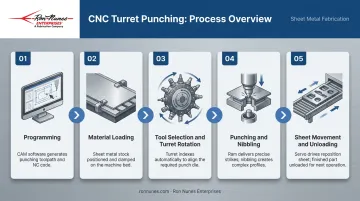
Step 1 — Programming
Before any metal loads onto the table, a CAM (Computer-Aided Manufacturing) program converts the CAD design into an NC program. This program defines which tool to use, in what sequence, at which X/Y coordinates, and how many hits are needed. Quality programming directly determines part accuracy and production efficiency: a poorly sequenced program wastes hits and increases cycle time.
Step 2 — Material Loading
A flat sheet is loaded onto the worktable and secured by clamps. The table is referenced to a calibrated datum so the machine knows exactly where the sheet begins. Every subsequent punch position is calculated from that reference point.
Step 3 — Tool Selection and Turret Rotation
The CNC system reads the program and rotates the turret to align the correct punch-and-die set with the ram. Modern machines use bi-directional indexing to reach the next tool via the shortest rotational path, cutting down idle time between features.
Step 4 — Punching and Nibbling
The ram drives the punch through the sheet into the matching die, shearing out the shape. For features larger than the available punch tool, nibbling traces the contour through a series of small, overlapping hits.
Nibbling is useful for occasional non-standard cutouts, but it comes with trade-offs:
- Edges can be rough or scalloped compared to a single dedicated punch
- According to MetalForming Magazine, a nibbling tool may last only around 5,000 hits versus roughly 50,000 for a well-selected dedicated punch
- Hit count increases, which extends cycle time
For any recurring finish-critical feature, a dedicated punch tool is nearly always the better choice.
Step 5 — Sheet Movement and Unloading
After each hit or sequence, the servo axes reposition the sheet to the next coordinate. Once all features are complete, the finished sheet moves to secondary operations — forming, deburring, hardware insertion, welding, or finishing — depending on what the part requires.
Key Benefits of CNC Turret Punching
Speed and Production Efficiency
Published machine ratings give a sense of raw capability:
- TRUMPF TruPunch 5000: up to 1,600 strokes/min
- Prima Power SG Dynamic: up to 1,000 hits/min
- Muratec M2048TS: up to 900 hits/min
These are machine specifications under defined conditions — not guaranteed parts-per-hour figures. Actual output depends on nest complexity, number of tool changes, and loading/unloading time. The meaningful comparison is a timed production run on a representative nest, not a raw stroke rating. That efficiency also has a direct impact on per-part cost.
Cost-Effectiveness at Volume
Standardized, modular tooling means no expensive job-specific dies. Once a program and tool setup are confirmed, costs behave predictably as volume scales:
- No custom die costs per job — standard tool stations handle most geometries
- Per-part cost drops steadily as run length increases
- Consistent geometry batch to batch keeps setup time minimal
Integrated Forming Capabilities
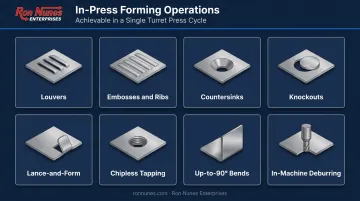
Turret punching goes well beyond hole-making. Mate Precision Technologies documents a broad range of in-press forming operations:
- Louvers and ventilation forms
- Embosses and ribs (which can stiffen lighter-gauge sheet)
- Countersinks
- Knockouts
- Lance-and-form features
TRUMPF adds chipless tapping, bends up to 90 degrees, roller-formed contours, and in-machine deburring to the list.
Combining these operations in a single press cycle removes handling steps and keeps parts flatter. For total routed cost, that consolidation often matters more than raw cutting speed when comparing processes.
CNC Turret Punch vs. Laser Cutting: Which Is Right for Your Project?
Neither process wins universally. The right choice depends on part geometry, production volume, edge requirements, and whether the design needs inline forming. For engineers and buyers specifying sheet metal work, knowing where each process excels prevents costly process mismatches.
When Turret Punching Wins
- Parts with standard, repeatable features: uniform hole grids, mounting slot arrays, standardized cutouts
- Medium-to-high volume production runs where per-part cost matters
- Any part requiring inline forms (louvers, embosses, knockouts) — laser cutting cannot produce these in the cutting step and requires a secondary operation
When Laser Cutting Is the Better Choice
- Complex organic contours or tight internal radii that don't match available punch tools
- Cosmetically critical edges where a burr-free finish is non-negotiable
- Low-volume or prototype work, where laser cutting's lack of hard tooling makes it more economical to set up
Side-by-Side Comparison
| Factor | CNC Turret Punch | Laser Cutting |
|---|---|---|
| Setup | Punch, die, and clearance selection required; turret must be loaded | Programmable beam path; no feature-specific hard tooling |
| Per-part cost at volume | Decreases significantly with repeat geometry | No tooling amortization, but cutting time per part is consistent |
| Edge quality | Single-hit features: clean. Nibbled contours: may scallop or burr | Clean outer and inner contours; kerf typically below 0.5 mm on modern fiber laser systems |
| Design flexibility | Best when geometry matches loaded tools | Very high contour flexibility |
| Inline forming | Yes — louvers, embosses, countersinks, ribs, threads | No — requires secondary operation or a punch-laser combination machine |
| Best-fit use case | Hole-dense, repeatable geometry at volume | Changing or intricate flat profiles; prototype and low-volume runs |
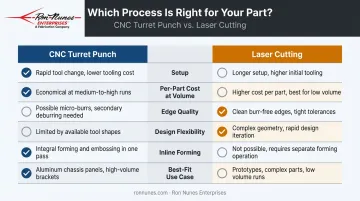
The most reliable way to choose is to quote both processes against the same CAD, material, tolerance, annual quantity, and downstream requirements — the numbers will point to the right answer.
Industries and Applications That Rely on CNC Turret Punching
Where Turret Punching Is Most at Home
Turret punching is well-suited to any industry that needs repeatable geometry across consistent production volumes. The clearest fit is electrical enclosures and electronics manufacturing — hole-intensive panels, knockout arrays, and ventilation forms are a natural fit for the process.
Other industries where the process is widely used:
- Rack-mount enclosures and chassis for telecommunications and data center equipment, built to standardized 19-inch hole patterns
- Precision sheet metal enclosures and support structures for semiconductor equipment
- Precision brackets and structural components for medical equipment, where tight tolerances and traceability are required
- Structural panels, MIL-spec chassis, and mounting hardware for defense and government programs requiring batch-to-batch repeatability
- Structural brackets, frames, and mounting plates for transportation applications
Common Part Types
- Electrical enclosures and control panels with cable gland knockouts, ventilation louvers, and mounting arrays
- Rack-mount chassis with dense, EIA-310d-compliant hole patterns
- Perforated grille panels for airflow management
- Structural brackets and chassis rails with repeatable slot-and-hole geometry
- High-volume subcomponents where consistent geometry drives cost efficiency
Ron Nunes Enterprises: Full-Cycle Fabrication Since 1969
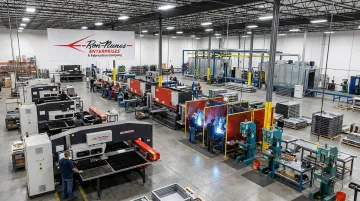
These part types represent the core of what Ron Nunes Enterprises has been producing from its Livermore, California facility for over 55 years. Their CNC punching equipment includes the Amada Pega-357 CNC Turret Punch Press (58 stations, 2 auto-index stations) and the Amada Octo-334 CNC Punch Press with Fanuc 6M Control, both capable of holes, cutouts, louvers, and formed features.
Downstream capability is where the operation distinguishes itself. Punched blanks move directly into press brake forming, TIG/MIG/spot welding, hardware insertion via an Auto-Sert AS 7.5 press, deburring, and finishing — including MIL-C-5541E chromate conversion and anodizing.
Parts go from flat blank to finished assembly without leaving the building, which cuts handling steps, compresses lead times, and centralizes quality control.
What to Look for in a CNC Turret Punch Service Provider
Capability Indicators to Evaluate
- Confirm the station map and forming tools are loaded for your specific features — "58 stations" doesn't mean the tool you need is installed
- Get written confirmation for your exact alloy, temper, coating, and thickness — not just a general material category
- Ask for a timed nest covering load, punch, form, unload, and sort — not just a strokes-per-minute figure
- Review first-article reports, gauge methods, inspection frequency, and tool-maintenance records
- Check whether deburring, forming, hardware insertion, and finishing happen under one roof — it reduces handling and lead time
- Understand capacity loading and backup equipment plans before committing to a schedule
The Value of DFM Support
A knowledgeable service provider catches problems before they reach the machine. Common issues worth flagging early include:
- Features placed too close to sheet edges (Mate recommends at least 2× material thickness from a hole to the edge)
- Forms placed too close together (at least 3× thickness from a form to the sheet edge)
- Geometry that would require heavy nibbling when a dedicated tool could do the job cleaner and faster
- Tolerances that are tighter than the process can reliably hold without engineering justification
That early review catches the issues that quietly inflate cost and stretch lead time — before a single punch hits metal. Ron Nunes Enterprises provides formal DFM consultation as part of its engineering support, working with customers before production begins to identify design adjustments that reduce rework and keep complex punching, forming, and finishing projects on schedule.
Frequently Asked Questions
What is a CNC turret punch?
A CNC turret punch is a computer-controlled sheet metal fabrication machine that uses a rotating turret of interchangeable punch-and-die sets to produce holes, slots, and formed features in flat sheet metal. It follows a pre-programmed NC sequence to position the sheet and strike with high speed and repeatability.
What is the use of a CNC punching machine?
CNC punching machines are used to fabricate holes, notches, slots, cutouts, and inline-formed features in sheet metal parts. They're particularly valuable in electronics, defense, telecommunications, and transportation applications where medium-to-high volume and consistent geometry are required.
What is the difference between laser and turret punch?
Turret punching uses physical punch-and-die tool sets for fast, repeatable features and can produce inline forms in a single press cycle. Laser cutting uses a focused beam for greater geometric flexibility and cleaner edges on complex contours. Each process suits different part geometries and production volumes — and they're often used together on the same part.
What materials can be processed with CNC turret punching?
The most common materials are mild steel, stainless steel (thinner gauges), aluminum (including 6061-T6 and 5052-H32), and galvanized steel. Material hardness and thickness affect tooling selection, achievable tolerances, and process efficiency — confirm your specific alloy and gauge requirements with your fabricator before quoting.
What tolerances can CNC turret punching achieve?
Typical positional accuracy is ±0.1 mm based on published machine specifications (Muratec M2048TS). Tighter control is generally achievable on standard punched features than on nibbled contours. Production tolerances vary with tooling condition, material thickness, sheet flatness, and edge proximity.