Contract manufacturing offers an alternative: outsource part or all of your production to a specialized third-party, and redirect your internal resources toward design, sales, and growth.
This guide covers everything you need to make that decision confidently — what contract manufacturing and assembly actually mean, how the process works step by step, the real benefits, and how to evaluate a qualified partner.
Key Takeaways
- Contract manufacturing converts fixed production costs into variable, volume-driven spending
- Sub-assemblies are built and tested independently before final integration — improving quality and speed
- A full-service CM handles fabrication, welding, finishing, and assembly under one roof
- Choose a CM partner based on end-to-end capability, certifications, and scheduling integration
- Outsourcing is the right move when demand fluctuates or in-house equipment would sit idle between runs
What Is Contract Manufacturing and Assembly?
Contract manufacturing (CM) is the practice of outsourcing part or all of a product's production — across fabrication, assembly, and finishing — to a specialized third-party manufacturer. The client company retains ownership of the design and focuses on core functions like engineering, sales, and customer relationships while the CM runs the production floor.
This model is common across defense, telecom, semiconductor, and industrial markets, where precision requirements and capital equipment needs make full in-house production difficult to scale efficiently. Understanding how CM differs from related models — and how assembly fits within it — helps clarify which arrangement best fits a given program.
Contract Assembly vs. Sub-Assembly — What's the Difference?
Contract assembly is the outsourcing of the process of combining pre-made components into finished or semi-finished products. This covers everything from mechanical builds to system integration and applies whether the client supplies the parts or the CM sources them.
Sub-assembly is a subset of that process. It involves joining two or more components into a modular unit that will later become part of a larger product. A practical example: a welded chassis frame assembled, inspected, and tested before being integrated into a complete rack system. That frame is a sub-assembly.
Sub-assemblies are inspected or tested independently before advancing to the final build stage. Catching defects at this step prevents them from becoming expensive failures in a completed product, and building sub-assemblies in parallel compresses the overall production timeline.
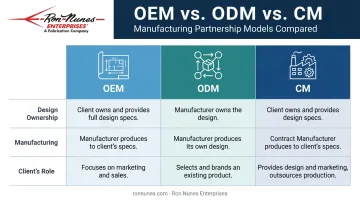
OEM, ODM, and CM — Understanding the Distinctions
These three terms get used interchangeably, but they describe meaningfully different relationships:
| Model | Design Ownership | Manufacturing | Client's Role |
|---|---|---|---|
| OEM | Client owns the design | May be in-house or outsourced | Owns the market-facing product |
| ODM | Supplier develops the base design | Supplier manufactures it | Client brands or customizes it |
| CM | Client supplies drawings/specs | CM manufactures to those specs | Client retains full design control |
For precision fabrication and custom industrial applications, the CM model is most relevant. The client provides engineering drawings; the contract manufacturer handles production. The client's IP stays with the client — the CM's role is execution, not ownership.
Key Benefits of Outsourcing to a Contract Manufacturer
Cost Structure, Not Just Cost Reduction
The economic case for contract manufacturing is structural, not a simple percentage savings. In-house fabrication requires committed spending on machinery, maintenance, operators, floor space, utilities, tooling, and quality staff — regardless of whether demand is high or low.
NIST's 2024 manufacturing report documents $149.2 billion in US manufacturing machinery and equipment capital expenditures and $58.6 billion in maintenance and repair spending — figures that show how capital-intensive ownership can be.
Buying production from a CM converts much of that fixed commitment into variable, volume-driven cost. When demand drops, your spend drops with it.
Access to Equipment and Expertise You Don't Own
A full-service contract manufacturer brings production-ready technology that would require significant capital investment to replicate internally. Each of the following represents a substantial purchase before you account for tooling, installation, maintenance, and trained operators:
- CNC turret punch presses
- Laser cutting systems
- High-definition plasma cutters
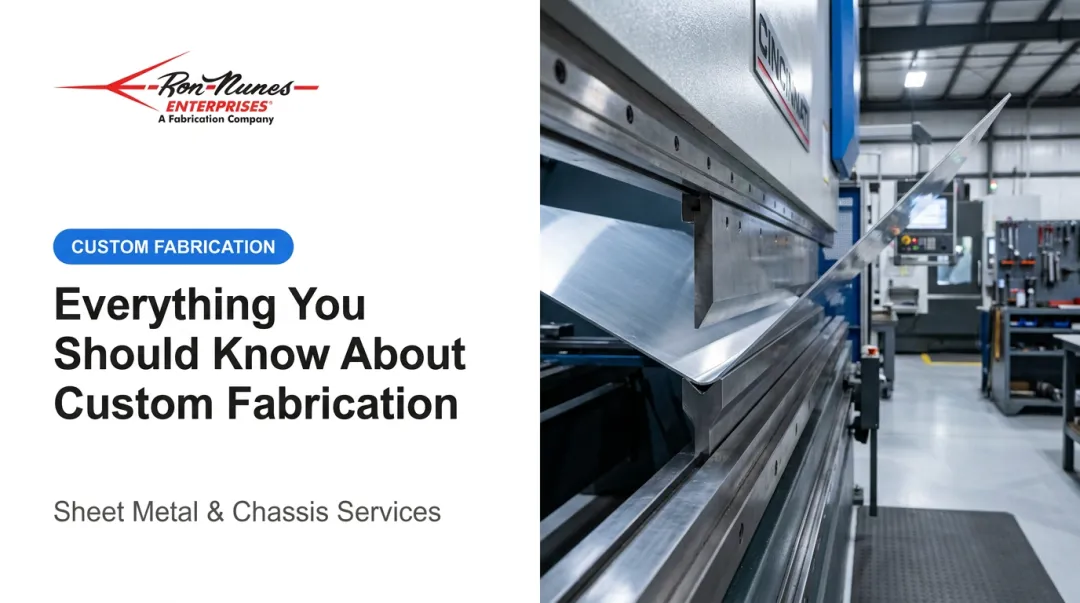
- Hydraulic press brakes
- Certified welding stations
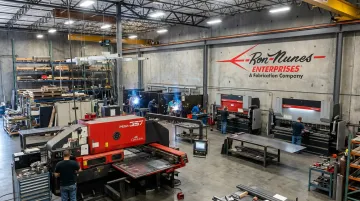
Ron Nunes Enterprises, operating from Livermore, California since 1969, runs exactly this kind of integrated shop — Amada CNC turret presses, a Komatsu HD plasma cutter, Cincinnati hydraulic press brakes, and a full welding department staffed by Class A/XX certified welders. Clients access that infrastructure without owning any of it.
Scalability Without Capital Commitment
Contract manufacturing lets you scale production volume up or down based on demand — without hiring, training, or leasing additional space. A product launch, a seasonal spike, or a new government contract can be handled through an established CM's existing capacity, eliminating forced headcount and equipment decisions.
Faster Time to Market
An existing production system with qualified processes, trained staff, and established supplier relationships compresses launch timelines compared to building in-house capability. The caveat: this holds when the CM already has open capacity and the right equipment. A full backlog or lengthy first-article approval process can offset the advantage.
Consistent Quality Through Repeatable Processes
FMA's benchmarking survey reported average scrap and rework at 1.4% of sales in 2023 — a useful industry baseline. Experienced contract manufacturers apply dimensional checks, incoming material inspections, and production controls that keep defect rates predictable across runs.
How the Contract Manufacturing and Assembly Process Works
Step 1 — Design Review and Specifications
The process begins when the client provides drawings, CAD files, part specifications, or product samples. A qualified CM reviews these for manufacturability — flagging potential production challenges before a single piece of material is cut. This Design for Manufacturability (DFM) review is where early cost savings are identified and downstream production problems are avoided.
Step 2 — Material Sourcing and Procurement
Once the scope is confirmed, the CM sources raw materials, fabricated components, and hardware based on the client's bill of materials. Managing supplier relationships and lead times is a core part of this stage. Deloitte reports average production-material lead times reached 79 days in April 2024, up from a 65-day pre-pandemic average. A CM with established supplier relationships navigates that environment more effectively than a first-time buyer.
Step 3 — Fabrication and Sub-Assembly
This is the core production stage. Sheet and plate stock is cut, formed, punched, welded, and finished into individual parts, which are then joined into sub-assemblies. Sub-assemblies are typically inspected at this stage before advancing — catching dimensional issues or weld defects while corrections are still low-cost.
Common processes at this stage:
- Laser cutting and N/C punching for holes, cutouts, and profiles
- Press brake forming for angles, channels, and enclosure shapes
- TIG/MIG welding for structural and cosmetic joints
- Hardware installation via hydraulic press
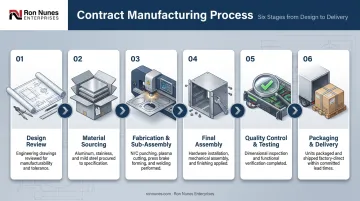
Step 4 — Final Assembly and Integration
All sub-assemblies and components come together into the finished product. This stage requires trained technicians working from assembly instructions and using fixtures, torque tools, and alignment systems to meet exact client specifications. The quality of this step depends heavily on how well the sub-assembly stage controlled dimensional accuracy.
Step 5 — Quality Control, Testing, and Inspection
Before anything ships, a reliable CM runs a structured inspection process. Traceability matters throughout — parts should carry identification markings tied to specific drawings and revision levels for the full production run.
Standard QC activities include:
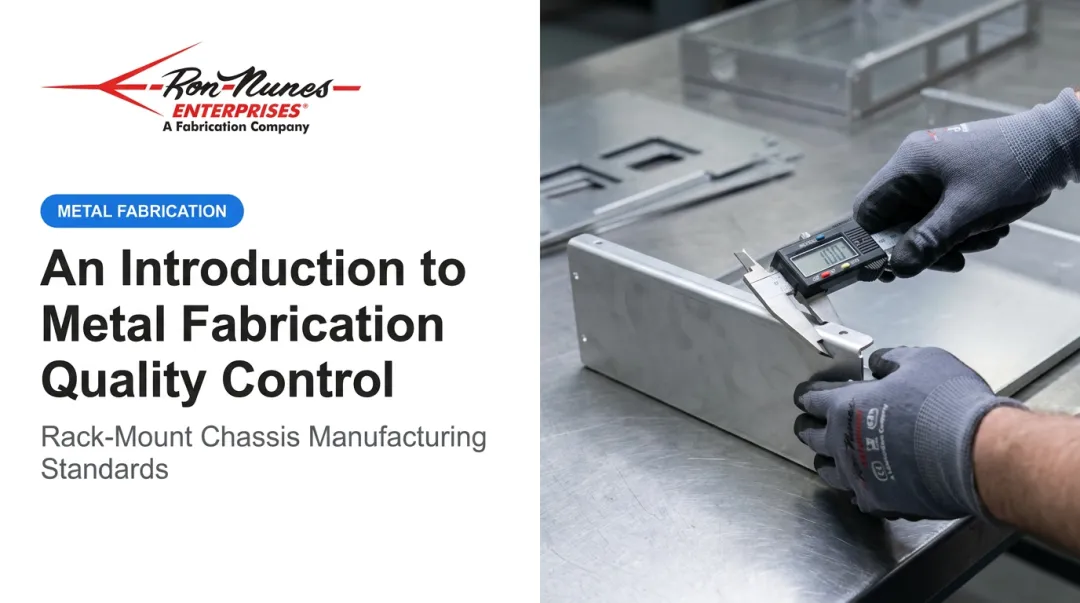
- Dimensional checks against client drawings and tolerances
- Functional tests where applicable to end-use requirements
- Visual inspections for surface finish and cosmetic defects
- Documentation of results for client records and compliance
Step 6 — Packaging, Scheduling, and Delivery
Finished products are packaged for safe transport, labeled per client requirements, and shipped against an agreed schedule.
Scheduling integration — aligning delivery timing with the client's broader production calendar — is where a CM earns its place as a supply chain partner rather than a one-off vendor. A CM that plans production runs around your inventory needs reduces downtime and keeps your assembly line predictable.
Types of Contract Manufacturing and Assembly Services
Different production requirements call for different CM capabilities. Here's how the common service types break down:
Mechanical and structural assembly — building welded frames, enclosures, and structural systems for industrial, transportation, and defense applications, typically involving multiple fabrication processes in a single production run.
**Precision metal fabrication and custom assembly** — laser cutting, shearing, N/C punching, forming, welding, finishing, and final assembly handled under one roof. Ron Nunes Enterprises has operated this model since 1969, fabricating precision metal parts, rack mount chassis systems, and mechanical assemblies for defense, telecom, semiconductor, and nuclear research clients from a single Livermore, California facility.
Electromechanical and component assembly — integrating wiring, sensors, controls, or electronic modules into mechanical systems. Common in semiconductor equipment, communications hardware, and medical devices.
Kitting, sub-assembly, and finishing services — grouping pre-selected components into ready-to-assemble kits and building modular sub-assemblies for later integration. Surface finishing — anodizing, powder coating, chemical film conversion — is typically included as part of the same workflow.
How to Choose the Right Contract Manufacturing and Assembly Partner
Evaluate End-to-End Capabilities
The fewer handoffs in a production run, the better. A CM that handles fabrication, forming, welding, finishing, and assembly in-house eliminates the coordination risk, lead time variability, and quality gaps that come with routing work through multiple vendors. Confirm specifically which processes are performed on-site versus outsourced before committing.
Assess Industry Experience, Certifications, and Track Record
Look for demonstrated experience in your specific sector — defense, telecom, medical, semiconductor — not just general metal fabrication. Relevant credentials to evaluate:
- Quality management certifications (ISO 9001, AS9100D for aerospace/defense applications)
- Government accreditations — such as DBE certification for public sector contracting work
- Sector-specific compliance for defense, medical, or telecommunications requirements
- Verifiable delivery history against client specifications
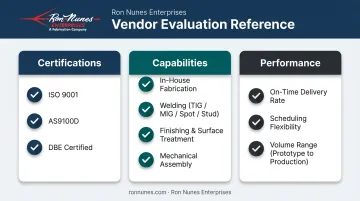
Ron Nunes Enterprises, for example, holds Caltrans Certified DBE status as a minority-owned business — a direct qualification for public sector and defense prime contractors with mandated supplier diversity requirements. The company has served precision, commercial, and industrial markets since 1969.
Review Capacity, Turnaround, and Scheduling Flexibility
Evaluate prospective partners on:
- Volume range — can they handle prototypes and full production runs?
- Turnaround commitments — what's their actual on-time delivery rate, not just a quoted estimate?
- Scheduling integration — can they align their production runs with your supply chain cadence?
For reference, FMA's industry benchmarking puts average on-time delivery at 84% across fabricators — a useful baseline when evaluating a specific partner's performance claims.
Prioritize Communication and Long-Term Partnership Fit
The best contract manufacturing relationships depend on clear communication, real-time production visibility, and a partner who treats your schedule with the same urgency as their own. That's hard to evaluate from a quote alone. When vetting candidates, ask for:
- References from clients with similar production volumes and complexity
- Examples of how they handled a missed deadline or quality issue
- Their process for keeping customers updated during production
Frequently Asked Questions
What is a contract assembly?
Contract assembly is the outsourcing of combining pre-made components into finished or semi-finished products. A specialized third-party manufacturer handles the build using the client's specifications and drawings, covering everything from mechanical builds to system integration.
What is OEM vs ODM vs CM?
An OEM owns the product design and may outsource manufacturing. An ODM both designs and manufactures the product for a client who then brands it. A CM focuses purely on manufacturing to the client's existing design and specifications; no design ownership transfers to the manufacturer.
What is an example of contract manufacturing?
A defense contractor outsourcing the fabrication and assembly of precision rack mount chassis to a specialized manufacturer illustrates this well. The CM handles all cutting, forming, welding, and finishing to exact MIL-spec requirements, then ships ready-to-install units.
What is the difference between sub-assembly and final assembly?
Sub-assembly joins two or more components into a modular unit that will later become part of a larger product. Final assembly is where all sub-assemblies and components are combined into the complete, finished product. Sub-assemblies are typically inspected independently before advancing to the final stage.
How do I know if my business is ready to outsource to a contract manufacturer?
You're typically ready when you have a defined product with clear specifications, a delivery timeline, and internal gaps — insufficient labor, space, or equipment — that a CM can fill. Having a budget range in mind will also speed up the quoting process.
What certifications should I look for in a contract manufacturing partner?
It depends on your industry. Key credentials to evaluate include:
- Quality management certifications (ISO 9001 or AS9100D for defense/aerospace)
- Government accreditations such as DBE certification for public sector work
- Sector-specific compliance for defense, medical, or telecommunications applications