Getting this wrong isn't just a technical slip. Order plate when you needed sheet, and you've overpaid for weight and strength nobody asked for. Order sheet when you needed plate, and you've built something that might fail under load. This guide breaks down where the line sits, what each material does best, and how to pick the right one for your next project.
Key Takeaways
- Sheet metal: under 6mm (0.25") thick, measured in gauge, best for lightweight, precision-formed parts.
- Plate: 6mm (0.25") and thicker, measured in inches, wins when strength matters over weight.
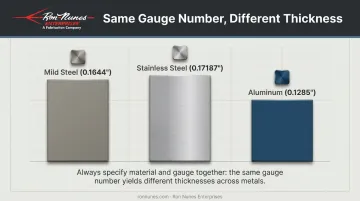
- Gauge thickness varies by material, so always specify decimal thickness alongside gauge number.
- Sheet metal fits enclosures, chassis, and panels; plate fits bridges, pressure vessels, and heavy machinery.
- The right choice balances load, weight limits, budget, and available fabrication equipment.
Sheet Metal vs Plate: Quick Comparison
The 6mm / 0.25" line is a widely used industry convention, though standards bodies define it with some nuance.
The American Iron and Steel Institute classifies plate as steel more than 8 inches wide starting at 1/4 inch thick, while ASTM A6 sets a separate structural-plate category at 0.230 inches. For everyday purchasing purposes, treat 6mm/0.25" as the practical dividing line.
Here's how the two stack up across the factors that actually drive purchasing decisions:
| Factor | Sheet Metal | Plate |
|---|---|---|
| Thickness | 0.5mm to under 6mm, measured in gauge | 6mm and above, measured in inches |
| Cost | Lower material and processing cost per unit | Higher material cost, heavier equipment needed |
| Weight & Handling | Lightweight; standard tools handle it fine | Heavy; often needs cranes or hoists |
| Strength | Good tensile strength for its weight | Superior load-bearing and impact resistance |
| Common Processes | Laser cutting, punching, bending, stamping | Plasma/flame cutting, heavy welding, quench & temper |
One catch worth flagging: gauge numbers don't mean the same thing across metals. At 8 gauge, mild steel measures 0.1644 inches, stainless steel measures 0.17187 inches, and aluminum measures just 0.1285 inches. Order by gauge alone without naming the material, and you might get a part that's 25% thinner or thicker than you expected.
On cost, there's no universal "plate costs X% more per pound" rule. What actually drives the price gap in the table above is everything around the material itself:
- Heavier handling equipment required for thicker sections
- Multi-pass welds instead of single-pass welding
- Preheat requirements before welding thick sections
- Inspection and testing that thicker sections often demand
What Is Sheet Metal?
Sheet metal is thin, flat stock generally running from about 0.5mm up to just under 6mm, produced through hot or cold rolling. Its defining trait is malleability. You can bend it, punch it, and form it into complex shapes without the tooling wear or forming force that heavier stock demands.
That malleability translates directly into shop-floor advantages:
- Less material waste from tight-tolerance cutting
- Faster turnaround because parts are easier to handle and move through machines
- Lower tooling wear compared to processing thicker cross-sections
Hot-Rolled vs. Cold-Rolled Sheet
Sheet metal splits into two production types, and the difference matters for anyone specifying material:
- Hot-rolled sheet: Rolled above the recrystallization temperature, this cost-effective option has a rougher, scaled surface and looser tolerances, best for non-critical tolerance work.
- Cold-rolled sheet: Adds cold reduction and annealing to hot-rolled sheet for a smoother finish, tighter tolerances, and higher yield strength, at a modest cost premium.
Use Cases of Sheet Metal
Sheet metal is the backbone of precision manufacturing wherever weight and formability matter more than raw strength. Think enclosures, chassis, and mechanical assemblies that need to be light enough to install, ship, and service without a forklift.
Industries where sheet metal dominates:
- Electronics and communications enclosures: housings that need to be lightweight and easily ventilated
- Automotive body panels: formed for aerodynamics and weight savings
- Rack-mount equipment housings: especially for defense and telecommunications, where EIA-310d compliance and MIL-spec finishes are non-negotiable
This is where Ron Nunes Enterprises operates day to day. Since 1969, the Livermore, California-based fabricator has specialized in standardized 19" rack-mount chassis for semiconductor, defense, and telecommunications customers.
Its standard chassis uses:
- 0.125" 6061-T6 aluminum sheet for the chassis body
- 5052-H32 aluminum at the same thickness for chassis plates
- 0.063" aluminum for angle brackets
- MIL-C-5541E finish for corrosion resistance
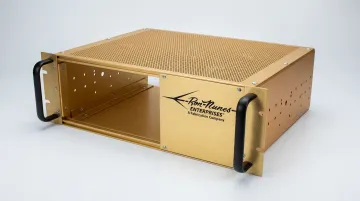
Stock configurations ship within 3 working days; custom chassis ship within 15.
What Is Plate?
Plate is flat metal stock 6mm or thicker, produced through hot rolling and, in demanding applications, further quenched and tempered for added hardness. Where sheet metal prioritizes formability, plate prioritizes structural integrity, and that shift shows up everywhere in how it's specified and used.
The operational payoff of choosing plate correctly:
- Reduced structural failure risk under sustained heavy loads
- Longer service life in high-stress environments
- Better resistance to impact and abrasive wear
Carbon Content and Mill Type Matter
Plate isn't one uniform product. Two classification systems shape how it performs:
- Carbon content: Low-carbon plate (0.05%-0.29%) balances weldability and formability, while medium- to high-carbon grades trade ductility for greater strength and hardness.
- Mill origin: Plate Mill Plate (PMP) is rolled from ingots one at a time, while Continuous Mill Plate (CMP) comes from continuously cast slab, affecting consistency and cost.
Use Cases of Plate
Plate is standard in any application where load-bearing capacity trumps weight concerns:
- Bridge and building construction: structural frames and girders
- Shipbuilding: hulls and structural bulkheads
- Heavy machinery: frames that absorb repeated impact
- Pressure vessels and military equipment: where wall thickness directly affects safety margins
The clearest evidence of how plate selection affects real structures comes from bridge engineering. AISC and the National Steel Bridge Alliance modeled High Performance Steel (HPS) bridge designs and found savings of up to 18% in cost and 28% in weight compared to traditional steel.
A Nebraska bridge over I-80 put this to the test in a real deployment. Its girders used HPS 100 plate in the webs and flanges, enabling two 139-foot spans while keeping each girder under a 30-ton crane limit. That's well beyond what a traditional 120-foot span design would allow.
This example doesn't guarantee identical results elsewhere, but it does show how plate grade and geometry, chosen together, can materially change what a structure can do.
Sheet Metal vs Plate: What Is Better?
Neither wins outright. The right answer depends on five factors you should weigh together, not separately:
- Required load capacity — Does the part carry structural weight, or just house components?
- Weight restrictions — Is the end product shipped, installed by hand, or mounted on something weight-sensitive?
- Budget — Can the project absorb plate's higher material and handling costs?
- Fabrication complexity — Does your shop have the press brake tonnage or crane capacity plate demands?
- Finishing needs — Does the application require tight tolerances and smooth surface finish, which favor cold-rolled sheet?
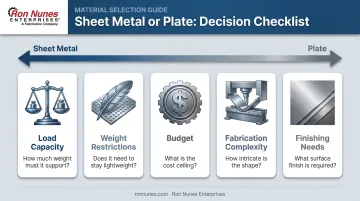
Choose sheet metal when cost-efficiency, light weight, and fast fabrication matter most. Enclosures, chassis, and equipment housings almost always fall here.
Choose plate when structural strength is non-negotiable. Load-bearing frames, pressure vessels, and heavy equipment components belong in this category.
Real-World Example: Choosing the Right Material
A documented redesign case study from The Fabricator illustrates the kind of savings possible when a part shifts toward formed sheet metal. A proximity-switch bracket originally made from two machined aluminum blocks, roughly 100mm x 40mm x 40mm, was redesigned as a single formed sheet metal part with two bends. The result: a 75% cost reduction on that component.
The triggering factor in cases like this is usually the same: engineering teams need parts that are lighter, faster to produce, and cheaper per unit. That need can't come at the cost of the fit and function a heavier or machined part would provide.
For rack-mounted electronics and enclosures specifically, that math almost always favors sheet metal. Precision-formed aluminum or stainless sheet delivers the strength these applications need at a fraction of plate's weight and cost.
The practical takeaway: if you're building rack chassis, enclosures, or equipment housings, sheet metal fabrication gets you there faster and cheaper. If you're building something that has to hold weight or absorb impact over years of service, plate is the only responsible choice.
If your project sits in that first category, Ron Nunes Enterprises offers full-service sheet metal fabrication, laser cutting, N/C punching, press brake forming, welding, and MIL-spec finishing, for both stock and custom rack chassis projects. Stock ships in 3 working days; custom builds in 15 working days.
Conclusion
Sheet metal and plate each serve a distinct role in fabrication, selected based on formability, weight, and load requirements. The 6mm (0.25") threshold marks a genuine shift in material behavior: below it, formability and weight savings drive the decision; above it, structural load capacity takes over.
For lighter, faster, cost-effective builds, such as rack chassis, enclosures, or equipment housings, sheet metal is the clear choice. For parts that must carry real structural or impact loads, plate earns its higher cost and heavier handling demands.
Our team at Ron Nunes Enterprises fabricates both sheet metal and plate assemblies daily, helping OEMs and system integrators specify the right gauge and grade for each application's load and budget requirements.
Frequently Asked Questions
At what point does sheet metal become a plate?
The industry-standard threshold is 6mm (0.25"). Metal thinner than that is sheet; metal at or above it is plate.
What are the two types of sheet metal?
Sheet metal comes in two types based on rolling process. Hot-rolled sheet is cost-effective for less precise applications, while cold-rolled sheet offers higher strength and a smoother finish for precision parts.
Is stainless steel sheet the same as stainless steel plate?
Both use the same base material. They differ only in thickness classification, with sheet under 6mm and plate at or above 6mm, which affects their respective uses.
Which is cheaper, sheet metal or plate metal?
Sheet metal is generally more cost-effective due to lower material volume and simpler processing. Plate costs more because of its thickness and the heavier handling equipment it requires.
Can sheet metal be welded like plate metal?
Both can be welded, but sheet metal typically needs lower heat input and techniques like TIG or spot welding to avoid warping. Heavier plate, by contrast, typically uses multi-pass welding techniques.
What gauge is considered heavy sheet metal?
Heavy-gauge sheet metal typically falls around 7-10 gauge for steel, roughly 3.4mm to 4.6mm. It offers more rigidity while still technically classifying as sheet.