This guide covers how stretch forming works mechanically, which alloys and temper states are viable, where the process is used, and the most consequential mistakes to avoid — including the finishing sequence error that voids nearly every coating warranty.
Key Takeaways
- Stretch forming combines tensile and bending force simultaneously, preventing the wrinkling that bending alone produces
- Alloy temper state is the single most critical variable — T5/T6 requires annealing; T1, T4, and T52 can be formed directly
- Cross-sectional integrity is preserved, keeping the process viable for structural aerospace, defense, and industrial applications
- Always finish aluminum after stretch forming: finishing beforehand risks coating damage and voids most applicator warranties
- Not every profile qualifies — complex cross-sections and tight radii need engineering review before tooling begins
What Is Stretch Forming Aluminum?
Stretch forming is a metal shaping process that grips an aluminum blank (extrusion or flat sheet) at both ends and applies continuous hydraulic tension. Under that tension, the blank wraps progressively around a precision-machined die to achieve a specific arc or compound curve.
The result is a dimensionally accurate, wrinkle-free curved part with no surface marring, ripple, or visible distortion, and with the original cross-sectional profile intact from end to end.
How It Differs from Stamping
Both processes shape metal, but the stress mechanics differ in ways that directly affect part quality:
| Stamping | Stretch Forming | |
|---|---|---|
| Stress State | Mixed tensile and compressive | Predominantly tensile throughout |
| Cross-Section Effect | Prone to distortion depending on operation | Geometry preserved end to end |
| Springback | Higher; varies by operation | Reduced due to concurrent tension |
| Wrinkling Risk | Present in bending and drawing ops | Eliminated by continuous tension |
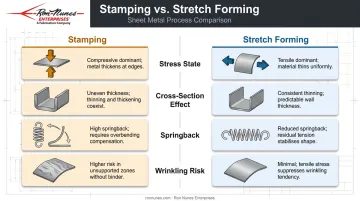
For long curved profiles such as curtain wall framing, aerospace structural members, and transportation components, the all-tensile approach consistently delivers better surface quality and tighter profile fidelity than conventional bending.
How Aluminum Stretch Forming Works: The Step-by-Step Process
The mechanical principle behind stretch forming is straightforward: aluminum, like all metals, has a yield point — the threshold beyond which it permanently deforms rather than springing back. Stretch forming deliberately keeps the material stretched past that yield point while wrapping it around the die, so it holds the die's shape permanently.
The core equipment is a stretch forming press with two arms or carriage beams, each holding gripper jaws connected to hydraulic tension cylinders. The arms rotate on large pin joints, letting the extrusion wrap around the die while tension holds throughout.
According to industry guidance on selecting stretch forming equipment, CNC motion control, constant strain management, and structural rigidity in the press frame are the primary drivers of dimensional repeatability across production runs.
Step 1: Material Preparation and Die Setup
The operator confirms the aluminum blank is at the correct temper state — this decision is made before any tooling is ordered. The die is then built to the specific radius required: a standard arc reused across projects, or a custom-machined form for complex or compound curves. Most jobs start from standard 24-foot extrusion lengths, which informs blank allowance calculations during die design.
Step 2: Tensioning, Wrapping, and Forming
Both ends of the blank are inserted into the gripper jaws. The hydraulic cylinders apply tension, stretching the extrusion beyond its yield point. The arms then swing to wrap the material around the die progressively — simultaneous stretching and bending is what prevents internal wrinkling. CNC controls on modern presses manage pre-stretch, forming force, and post-stretch sequencing for part-to-part consistency.
Step 3: Release, Springback Management, and Inspection
Once wrapping completes, the tension releases and the jaws open. Some springback is expected and is compensated for in the die geometry at the design stage. The finished part is then inspected for surface quality, arc accuracy, and profile integrity before any downstream operations.
Choosing the Right Aluminum: Alloys and Temper States
Alloy family, temper state, wall thickness, and cross-section complexity all determine whether a part can be formed, what radius is achievable, and whether pre-forming heat treatment is required. Getting these decisions right upfront avoids costly rework or annealing later in the process.
Alloy Families
The 6xxx series — particularly 6061 and 6063 — covers the majority of structural and architectural stretch forming applications. Both alloys combine reasonable formability with good corrosion resistance and are widely available as extrusions.
Hydro's alloy data rates the formability of these alloys by temper:
| Alloy | Temper | Yield Strength | Min. Elongation | Formability |
|---|---|---|---|---|
| 6061 | O | 16 ksi max | 16% min | Excellent |
| 6061 | T4/T4511 | 16 ksi min | 16% min | Good |
| 6061 | T6/T6511 | 35 ksi min | 8–10% min | Fair |
| 6063 | T1 | 9 ksi min | 12% min | Good |
| 6063 | T4 | 10 ksi min | 14% min | Good |
| 6063 | T52 | 16–25 ksi | 8% min | Fair |
| 6063 | T6 | 25 ksi min | 8–10% min | Poor |
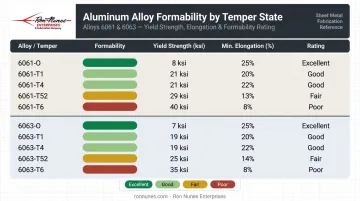
The 5xxx series (5052 in particular) suits non-structural applications where higher formability is prioritized over yield strength.
Temper States: What's Formable and What Isn't
Temper selection determines whether a part forms cleanly or cracks — and whether downstream heat treatment is needed:
- T1 and T4 — naturally aged with lower yield strength and higher elongation; stretch form directly, then oven-age post-forming to develop T6 properties
- T52 — stress-relieved by stretching after elevated-temperature forming; can be stretch formed without annealing and requires no downstream tempering to retain properties
- T5 and T6 — artificially aged to full hardness; too stiff for direct forming without cracking; must be annealed before forming
When T5 or T6 is your starting material, annealing is required before forming can proceed.
Annealing Pre-Hardened Material
T5 or T6 extrusions require full annealing before stretch forming. Per MIL-H-6088G (now superseded by SAE-AMS-H-6088), full annealing of 6061 and 6063 wrought products is performed at 760°F for approximately 2–3 hours, followed by controlled cooling at 50°F/hour down to 500°F. This produces an O-temper condition.
The critical limitation: once annealed, aluminum cannot be economically re-hardened to T5 or T6. For structural or load-bearing applications, this makes annealing generally unacceptable — which is why specifying the correct starting temper matters so much.
Thickness and Minimum Bend Radius
Thinner cross-sections accommodate tighter radii more readily. Heavier wall thicknesses require greater press tonnage and impose larger minimum bend radii. For sheet bending reference, FAA AC 43.13-1B provides alloy-specific minimum bend radius guidance by sheet thickness — though these values are for 90-degree sheet bending and don't translate directly to stretch-formed extrusions. For extrusion-specific radius limits, consult the die supplier or fabricator during tooling review.
Where Stretch Forming Aluminum Is Applied
Architectural and Construction
Curved curtain wall framing, skylights, storefronts, canopy structures, handrails, and façade cladding represent the most common applications. The PARQ Resort and Casino in Vancouver used stretch-formed aluminum framing across a 23,000-square-foot façade with curved corner details. Linetec's stretch-formed framing also appears in the Orlando International Airport South Intermodal Terminal's segmented barrel-vault skylight.

These applications share a common requirement: large-radius arcs that must meet tight dimensional specifications with no visible surface defects.
Aerospace, Defense, and Transportation
NASA's Space Launch System used stretch forming to produce aluminum-lithium 2195 alloy cryogenic tank gores at 0.525 and 0.75 inches thick — material thicknesses that underscore the process's capability for heavy structural work. Aircraft fuselage skin panels, frame components, and vehicle structural profiles rely on stretch forming because it preserves aluminum's strength-to-weight ratio while holding close tolerances.
Defense, transportation, and precision industrial sectors demand consistent, repeatable part quality across both prototype and production quantities.
Industrial and Precision Manufacturing
Equipment housings, enclosures, and structural profiles for telecommunications and electronics applications benefit from stretch forming when curved geometries must integrate cleanly with adjacent assemblies. Common use cases in precision manufacturing include:
- Curved enclosures for semiconductor and test equipment
- Structural frames for telecommunications infrastructure
- Housings requiring flush surface finish with no distortion at bend transitions
Alloys such as 6061-T6 and 5052-H32 — widely used in these sectors — are well-suited to stretch forming due to their ductility and post-process strength retention. Ron Nunes Enterprises fabricates with these same alloy families across defense, semiconductor, and telecommunications applications.
Key Factors, Common Misconceptions, and When to Use a Different Process
Variables That Determine Outcome
Material side:
- Alloy series and temper state (confirm before tooling begins)
- Wall thickness and cross-sectional complexity
- Whether annealing is required and acceptable for the end use
Process side:
- Die accuracy and surface condition
- Pre-stretch and post-stretch magnitude
- Forming speed (some alloys and surface conditions require slower cycles)
- Gripper jaw pressure consistency across the production run
Studies on rectangular aluminum extruded tubes confirm that increasing axial tension reduces springback but also raises the risk of cross-section distortion. Die geometry and process parameters must be calibrated together to manage this trade-off.
Misconception: Finishing Before Forming Saves Steps
Finishing before forming is the most costly sequencing error in stretch forming workflows. As Linetec documents, nearly all manufacturer and applicator warranties require that aluminum extrusions are finished after curving, not before.
The reasons are specific:
- Annealing at 760°F burns painted finishes and causes anodized coatings to thermally craze — Lorin reports anodize crazing above 320°F
- Even without annealing, die contact during forming mars pre-applied coatings through mechanical friction
- Warranties are structured around finishing the final formed geometry
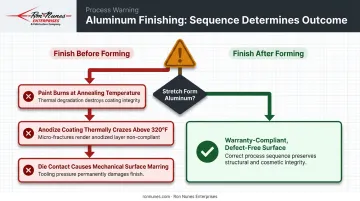
If a finishing vendor requires pre-formed parts, raise the warranty implications before committing to that sequence.
Misconception: Stretch Forming Works for Any Aluminum Profile
Not every profile is a viable candidate. The following situations require process engineering review before committing to tooling:
- Highly complex cross-sections with thin webs or asymmetric geometry
- Compound curves (multiple radii in a single extrusion)
- Very thick walls that exceed available press tonnage
- Tight radii that approach the material's minimum achievable limit
When to Use a Different Process
Some applications are better served by other forming methods. Stretch forming is not the right choice when:
- Cycle time is critical — per-cycle duration makes stretch forming impractical for high-volume progressive operations
- The part has sharp reentrant angles, which require matched-die stamping or press brake forming rather than gradual arc wrapping
- Tolerances demand closed-die repeatability that open stretch forming cannot reliably achieve
Frequently Asked Questions
What is the process of stretch forming?
Stretch forming keeps an aluminum blank under continuous hydraulic tension while wrapping it progressively around a precision die. The material is stretched past its yield point during forming, so it permanently takes the shape of the die without wrinkling or cross-section distortion.
What is the difference between stretch forming and stamping?
Stamping uses mixed tensile and compressive stress states depending on the operation. Stretch forming applies predominantly tensile force throughout the entire bending cycle, which preserves cross-sectional geometry and produces better surface quality on long curved profiles.
What thickness of aluminum is bendable?
Thinner aluminum accommodates tighter radii more easily, while heavier walls impose larger minimum bend radii and require greater press capacity. For sheet bending, FAA AC 43.13-1B provides alloy-specific radius guidance by thickness. For extruded profiles, minimum radius depends on alloy, temper, cross-section geometry, and press capacity — your fabricator will review these variables during the tooling stage.
What is the best aluminum for forming?
The 6xxx series (6061, 6063) covers most structural and architectural stretch forming applications. T52 temper is a reliable choice: it can be stretch formed without annealing and retains its mechanical properties without requiring post-forming heat treatment. T1 and T4 are also viable starting points when parts will be oven-aged to T6 properties after forming.
Does aluminum need to be annealed before stretch forming?
Fully hardened T5 and T6 temper aluminum requires annealing to O-temper before forming (760°F for 2–3 hours per MIL-H-6088G). T1, T4, and T52 tempers can be stretch formed directly — for structural applications, annealing is generally avoided since the material cannot be economically re-hardened afterward.
Should aluminum be finished before or after stretch forming?
Always finish after stretch forming. Finishing beforehand risks burning paint, thermally crazing anodized coatings, and causing mechanical surface damage from die contact — most applicator warranties also cover only parts finished after the final formed geometry is established.