The stakes are higher than they might seem. The global industrial enclosures market is valued at $8.4 billion in 2024 and is projected to hit $10.2 billion by 2030, growing at a 3.4% CAGR, according to a 2024 industrial enclosures market report. As demand grows, so does the pressure on manufacturers to get mounting decisions right the first time.
This guide breaks down what separates surface and flush mounted panels, where each one fits, and how to choose between them for your next build.
Key Takeaways
- Surface mounted panels install faster and cost less for budget-driven builds.
- Flush mounted panels sit level with the chassis for cleaner, more protected integration.
- Budget, environment, and space constraints, not brand preference, should guide your choice.
- Custom fabrication, like laser cutting and N/C punching, tailors either style to your rack specs.
Surface Mounted vs Flush Mounted Panels: Quick Comparison
Before covering definitions, here's how the two styles stack up across the factors that matter most to engineers and procurement teams.
| Factor | Surface Mounted | Flush Mounted |
|---|---|---|
| Cost | Lower: simpler fabrication and installation | Higher: precision cutting adds labor and material cost |
| Installation | Quick, bolt-on assembly with minimal prep | Requires precise cutouts, alignment, often professional fabrication |
| Aesthetics | Protrudes from the surface; visible edges | Seamless, integrated look; saves clearance space |
| Durability | More exposed to impact, dust, tampering | Better shielded from environmental exposure |
A manufacturer comparing touch-display mounting options found surface mounting faster and cheaper to install. Flush mounting demands a panel cutout, rear access, brackets or clamps, and precise alignment before it ever gets sealed, according to TouchWo's OEM mounting comparison.
This trade-off between speed, cost, integration, and protection shapes every decision ahead. Keep it in mind as you compare each style in detail below.
What Is a Surface Mounted Panel?
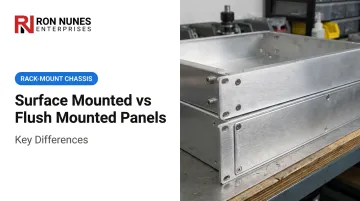
A surface mounted panel attaches directly onto the exterior of a rack, enclosure, or wall surface. Rather than recessing into the structure, it sits on top, fastened with screws, bolts, or brackets.
This method matters on the production floor because it cuts fabrication steps. Fewer cutouts and less precision alignment mean:
- Faster turnaround on the assembly line
- Reduced installation labor per unit
- Easier field replacement or upgrades without disassembling the chassis
Common Variations
Surface mounted configurations show up across rack systems in several forms:
- Bolt-on access panels for quick equipment servicing
- Blank panels used to fill unused rack space
- Surface-mounted connector plates for I/O and cabling access
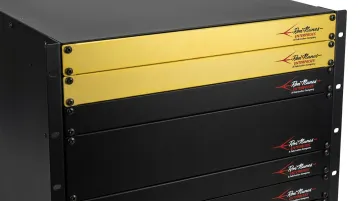
Ron Nunes Enterprises stocks Blank Front Panels in 1U through 12U heights (BFP1 through BFP12), machined from 0.125" aluminum 6061-T6. They're available with a standard chemical film finish per MIL-C-5541E Type I Class 3 or a black painted option, and most ship within 3 working days.
Use Cases
Surface mounting fits naturally into workflows where speed and accessibility matter more than a fully integrated finish:
- Quick-swap maintenance panels in field-service and portable equipment settings
- Basic industrial enclosures and lower-cost telecom cabinets
According to Rittal's industrial enclosure buying guide, its newer wall-mount enclosure generation cuts assembly time by 30% compared to the previous product line. That gap shows how much faster externally mounted designs move through production, and on a run of dozens or hundreds of units, savings like that add up fast.
What Is a Flush Mounted Panel?
A flush mounted panel sits level with the surrounding chassis or wall surface. Getting there requires precision-cut openings, tight tolerances, and often more fabrication steps than a surface-mount equivalent.
The payoff shows up in performance. Flush integration supports:
- Better EMI shielding through continuous, gasketed seams
- Improved airflow management via engineered vent placement
- Protection for internal components from external impact
METCASE notes that recessing a front panel within the bezel is specifically designed to shield displays and membrane keypads from accidental contact, a direct benefit of the flush approach.
Flush mounting also covers a range of panel types depending on the application:
- Recessed connector panels
- Flush-mounted control interfaces and HMI displays
- Custom cutout access doors
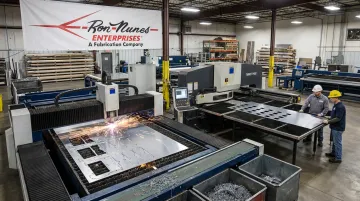
Ron Nunes Enterprises supports these configurations through full-service fabrication: laser cutting, N/C punching, press brake forming, and certified welding. That combination allows precision flush-panel geometry on standardized 17" chassis built for 19" racks, with custom orders delivered in 15 working days.
Use Cases of Flush Mounted Panels
Flush mounting earns its higher fabrication cost in environments where panel integrity isn't optional:
- Defense and aerospace systems requiring MIL-STD-461G electromagnetic interference control
- Semiconductor equipment where shielding protects sensitive process electronics
- Telecom infrastructure using EMC gaskets across front-panel seams to maintain signal integrity
A 19-inch Eurocard subrack design guide ties front-panel EMC gaskets directly to 5G communications, industrial automation, and military equipment. This confirms that seam continuity, not just aesthetics, drives the flush-mount decision in these sectors.
Surface Mounted vs Flush Mounted: Which Is Better?
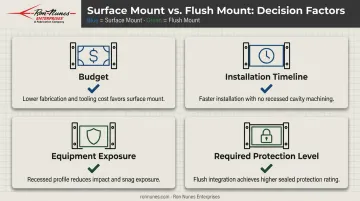
Neither style wins by default. The right call depends on four factors:
- Budget: Flush mounting costs more upfront due to precision cutting.
- Installation timeline: Surface mount installs faster with less prep.
- Equipment exposure: High-traffic or rugged environments favor flush protection.
- Required protection level: EMI-sensitive or safety-critical builds need flush integration.
A Practical Scenario
Picture a telecom equipment manufacturer running surface mounted access panels on a field cabinet line. Panels get bumped during transport, edges start showing dents, and warranty claims tick upward.
The fix doesn't require a redesign from scratch. Switching the exposed panels to flush mounted configurations lets them sit protected within the chassis frame instead.
The trigger is usually the same: repeated field damage or accessibility complaints that outweigh the installation savings surface mounting offered. Once the switch happens, damage claims drop and the chassis holds up better in transit and handling.
Making that pivot without stalling production depends on your fabricator's turnaround. Ron Nunes Enterprises ships stock items within 3 working days and custom rack chassis within 15 working days, so switching mounting strategies mid-production doesn't mean months of delay.
If you're unsure which mounting style fits your next build, Ron Nunes Enterprises offers custom panel fabrication engineered to your exact rack and enclosure specifications.
Conclusion
Surface mounted and flush mounted panels each solve different problems; no single style wins across every application. The right choice hinges on your operating environment, budget, and how much protection your equipment actually needs.
An experienced fabricator matters either way. Ron Nunes Enterprises has built both panel styles to precise specifications since 1969, ensuring your mounting decision strengthens equipment performance rather than compromising it.
Frequently Asked Questions
What is a surface mounted panel?
A surface mounted panel attaches directly to the exterior of a chassis, rack, or enclosure rather than recessing into a cutout. It's the standard approach for covers, brackets, and access panels in rack-mount chassis assemblies.
How long do surface mounted panels last in industrial use?
Surface mounted aluminum and steel panels can last decades when properly finished, since metal fabrication doesn't degrade like electronic components. Powder coat, chromate conversion, or plating finishes protect against corrosion in harsh industrial and defense environments.
What is the difference between surface mounted and flush mounted panels?
Surface mounted panels sit on top of the chassis or rack surface and remain visible from outside. Flush mounted panels integrate into the surface itself, requiring precision cutouts for a seamless appearance.
Which is more cost-effective, surface mount or flush mount panels?
Surface mount is generally more cost-effective due to simpler fabrication and faster installation. Flush mount carries a premium because of precision cutting and integration work.
Can flush mounted panels be retrofitted into existing racks or enclosures?
Retrofitting is possible but requires precise custom cutouts and alignment work. It's more practical to plan flush mounting during initial chassis design rather than after the fact.
Do surface mounted panels affect airflow or cooling in rack systems?
Surface mounted panels can sometimes obstruct airflow paths compared to flush designs with engineered vent placement. Ventilation layout should be considered during the panel selection process.