Fiber laser welding solves that problem by generating a focused, high-intensity beam inside a doped optical fiber, then directing it onto a joint to melt and fuse metal with minimal heat input. This article breaks down how the technology works, its real advantages, the machine types available, which materials it handles best, and where it's making the biggest impact across industry.
Key Takeaways
- Fiber lasers produce a tightly focused beam, fusing metal with far less heat than arc welding
- Cycle times run several times faster than TIG welding, with a smaller heat-affected zone
- Weldable thickness scales with laser power, from micron-thin foils to thick plates
- Machines range from handheld guns to fully robotic welding cells
- Automotive, aerospace, medical, semiconductor, and defense manufacturers are the primary adopters
How Fiber Laser Welding Works
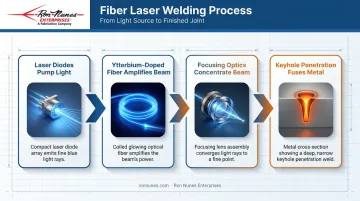
The process starts with laser diodes acting as a pump source, converting electricity into light. That light gets injected into an optical fiber core doped with rare-earth elements, most commonly ytterbium.
Inside the fiber, that pumped light gets amplified as it travels through the cavity. Fiber Bragg gratings act as wavelength-selective mirrors at each end, building a coherent beam typically in the 1030-1070 nm range.
Because the beam stays inside the fiber for delivery, there's less free-space optical hardware to align and maintain compared to older laser designs.
From there, lenses, beam expanders, or scanning heads focus that beam into a small, high-energy spot on the workpiece.
At sufficient power density, the beam vaporizes metal fast enough to create a narrow "keyhole" that penetrates deep into the joint. As the beam moves on, the melted metal cools and fuses, sometimes with depth-to-width ratios as steep as 10:1. How continuously that beam fires — versus pulsing on and off — shapes the weld's heat profile and depth.
Continuous-Wave vs. Pulsed Fiber Lasers
- Continuous-wave (CW) lasers deliver constant output, ideal for thick sections and high-speed deep-penetration welds
- Pulsed lasers fire discrete high-peak-power bursts, giving tighter control over heat input
- Pulsed systems suit thin foils, delicate assemblies, and hermetic seals where excess heat causes warping
Beam mode selection works alongside another key variable: how tightly the laser can focus its light.
Single-Mode vs. Multimode Fiber Lasers
Single-mode lasers use a smaller fiber core, producing beam spots as tight as 25-30 microns. That precision makes them the go-to choice for micro-welding tasks like battery tab joining or medical device assembly.
Multimode lasers use a larger core. They trade some precision for higher achievable power, which lets them process larger parts faster, but with less fine control than single-mode systems.
Key Advantages of Fiber Laser Welding
Speed is the most obvious win. IPG Photonics reported its LightWELD platform running up to 4 times faster than TIG welding on comparable joints. That figure comes from the manufacturer's own testing, but it lines up with what many shops report on the floor.
Beyond raw speed, fiber laser welding brings several other real advantages:
- Smaller heat-affected zone (HAZ) — the concentrated beam limits how far heat spreads, cutting warping and distortion on thin-walled or precision parts
- Material versatility — welds dissimilar metal combinations like aluminum-to-copper or aluminum-to-stainless without extensive rework
- Automation-friendly — controller-based operation integrates cleanly with robotic arms and cobots for repeatable, high-volume production
- Long service life — fiber sources require less maintenance than older CO2 laser systems, with fewer moving optical parts to align or replace
Efficiency numbers vary by system, but they're notable. IPG's YLS-6000-ECO datasheet lists greater than 50% wall-plug efficiency on a 6 kW continuous-wave unit. That's a meaningful improvement over legacy laser architectures, which historically converted far less input power into usable beam energy.
What Materials and Thicknesses Can Fiber Lasers Weld?
Fiber lasers handle a broad range of metals, which is part of why they've spread across so many industries.
Commonly welded metals include:
- Stainless steel
- Aluminum (3-series, 5-series, and 6-series alloys)
- Copper
- Titanium
- Nickel alloys
- Dissimilar combinations, such as copper busbars welded to nickel-plated steel
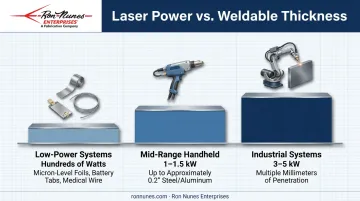
Thickness capability scales directly with laser power:
- Low-power systems (hundreds of watts) handle micron-level foils, the kind used in battery tab and medical wire welding
- Mid-range handheld systems (1-1.5 kW) typically weld steel and aluminum up to roughly 0.2 inches
- Industrial systems (3-5 kW) push into multiple millimeters of penetration, though exact depth depends on alloy, joint design, and travel speed
A few materials present real challenges:
- Copper reflects near-infrared laser light and conducts heat away fast, causing spatter and inconsistent penetration; adjustable ring mode beam shaping stabilizes the weld pool.
- Highly reflective or sintered metals often need process tuning, not blanket avoidance.
- Certain cold-worked steels and tungsten carbide require careful application development due to cracking and porosity risks, rather than being universally off-limits.
Types of Fiber Laser Welding Machines
Not every shop needs the same fiber laser setup. Machine type usually comes down to volume, precision requirements, and budget.
- Handheld welders work like a MIG or TIG gun with built-in presets, ideal for repairs, prototyping, and manual production with a short learning curve for arc-welders.
- Semi-automated workstations use motion tables and sometimes galvanometer scanners to handle small production batches with better repeatability than manual welding.
- Fully automated robotic and robot-assisted systems handle high-volume precision manufacturing, often running multi-axis motion with positioning accuracy measured in microns.
Regardless of configuration, every fiber laser welding machine shares four core components:
- Laser source
- Fiber optic delivery cable
- Focusing optics
- Cooling system
Weld quality and long-term reliability trace back to how well these elements are matched and maintained.
Fiber Laser Welding vs. Traditional Welding Methods
Fiber Laser vs. MIG/TIG
TIG welding demands a skilled operator and delivers excellent quality, but slowly. MIG tolerates joint gaps and misalignment better than laser welding, which rewards tight, repeatable fixturing.
The American Welding Society notes that industrial laser systems commonly weld up to about 0.5 inches (12 mm) in a single pass. Arc processes remain more practical for very thick sections or poor fit-up. Fiber laser wins on precision, speed, and heat-affected zone (HAZ) size, but the trade-off is a higher upfront equipment cost and stricter fixturing requirements.
Fixturing tolerance isn't the only factor separating these processes from arc welding. Resistance welding introduces a different set of trade-offs, starting with how the weld itself gets formed.
Fiber Laser vs. Resistance Welding
Resistance welding relies on physical electrode contact, which wears over time and can introduce quality drift. Fiber laser welding is non-contact, allowing scanner access from a single side and more programmable control over weld geometry, an advantage that's driven its adoption in battery and busbar assembly.
This contactless approach also lowers consumable costs, since there are no electrode tips to replace or dress.
When Traditional Methods Still Make Sense
Fiber laser isn't the right call for every shop floor. Traditional methods still hold an edge when:
- Tight capital budgets that can't absorb laser equipment costs
- Low-volume manual jobs where operator flexibility outweighs speed
- Applications where weld bead appearance matters more than precision
- Thick-section work beyond the roughly 0.5-inch single-pass range, where arc welding remains the more practical choice
Applications of Fiber Laser Welding Across Industries
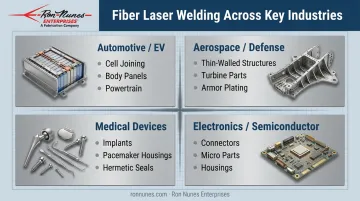
Applications span multiple industries, each with distinct requirements:
- Automotive and EV manufacturing relies on fiber laser welding for battery cell and module joining, body panel assembly, and powertrain components, where speed and dissimilar-metal capability both matter.
- Aerospace and national defense use it for thin-walled structures, turbine components, structural frames, and armor plating, where a smaller heat-affected zone protects material integrity.
- Medical device manufacturing depends on fiber laser welding for surgical instruments, implants, and pacemaker housings, where contamination-free, hermetic seals are non-negotiable.
- Electronics, semiconductor, and communications manufacturers weld connectors, circuit components, micro parts, and equipment housings that demand tight tolerances at small scale.
Ron Nunes Enterprises supports this same precision ecosystem, just from an adjacent angle. Based in Livermore, California, the company has run a full-service metal fabrication operation since 1969.
Its capabilities include laser cutting, press brake forming, TIG and MIG welding, mechanical assembly, and finishing (including MIL-C-5541E chromate conversion) for customers across semiconductor, defense, medical, and communications sectors.
Fiber laser welding itself isn't part of that in-house process mix. But the company's precision laser-cut and formed chassis, brackets, and enclosures are exactly what fiber-laser-welded components ultimately get mounted into.
Stock items ship within 3 working days, and custom rack chassis mounts are guaranteed within 15 working days, timelines that matter when a finished assembly is waiting on its housing.
Frequently Asked Questions
What materials and thicknesses can a fiber laser weld?
Fiber lasers commonly weld stainless steel, aluminum, copper, and titanium, along with select dissimilar-metal combinations. Thickness capability scales with laser power, from micron-level foils in micro-welding up to several millimeters in industrial 3-5 kW systems.
How does fiber laser welding differ from traditional welding methods like MIG or TIG?
Fiber laser welding offers higher precision, faster cycle times, and a smaller heat-affected zone than MIG or TIG. The trade-off is stricter fixturing requirements and a higher upfront equipment investment.
What are the main types of fiber laser welding machines?
The main types are handheld welders for manual and repair work, and semi-automated workstations for smaller batches. Fully automated robotic or robot-assisted systems handle high-volume precision manufacturing.
Is fiber laser welding safe for industrial environments?
Yes, when proper protocols are followed. Industrial systems are typically Class 4 lasers, requiring eye protection matched to wavelength, fume extraction, and beam containment per standards like ANSI Z136.1.
What industries benefit most from fiber laser welding?
Automotive, aerospace, medical device, electronics, semiconductor, and defense manufacturing all rely heavily on fiber laser welding for precision, speed, and consistency in production.
How much does a fiber laser welding system cost?
Costs vary widely by power and automation level. Entry-level handheld systems start in the tens of thousands of dollars, while fully automated robotic cells can run well into six figures, offset over time by lower maintenance and operating costs.