Introduction
CNC sheet metal cutting uses computer-controlled machines, such as laser, plasma, waterjet, and punching, to cut precise two-dimensional shapes and profiles from flat metal stock. It's a backbone process in modern fabrication, showing up everywhere from defense electronics to telecom equipment racks to medical device housings.
Here's the catch: "CNC cutting" sounds like one process, but it isn't. Results vary widely depending on which method you choose, the material and thickness involved, and how well the machine and program are dialed in.
This guide walks through the step-by-step process, how to pick the right cutting method, and what you need before starting. It also covers the parameters that actually drive results, common mistakes to avoid, and when alternatives make more sense.
Key Takeaways
- Laser, plasma, waterjet, and punching each match specific materials, thicknesses, and tolerances
- Method selection depends on thickness, precision needs, heat sensitivity, and production volume
- Parameter tuning and machine maintenance drive results more than a machine's rated capability
- Combining laser cutting, shearing, and N/C punching in one shop cuts cost and turnaround
How CNC Sheet Metal Cutting Works: Step-by-Step Process
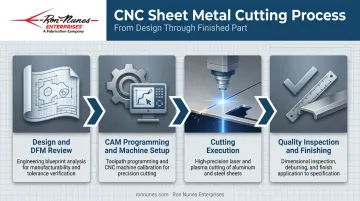
Step 1: Design and DFM Review
Every job starts with a CAD model of the part. Before that file goes anywhere near a machine, it needs a design-for-manufacturing (DFM) check.
This review flags issues like:
- Minimum hole diameters relative to material thickness
- Bend reliefs that avoid tearing during forming
- Tolerance callouts the chosen method can actually hold
Catching a geometry problem here, rather than mid-run, saves scrapped sheets and blown deadlines.
Step 2: CAM Programming and Machine Setup
Once the design clears review, CAM software converts the CAD file into a CNC toolpath. This step specifies the cutting method, feed rate, and kerf compensation.
Machine setup follows: securing the sheet on the bed, confirming tool or nozzle condition, and calibrating the laser head or plasma torch before the program runs.
At Ron Nunes Enterprises, this stage happens on equipment like Amada CNC turret punch presses and a Komatsu HD plasma cutter, each set up and verified before cutting starts.
Step 3: Cutting Execution
The machine follows the programmed path while monitoring method-specific variables:
- Laser: power output and assist gas flow
- Plasma: amperage and torch standoff
- Waterjet: water pressure and abrasive feed
- Punching: tool station selection
Nesting multiple parts on a single sheet reduces material waste during this stage. On costlier alloys like stainless steel, tighter nesting cuts scrap cost per job.
Step 4: Quality Inspection and Finishing
Once cutting finishes, parts get checked against the CAD model for dimensional accuracy, and inspected for burrs, dross, or edge taper. This isn't a formality. Cut edge quality affects every downstream step, from deburring to forming to welding.
Ron Nunes Enterprises handles this transition in-house, moving parts from cutting directly into deburring, press brake forming, welding, and finishing. That includes MIL-C-5541E chromate conversion for chassis parts headed into defense or government applications.
CNC Cutting Methods Compared: Laser, Plasma, Waterjet, and Punching
Before comparing methods, here's a distinction that trips people up: CNC "cutting" profiles flat shapes from sheet stock. Broader "CNC machining," meaning milling and turning, removes material to build 3D parts from blocks or bar stock. They overlap in a shop that does both, but they're not the same operation.
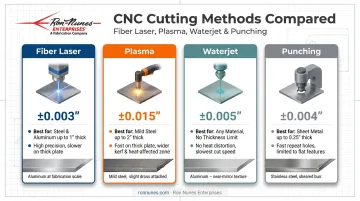
Here's how the four main cutting methods stack up:
| Method | Typical Tolerance | Best For | Trade-Off |
|---|---|---|---|
| Fiber laser | ±0.005 in. | Thin-to-medium gauge, intricate profiles | Assist gas cost, thickness limits |
| Plasma | ±0.020 in. | Thick conductive plate | Wider kerf, rougher edge |
| Waterjet | ±0.005 in. | Heat-sensitive materials | Slower, higher per-part cost |
| Punching | Tool-dependent | Standard holes and repeated features | Limited to tool-producible shapes |
Tolerances reflect historical trade benchmarks reported by The Fabricator; actual results depend on machine condition and material.
Laser Cutting
A focused beam melts or vaporizes a narrow path through the material. It's the go-to choice for thin-to-medium gauge stock needing intricate profiles and clean edges without a lot of secondary cleanup.
Plasma Cutting
Plasma uses ionized gas to cut electrically conductive plate faster and cheaper than laser once you get into thicker material. According to Hypertherm's comparison of plasma and fiber laser cutting, plasma overtakes fiber laser in speed above roughly 5/8 in. (16 mm) thickness. The trade-off is a wider kerf and rougher edge than laser delivers.
Waterjet Cutting
High-pressure abrasive water cuts without generating heat, which makes waterjet the choice for heat-sensitive materials or parts where a heat-affected zone isn't acceptable. It's slower and runs a higher per-part cost than the thermal methods.
CNC Punching and Nibbling
A turret of tools mechanically shears standard holes and shapes fast. The limitation is straightforward: you're restricted to geometries the tooling can produce.
Many shops don't pick just one method per part. It's common to punch standard holes and laser-cut the outline on the same piece, balancing speed, cost, and complexity. Ron Nunes Enterprises applies this same logic across laser cutting, HD plasma cutting, N/C punching, and shearing, all under one roof. A single chassis part doesn't need to travel between vendors to get finished.
Is CNC Cutting Right for Your Project?
When CNC Cutting Makes Sense
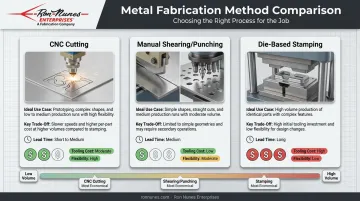
CNC cutting shines for prototypes, short-to-medium production runs, and high-mix/low-volume work where design changes happen often and tooling cost needs to stay low. No dedicated die means no upfront tooling investment.
That calculus flips at extremely high single-part volumes, though, where a dedicated stamping die can lower per-piece cost enough to justify the tooling spend and lead time.
What You Need Before Starting
Before a shop can quote or cut your job, line up:
- A print-ready CAD file
- Confirmed material type, thickness, and temper (for example, 6061-T6 or 5052-H32 aluminum, stainless steel, or mild steel)
- A machine matched to that material and gauge
It also pays to work with a full-service fabricator rather than juggling multiple vendors. Ron Nunes Enterprises, for instance, combines laser cutting, shearing, N/C punching, and finishing in-house.
That in-house setup keeps turnaround tight: stock items ship within 3 working days, custom runs within 15 working days. The company also holds Caltrans DBE certification and builds to EIA-310d standards, relevant if your project involves government or defense contracting.
Key Parameters That Affect CNC Cutting Results
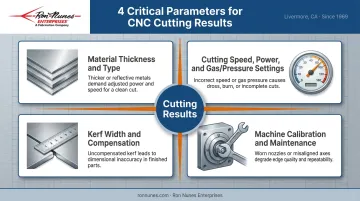
A machine's rated specs tell you what's possible. What actually happens on the shop floor depends on tunable variables the operator controls.
Material Thickness and Type
Why it matters: Thickness and type determine which method can realistically hit the required speed and edge quality.
Impact: Mismatch the thickness to the wrong method, and you get slow cuts, poor edges, or cuts that don't fully penetrate.
Cutting Speed, Power, and Gas/Pressure Settings
Why it matters: These settings control heat input and how efficiently material gets removed from the kerf.
Impact: Get them wrong and you'll see dross, burning, or an incomplete cut path. Plasma dross, in particular, can come from travel speed being either too slow or too fast, not just one direction.
Kerf Width and Compensation
Why it matters: Every cutting method removes a strip of material. The program has to account for that width to hit dimensional targets.
Impact: Skip kerf compensation and parts come out undersized or oversized, even when the toolpath geometry was correct. Plasma kerf commonly runs 0.06–0.12 inch depending on amperage, versus 0.004–0.012 inch for laser, so the compensation value has to match the process, not just the material.
Machine Calibration and Maintenance
Why it matters: A worn nozzle, a misaligned guide, or a fouled lens degrades accuracy no matter how well the program is written.
Impact: Tolerances drift and edge quality declines across successive runs, often getting blamed on the program when it's actually a maintenance issue. Shops running plasma, laser, and punching together, like ours, catch drift early by checking first-run parts.
Common Mistakes and Troubleshooting Tips
Most cutting defects trace back to one of a few root causes:
- Skipping DFM review or material verification before programming, which surfaces as tolerance failures or unmachinable features mid-run
- Using generic default parameters instead of tuning speed, power, and gas to the specific material and thickness, causing dross or burr defects
- Ignoring nesting efficiency, which inflates scrap cost on expensive alloys like stainless
- Treating recurring burrs, dross, or edge taper as unavoidable, when they usually signal a parameter or maintenance issue, not a hard material limit
That last one trips up a lot of shops. Before assuming a defect is "just how the material cuts," check gas pressure, cutting speed, and nozzle or torch condition first. Nine times out of ten, that's where the fix lives. Shops working with a fabricator that reviews designs for manufacturability upfront, like Ron Nunes Enterprises, tend to catch these issues before they ever reach the cutting floor.
Alternatives to CNC Sheet Metal Cutting
CNC profiling isn't always the most cost-effective route, particularly at very high production volumes. Two traditional methods still make sense for specific jobs, especially when simplicity or scale changes the economics.
Manual Shearing and Traditional Punching
When it's better: Simple, straight-line cuts or standard hole patterns where setup cost needs to stay minimal.
Key trade-offs: Limited to simple geometry and less repeatable than a programmed CNC cut. Ron Nunes Enterprises runs both processes in-house, pairing manual shearing and N/C punching with CNC work whenever a job doesn't call for programmed precision.
Die-Based Stamping and Blanking
When it's better: Very high single-part volumes where low per-piece cost outweighs the tooling investment.
Industry rules of thumb vary here. According to a Fabricator analysis on fabrication versus stamping decisions, some shops set the crossover point at 3,000 to 6,000 parts per year, while others use a broader 5,000 to 10,000 range. The right answer depends on the specific part.
Key trade-offs: High upfront die cost and long lead times to build tooling, which makes stamping inflexible when design changes are still likely.
Frequently Asked Questions
What is the best machine to cut sheet metal?
There's no single best machine. Fiber lasers suit thin-to-medium precision work, plasma suits thick conductive plate, and waterjet suits heat-sensitive materials. The right choice depends on thickness, tolerance, and material.
What is the difference between CNC machining and sheet cutting?
CNC sheet metal cutting profiles flat shapes from sheet stock using laser, plasma, waterjet, or punching. CNC machining (milling, turning) removes material from a solid block to build 3D parts. Shops often use both in one workflow.
How accurate is CNC sheet metal cutting?
Tolerances vary by method, with laser and waterjet generally hitting the tightest accuracy (around ±0.005 in.) and plasma running looser (around ±0.020 in.). Actual precision still depends on machine calibration and material flatness.
What materials can be cut using CNC sheet metal methods?
Common materials include aluminum, mild and stainless steel, copper, and brass. Method choice shifts based on conductivity and heat sensitivity, since plasma requires conductive metal and waterjet handles heat-sensitive alloys best.
Can CNC cutting handle both prototypes and full production runs?
Yes. Since CNC cutting skips part-specific tooling, it works well for prototypes and mid-volume runs. At very high single-part volumes, the economics can shift toward die-based stamping.
How much does CNC sheet metal cutting typically cost?
Cost is driven mainly by machine time, material, and nesting efficiency rather than tooling. For an accurate estimate based on your part specifics, get a quote from a full-service fabricator like Ron Nunes Enterprises.