The stakes are real. Your choice affects IP ownership, cost structure, time-to-market, and how much control you retain over components and design changes. In sectors like defense, telecommunications, and semiconductor manufacturing, getting this wrong can mean compliance failures or costly supplier transitions mid-program.
This guide breaks down both models clearly — what each one is, where each one wins, and a practical framework for deciding which fits your situation.
Key Takeaways
- OEM manufacturing leverages existing infrastructure and supply chains — faster to scale, but with limited design control and shared IP
- Contract manufacturing is build-to-spec: you own the designs, the tooling, and all IP from day one
- OEM suits high-volume, established product categories with speed requirements
- Contract manufacturing fits custom, niche, or IP-sensitive products — particularly in defense, telecom, and medical
- Your choice hinges on product maturity, IP sensitivity, budget, and how much design input your project requires
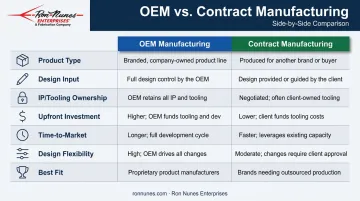
OEM vs Contract Manufacturing: At-a-Glance Comparison
The right model depends on your product, IP ownership needs, and production volume. Use this table to identify which profile fits your situation.
| Criteria | OEM Manufacturing | Contract Manufacturing |
|---|---|---|
| Product type | Established categories | Custom or niche products |
| Customer design input | Spec parameters only | Complete drawings & specs |
| IP/tooling ownership | Shared or split | Customer retains full ownership |
| Upfront investment | Lower (existing tooling) | Higher (custom tooling & setup) |
| Time-to-market | Faster | Longer initial development |
| Design flexibility | Low once specs are locked | High — adjustments possible throughout |
| Best fit | High-volume, price-sensitive runs | Custom, scalable, IP-sensitive programs |
What Is OEM Manufacturing?
OEM stands for Original Equipment Manufacturer. The model works like this: a manufacturer produces a finished product using their own infrastructure, supply chain, and certified components. The customer provides design parameters and markets the result under their own brand.
The typical workflow: a customer submits size, feature, and output requirements; the manufacturer applies existing tooling and pre-certified components to deliver production-ready units. The customer doesn't own the factory, the tooling, or the underlying component architecture.
Where OEM Works Best
OEM manufacturing excels in established product categories — consumer electronics, appliances, automotive components — where scale and speed matter more than radical differentiation. Apple's relationship with Foxconn is the clearest large-scale example: Apple outsources most of its manufacturing; Foxconn alone handled roughly 70% of global iPhone shipments in 2022. That arrangement lets Apple focus internal resources on design and brand while Foxconn handles production at scale.
That tradeoff — speed and scale in exchange for control — defines the OEM model. Here's what it means in practice:
Key advantages:
- Lowers unit costs through economies of scale and amortized tooling
- Accelerates product development since existing tooling eliminates custom setup lead time
- Gives customers access to pre-certified components and specialized production expertise
- Frees internal resources to focus on branding, sales, and go-to-market
Key disadvantages:
- Locks in design specifications with limited flexibility to deviate later
- Splits IP ownership, with the manufacturer retaining rights to internal components and tooling
- Creates shared-manufacturer risk; multiple competing brands may use the same production line
- Exposes all customers simultaneously to supply disruptions at the OEM level
What Is Contract Manufacturing?
Contract manufacturing is a build-to-spec outsourcing model. The customer provides complete design drawings and specifications; the manufacturer provides labor, equipment, and production expertise to build exactly what the customer has engineered. The contract manufacturer has no proprietary components of their own in the final product.
This structural difference matters: unlike OEM, a contract manufacturer doesn't specialize in a single product type. Their facilities are configured to produce custom tooling and cover a wide range of product categories based on customer drawings.
The Spectrum of Engagement
Engagements range widely in scope, typically falling somewhere between:
- Single-stage fabrication — the manufacturer handles one specific process (say, laser cutting or welding), while the customer manages everything else
- Full turnkey — design-through-delivery under one roof, from DFM consultation through prototype, production, assembly, and finishing
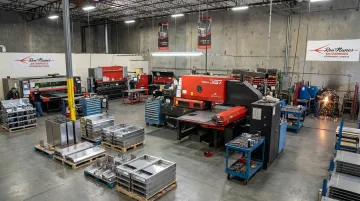
Ron Nunes Enterprises, a Livermore, California-based precision metal fabricator with over 55 years of experience, operates across both ends of this spectrum. A defense contractor might engage them purely for custom rack chassis fabrication; a telecom equipment supplier might run a full program from engineering consultation through production and assembly with scheduling integration built in.
Where Contract Manufacturing Excels
Contract manufacturing is the right model for custom, niche, or technically demanding products — particularly in defense, telecommunications, semiconductor, and medical sectors, where unique specifications, IP sensitivity, and component-level control aren't optional.
Key advantages:
- Customer retains full IP and tooling ownership
- Greater design control down to supplier and component level
- Flexibility to adjust designs iteratively or swap manufacturers
- Better suited to prototype-to-production scaling for new or complex products
Key disadvantages:
- Higher upfront investment in custom tooling, testing, and certification
- Longer initial development lead times than OEM
- More design engineering burden on the customer side
The design burden shrinks considerably with the right manufacturing partner. Ron Nunes Enterprises offers DFM consultation before a single piece of metal is cut — helping customers optimize designs for manufacturability before committing to tooling — and delivers custom rack chassis mounts within 15 working days.
How to Choose Between OEM and Contract Manufacturing
The decision comes down to five practical filters. Run your project through each one.
1. Product Type and Category Maturity
If your product falls into a well-established category — standard electronics, automotive components, commodity appliances — an OEM supply base likely already exists and can serve you efficiently.
If your product involves proprietary engineering, non-standard form factors, or highly specific requirements (as is common in defense, telecom infrastructure, and medical device manufacturing), contract manufacturing preserves your competitive position.
2. IP Sensitivity
This is the clearest differentiator. In contract manufacturing, the customer typically retains full ownership of all designs, drawings, and tooling since the manufacturer builds purely to customer specifications. OEM arrangements frequently result in mixed IP ownership — the manufacturer retains rights to internal components and tooling — which can complicate supplier transitions later.
BCG's make-or-buy framework identifies strategic value and innovation potential as core evaluation criteria: if the product design is central to your competitive differentiation, that IP needs to stay with you.
In federal defense contracting, DFARS 252.227-7013 allocates technical data rights based on development funding and contract terms — not just the label on the manufacturing model. IP ownership must be stated expressly in the agreement regardless of which model you choose.
3. Budget and Investment Horizon
OEM offers lower entry costs for large runs — pre-existing tooling means no upfront NRE (non-recurring engineering) costs. Contract manufacturing requires higher initial investment but avoids long-term dependence on a single manufacturer's product architecture.
For buyers with variable demand or tighter initial budgets, contract manufacturing's pay-per-unit structure can be more cost-effective over time. IndustryWeek has reported that end-to-end contract manufacturing transformations can reduce total landed cost and working-capital requirements by 10%-25%, though this depends heavily on product type and volume.
4. Time-to-Market Urgency
OEM wins on initial speed — existing tooling and certified components mean shorter lead times for established product types. Contract manufacturing takes longer upfront because custom tooling, first article inspection (FAI), and qualification steps add time before production begins.
The right call depends on where your product sits:
- Established category, speed-critical: OEM is the more efficient path
- Custom or new-to-market product: Contract manufacturing's longer development cycle pays back in design control and supplier flexibility over the product's lifetime
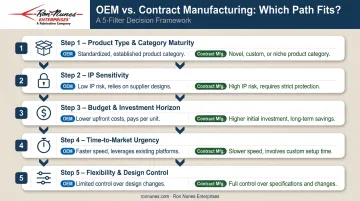
5. Flexibility and Design Control
OEM offers minimal flexibility once production begins — specifications are locked when the relationship starts. Contract manufacturing allows iterative adjustments, customer-designated suppliers, and consigned parts throughout the program.
For product lines that evolve with technology cycles — common in telecom infrastructure and semiconductor capital equipment — contract manufacturing's flexibility is worth the premium.
Real-World Examples and Choosing Your Path
The Apple-Foxconn relationship illustrates what OEM at scale looks like: Apple remains the OEM (the end-product manufacturer), while Foxconn serves as the contract electronics manufacturer. This arrangement lets Apple avoid billions in facility overhead while Foxconn applies its production expertise and scale.
Apple does not surrender design control in this model — but it does accept concentration risk. Apple's own 10-K acknowledges that custom components for new products are often initially available from a single source, and supplier constraints can affect capacity.
Toyota's approach shows that sophisticated buyers don't always choose one model exclusively. Toyota's 2025 Sustainability Data Book identifies 280 major Tier 1 suppliers accounting for 90% of procurement value, with engagement extending to Tier 2 and beyond. Different components get different sourcing strategies based on strategic value, supplier availability, and complexity.
For companies in precision manufacturing sectors — defense contractors, telecom equipment providers, semiconductor capital equipment manufacturers — contract manufacturing typically aligns better with the need for custom specs, full IP control, and component-level oversight.
Ron Nunes Enterprises has served these sectors since 1969. Capabilities include:
- EIA-310d compliant rack mount chassis with MIL-C-5541E and MIL-A-8625E finishes for defense and government customers
- Precision fabricated enclosures for semiconductor and medical applications
- Custom structural components for telecommunications infrastructure
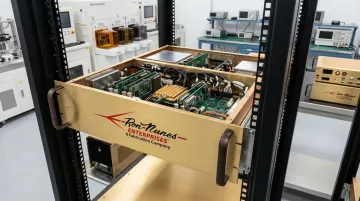
As a Caltrans Certified DBE minority-owned business, the company also supports government contractors with DBE participation requirements.
For precision metal fabrication — from prototype through production — contact Ron Nunes Enterprises at 1-877-800-RACK.
OEM is the efficient path for scale and speed in established product categories. Contract manufacturing is the flexible, IP-secure path for custom and innovative products. Match the model to your product's maturity, your IP requirements, and where you need operational control — and the right choice follows from there.
Frequently Asked Questions
What does OEM manufacturing mean?
OEM (Original Equipment Manufacturer) is a model where a manufacturer builds a product to a customer's design parameters — using its own tooling and supply chains — and the customer markets it under their own brand. The OEM handles production infrastructure; the customer owns brand and go-to-market.
Do OEMs use contract manufacturing?
Yes. OEMs frequently engage contract manufacturers for sub-components or specialized production stages. In the automotive sector, for example, Toyota sources from hundreds of Tier 1 and Tier 2 contract manufacturers before final vehicle assembly — a supplier hierarchy rather than a single-model approach.
What is the difference between OEM and ODM?
In OEM, the customer provides the design and the manufacturer builds to those specs. In ODM (Original Design Manufacturer), the manufacturer owns the design and the customer licenses and re-brands it — giving the customer even less input over the product. ODM is common in consumer electronics.
Who owns the intellectual property in contract manufacturing?
In contract manufacturing, the customer typically retains ownership of all designs, drawings, and tooling. Ownership should always be spelled out explicitly in the manufacturing agreement; the model label alone doesn't guarantee it.
Is contract manufacturing better for small or new businesses?
Often, yes. Contract manufacturing eliminates the need for capital-intensive infrastructure, allows production to scale with demand, and lets businesses focus resources on product development and sales rather than facility management.
What industries benefit most from contract manufacturing?
Industries with high customization needs and strict specifications, such as defense, telecommunications, semiconductor, transportation, and medical, rely heavily on contract manufacturing. Proprietary designs, regulatory compliance, and tight component-level control make it the more practical model in these sectors.