This guide covers what custom fabrication is, how the core processes work, which industries depend on it, and what to look for when choosing a fabrication partner. Whether you're sourcing a prototype or planning a production run, you'll leave with a clear picture of when custom is the right call — and how to make it work.
Key Takeaways
- Custom fabrication builds parts from raw materials to exact client specifications, not from a fixed catalog design
- Core processes include cutting, forming, welding, and finishing — ideally under one roof to reduce hand-off risk
- Defense, semiconductor, telecom, and nuclear research sectors rely on custom fabrication when off-the-shelf parts can't meet tolerance or compliance requirements
- Total cost of ownership is often lower with custom parts despite higher upfront costs
- Choose a fabricator based on verifiable process capabilities, industry experience, and published turnaround commitments
What Is Custom Fabrication?
Custom fabrication is the process of building parts, assemblies, or structures from raw materials according to a specific set of client-defined requirements. Every dimension, material choice, and feature is determined by what the application requires. Nothing is pulled from a standard catalog.
This is what separates custom fabrication from standard manufacturing. Standard production starts with a fixed design and makes identical units at scale. Custom fabrication works in reverse: it starts with the customer's drawing or specification and builds a part to match it exactly.
What "Custom" Actually Covers
The term is broader than most people assume:
- Covers single prototypes, short runs, and full production volumes
- Uses aluminum alloys, stainless steel, mild steel, and specialty metals matched to the application
- Ranges from simple brackets and plates to fully assembled enclosures, chassis, and structural weldments
- Built from customer-supplied engineering drawings, CAD files, or detailed prints
That distinction matters most where dimensional tolerances are tight, material specifications are controlled, and compliance documentation is required.
Ron Nunes Enterprises, a Livermore, California-based manufacturer operating since 1969, handles this full range — from one-off prototypes to ongoing production contracts — across industries including defense, semiconductor, telecom, and medical.
Key Custom Fabrication Processes Explained
Most fabricated parts move through four process stages: cutting, forming, welding, and finishing. Understanding each one helps you have better conversations with fabricators and catch potential specification issues before they become delivery problems.
Cutting
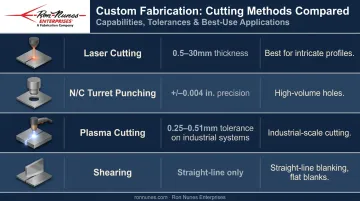
Cutting shapes raw material to size and profile. The right method depends on material, thickness, and required edge quality:
- Laser cutting — A focused, non-contact beam melts or vaporizes material. TRUMPF reports processing thicknesses from 0.5 mm to more than 30 mm, with clean, low-burr edges when parameters are optimized. Best choice for intricate profiles and tight tolerances.
- N/C turret punching — Computer-controlled punch presses create holes, slots, louvers, and formed features. A 2023 case study documented precision punching achieving +/-0.004 in. in some instances, making it cost-effective for high-volume, repetitive hole patterns.
- Plasma cutting — High-definition systems offer tighter tolerances than standard plasma. Handheld systems run around 1.6 mm tolerance; high-production industrial systems reach 0.25–0.51 mm.
- Shearing — Straight-line blanking of sheet stock. Fast and economical for producing flat blanks before downstream forming or punching.
Forming
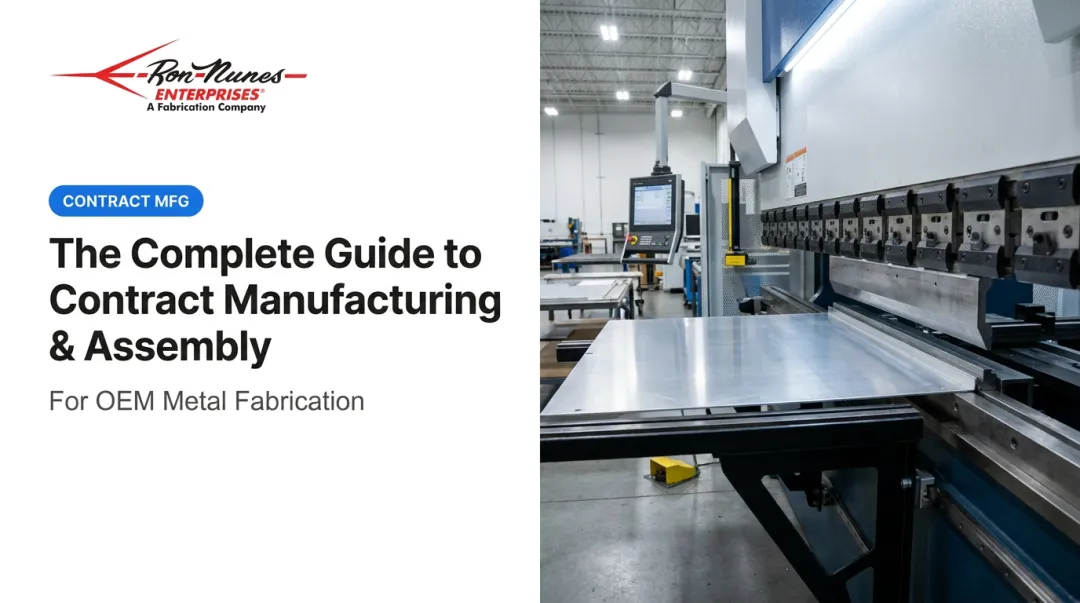
Forming takes flat cut material and shapes it into 3D geometry. The primary method in sheet metal fabrication is press brake bending, where tooling applies controlled force to bend material to a specified angle.
Key tolerance benchmarks for press brake work:
- Bend tolerance: +/-1.5 degrees for 10-gauge-or-thinner sheet steel up to 10 feet (Cincinnati press brake data)
- Springback allowance: 2–4 degrees for mild steel, factored into toolpath programming
- Assembly impact: A bracket off by even one degree can prevent a chassis from seating flush or sliding into a rack — problems that only surface later, during assembly.
Welding and Assembly
Welding joins fabricated components into finished assemblies. Each method has a specific purpose:
| Method | Best Application |
|---|---|
| TIG (GTAW) | Thin sheet, stainless steel, aluminum, cosmetic welds |
| MIG (GMAW) | Steel and aluminum across a broad thickness range |
| Spot welding | Repetitive lap joints in sheet metal |
| Stud welding | Fastener and hardware attachment |
Weld quality determines structural integrity and service life. Ron Nunes Enterprises uses Class A/XX certified welders across all methods, with a fleet that includes five Miller TIG welders, five Hobart MIG units, a Federal 50 KVA spot welder, and TRW Nelson stud welders.
Finishing
Post-fabrication finishing protects parts and prepares them for service:
- Deburring and grinding — Removes sharp edges that create safety hazards or interfere with assembly
- Chemical conversion coating — MIL-DTL-5541 (validated 2024) covers coatings on aluminum for corrosion protection; MIL-C-5541E remains the legacy designation still referenced on many drawings
- Anodizing — MIL-PRF-8625 covers six types of electrolytically formed anodic coatings on aluminum
- Powder coating — Appropriate pretreatment improves adhesion and corrosion inhibition
- Silkscreening — Part marking, panel labeling, and identification
Ron Nunes Enterprises runs Amada CNC turret punch presses (the Pega-357 and Octo-334), a Komatsu Rasor HD plasma cutter, and laser cutting equipment — covering all four cutting methods in-house.
Benefits of Custom Fabrication for Your Business
Exact Fit Eliminates Costly Workarounds
When a part is built to your drawing, there's no adaptation required. Every hole pattern, bend angle, and surface finish matches the assembly it's going into. For rack mount systems, enclosures, and precision chassis, even minor dimensional deviations cascade into rework at the assembly stage — which is far more expensive than getting the fabrication right the first time.
Lower Total Cost of Ownership
Custom parts cost more upfront than catalog items — but the total cost comparison tells a different story:
- Fewer rejected parts due to poor dimensional fit
- Reduced rework and scrap at assembly
- Longer service life when material selection matches the application environment
- No emergency procurement costs when standard parts go on backorder
According to NAM surveys, 85.5% of manufacturers identified supply-chain challenges as a primary concern in Q2 2022. Custom fabrication gives you direct control over production timelines — removing dependence on catalog suppliers whose stock levels you can't influence.
Design Flexibility from Prototype to Production
Custom fabrication doesn't lock you into a single design iteration. It supports the entire product lifecycle:
- Prototype — Validate fit, form, and function before committing to tooling or volume
- Pilot run — Refine the design with real assembly feedback
- Production — Scale to required volume with a fabricator who already knows your part
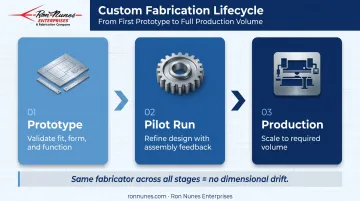
Working with the same fabricator across all three stages means your production parts reflect every tolerance refinement made during prototyping — no relearning, no dimensional drift between runs.
Industries That Rely on Custom Fabrication
Defense, Nuclear Research, and Semiconductor
These sectors share a common requirement: parts must meet controlled specifications with full documentation. Standard catalog parts rarely meet those requirements.
Each industry brings distinct demands:
- Defense contractors require chassis and enclosures built to MIL-spec finishes (MIL-C-5541E, MIL-A-8625E), specific alloy designations, and traceability to verified material certifications.
- Nuclear and physics research facilities, including national laboratories, specify finishes and dimensional tolerances that exceed anything in a standard catalog.
- Semiconductor equipment manufacturers need precision sheet metal parts with exacting dimensional requirements for equipment housings and support structures.
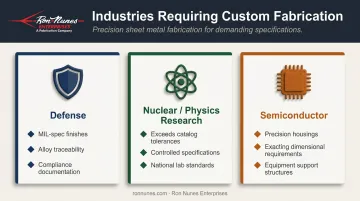
Ron Nunes Enterprises has supplied all three sectors since 1969, including chassis to Lawrence Livermore National Laboratory specifications and EIA-310d compliant rack systems for defense electronics packaging.
Telecommunications and Data Center Infrastructure
Rack mount chassis systems for telecom and data center applications follow the EIA/ECA-310-E standard for 19-inch rack compatibility. The outer dimensions are standardized. Everything inside — depth, internal mounting configurations, cover perforation patterns, cutouts — is application-specific.
The global data center rack market was valued at $4.133 billion in 2023, projected to reach $7.574 billion by 2030. Most of that hardware requires some degree of custom configuration to match the equipment being housed.
Transportation and Medical
Caltrans-governed transportation projects specify welding inspection against qualified WPS/AWS provisions and call out galvanized or specifically finished metal parts in identified applications. Medical device manufacturers operate under FDA's Quality Management System Regulation (QMSR), effective February 2026, which requires supplier selection to address the ability to meet specified requirements. Both sectors use custom fabrication when safety, regulatory, or performance standards eliminate general-purpose alternatives.
How to Choose the Right Custom Fabrication Partner
Evaluate In-House Capabilities First
A fabricator that handles cutting, forming, welding, assembly, and finishing under one roof reduces hand-off risk, compresses timelines, and gives you a single point of accountability. Every time a part moves between vendors, you introduce scheduling uncertainty and quality risk.
Ask specifically:
- Which processes are performed in-house versus subcontracted?
- What equipment supports each process?
- Can you handle both prototype quantities and full production runs?
Verify Track Record and Turnaround Commitments
Industry experience matters because each sector has distinct requirements. Tolerance expectations in semiconductor work differ from documentation requirements in defense, which differ from compliance obligations in medical or transportation applications.
Look for fabricators with published, specific turnaround commitments. Ron Nunes Enterprises, for example, guarantees shipment of stock items within 3 working days and custom rack chassis mounts within 15 working days, with over 55 years of manufacturing experience across defense, semiconductor, telecom, and transportation markets.
Confirm Quality Standards and Communication Practices
Before committing to a fabricator, get clear answers on:
- How do they verify incoming material against specifications?
- What inspection equipment is used, and at what stages?
- How are specification changes communicated and tracked mid-project?
- Do they provide part identification and revision tracking?
Ron Nunes Enterprises maintains granite surface plates, dial height gauges, precision squaring blocks, and vernier calipers for dimensional verification, and tracks parts by revision number, enabling consistent dimensional accuracy across production runs.
Frequently Asked Questions
What does "custom fabricated" mean?
A custom fabricated product was built from raw materials to a specific set of client-defined requirements. It has no equivalent in a standard catalog — every dimension, material, and feature was determined by what the application needed.
How much does custom fabrication cost?
Cost depends on material type, design complexity, quantity, and finishing requirements. Custom fabrication carries higher upfront costs than catalog parts, but typically delivers lower total cost of ownership through better fit, longer service life, and reduced assembly rework.
What materials are used in custom fabrication?
The most common metals are carbon steel, stainless steel, and aluminum. Specific alloys — such as 6061-T6 or 5052-H32 aluminum — are chosen based on strength, corrosion resistance, weight, and application environment, with specialty alloys brought in when standard options fall short.
What is the difference between custom fabrication and standard manufacturing?
Standard manufacturing produces identical parts at scale from a fixed design. Custom fabrication starts from the customer's unique specifications and builds parts to meet them exactly — not the other way around.
How long does a custom fabrication project take?
Lead time depends on complexity, material availability, and shop capacity. As a reference point, reputable fabricators publish firm commitments — for example, 15 working days for custom chassis and 3 working days for stock items. Look for those specifics when evaluating suppliers.
What industries benefit most from custom fabrication?
Defense, semiconductor, nuclear and physics research, telecommunications, medical, and transportation industries rely most heavily on custom fabrication. These sectors require dimensional tolerances, material specifications, and compliance documentation that standard catalog parts simply can't provide.