The technique, output quality, and practical applications diverge significantly. For engineers and industrial buyers, that divergence matters. Specifying the wrong process can compromise weld strength, introduce cosmetic defects, extend lead times, or inflate fabrication costs before a single part ships.
This guide breaks down how each process works, compares them across the factors that matter most in production environments, and provides clear situational guidance for choosing between them.
Key Takeaways
- MIG welding uses a consumable wire electrode fed continuously — best suited for thick materials and high-volume production
- TIG welding uses a non-consumable tungsten electrode for precise, clean welds on thin or exotic metals
- MIG costs less per weld foot; TIG runs slower and requires greater skill, which drives up cost
- Neither process is universally superior — material type, thickness, finish requirements, and volume all drive the right selection
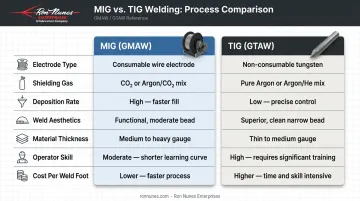
MIG vs TIG: Quick Comparison
| Factor | MIG (GMAW) | TIG (GTAW) |
|---|---|---|
| Electrode type | Consumable wire (auto-fed) | Non-consumable tungsten |
| Shielding gas | 75% argon / 25% CO₂ (mild steel) | Pure argon (standard) |
| Deposition rate | ~8–9 lb/hr | ~2–3 lb/hr |
| Weld aesthetics | More spatter; functional finish | Narrow, clean bead; cosmetically refined |
| Material thickness | Better on thicker stock (above 1/8") | Better on thin, delicate, or exotic metals |
| Operator skill | Lower learning curve | Requires two-hand + foot pedal coordination |
| Cost per weld foot | Lower | Higher |
Both processes rely on shielding gas and are sensitive to wind and drafts. According to a TWI technical reference, as little as 5% air in a TIG shielding environment can produce a poor bead profile and reduce stainless steel corrosion resistance. Draft control in the work environment is non-negotiable for both processes.
What Is MIG Welding?
MIG welding — formally Gas Metal Arc Welding (GMAW) — feeds a consumable wire electrode continuously through a welding gun alongside a shielding gas. The arc melts both the wire and the base metal, forming the weld pool. The operator guides the gun with one hand while wire feed runs automatically — which is what makes MIG so fast in production settings.
Gas selection shapes the result. For mild steel, Miller identifies 75% argon / 25% CO₂ (C-25) as the best all-purpose shielding gas — it minimizes spatter, improves bead appearance, and helps prevent burn-through on thinner sections. Pure CO₂ offers deeper penetration but produces more spatter and a rougher bead.
Why MIG Suits High-Volume Production
The automated wire feed is MIG's defining production advantage. Operators run long, uninterrupted passes without stopping to reposition filler rod — increasing arc-on time and throughput across long production runs. The broader arc shape also dissipates heat across a wider area, making MIG more forgiving on thicker base metals without overheating.
Key operational characteristics:
- Higher travel speeds than TIG for equivalent joint types
- Deposition rates roughly 3–4× faster than GTAW
- Single-hand operation makes it accessible for less experienced welders
- Spatter cleanup and less refined bead appearance are trade-offs
With proper joint preparation — a V-groove on heavier plate, for example — MIG produces structurally sound welds. The bead finish leans functional rather than cosmetic, which is why MIG fits naturally into workflows where welds will be coated, painted, or post-processed.
Common MIG Welding Applications
MIG dominates where speed and throughput matter:
- Automotive and transportation manufacturing — body, frame, and structural components
- Pressure vessel construction — mechanized GMAW is standard for many vessel fabrication workflows
- Heavy equipment and general manufacturing — structural frames, enclosures, and load-bearing assemblies
- Commercial metal fabrication — production runs where weld appearance is secondary to cycle time
MIG handles mild steel, aluminum (with 100% argon shielding), and stainless steel — making it viable across most industrial material requirements without a process change.
What Is TIG Welding?
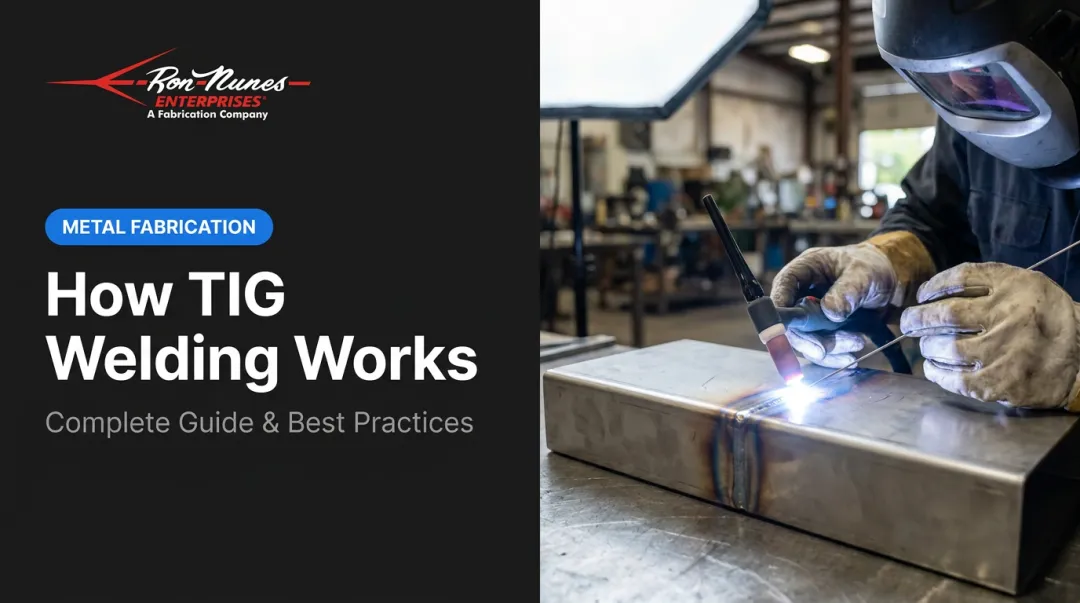
TIG welding — formally Gas Tungsten Arc Welding (GTAW) — uses a non-consumable tungsten electrode to create the arc. The operator feeds a separate filler rod manually with the other hand while controlling amperage in real time through a foot pedal — a three-way coordination of torch, filler, and foot that takes considerable practice to master.
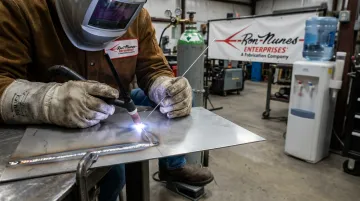
Pure argon is the standard shielding gas. Reactive gases degrade the tungsten electrode and contaminate the weld pool — argon's inert chemistry keeps both intact. Helium and argon-helium blends exist for special applications, but argon remains the default.
The Precision Advantage
TIG's narrow, focused arc concentrates heat precisely on the joint. That focused energy achieves better penetration on thin sections without the burn-through risk that MIG's broader arc creates. It also gives the operator finer control over the heat-affected zone, which matters for materials that distort easily or assemblies with tight dimensional tolerances.
The result is a weld profile that's visually distinct: clean stacked beads, minimal spatter, consistent geometry. For unpainted chassis, medical enclosures, or defense hardware where the weld is visible and inspected, that appearance matters.
Skill and Setup Requirements
TIG's precision comes at a cost in setup time and operator demand:
- Surfaces must be thoroughly cleaned before welding — contamination directly degrades weld quality
- Two-hand plus foot pedal coordination requires significant practice to master
- Slower travel speeds mean lower throughput per hour
- Higher labor cost per weld foot than MIG for equivalent joint length
AWS describes GTAW as the "gold standard" for clean, precise welds and notes it is widely specified for aerospace fabrication, thin-wall tubing, and specialty alloys where tight heat-affected zone control is critical.
Common TIG Welding Applications
TIG is the specified process where precision, appearance, or material sensitivity are non-negotiable:
- Aerospace and defense components requiring tight tolerances and high structural integrity
- Semiconductor and physics research equipment where clean welds and dimensional precision are specified
- Medical device fabrication requiring surface cleanliness and leak-free integrity
- Pipe joints requiring pressure-tight sealing
- Automotive restoration — cosmetically visible welds
- Telecommunications and rack mount chassis — tight tolerances, visible finish on unpainted assemblies
AWS explicitly supports TIG's material versatility across stainless steel, aluminum, magnesium, titanium, and copper. These are the same materials specified across defense, semiconductor, and medical fabrication — industries where weld quality is part of the product specification, not an afterthought.
Ron Nunes Enterprises operates five Miller TIG welders to support this level of work. The facility serves semiconductor, defense, medical, and telecommunications customers, with rack mount chassis assemblies built to Class A/XX welder and assembler standards — a certification consistent with structurally and aesthetically demanding fabrication.
MIG vs TIG: Which Should You Choose?
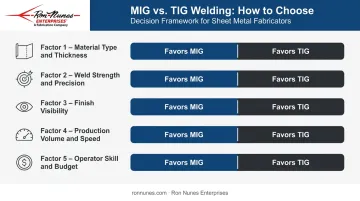
The process decision comes down to five factors:
- Material type and thickness: thin or exotic metals favor TIG; thicker structural stock favors MIG
- Weld strength and precision requirements: TIG's focused arc achieves better penetration and fewer defects on precision joints
- Finish visibility: if the weld is visible and unpainted, TIG's clean bead profile matters
- Production volume and speed: MIG's throughput advantage compounds over long runs
- Operator skill and budget: MIG is faster to train and cheaper per weld foot at scale
When MIG Is the Right Call
- Base metals generally thicker than 1/8"
- Welds will be coated, painted, or post-processed
- Project involves long continuous runs or high part volume
- Production speed and cost-per-part are primary constraints
- Less experienced operators are in the workforce
When TIG Is the Right Call
- Thin sheet metal or exotic alloys (titanium, copper, magnesium)
- Weld appearance is visible and will be inspected — chassis assemblies, medical enclosures, defense hardware
- Weld integrity under pressure or stress is non-negotiable
- Joining dissimilar metals
- Dimensional tolerance requirements are tight
The Cost-Quality Trade-Off
TIG costs more per weld foot. Slower deposition, more prep time, and higher operator skill requirements all push the number up. On structural or production work where the weld is hidden and the part is robust, that premium rarely pays off.
Where failure or aesthetic rejection is expensive — defense components, semiconductor research enclosures, medical assemblies — TIG's precision reduces rework and quality rejections downstream. The higher upfront cost often saves money at the program level.
For manufacturers producing precision components across defense, telecommunications, and semiconductor research sectors, working with a fabricator experienced in both processes is the practical way to avoid mis-specifying a weld method early in a program.
Ron Nunes Enterprises has operated both MIG and TIG welding stations for over 55 years, serving customers from prototype through production runs across exactly these sectors. The engineering and sales team can provide process guidance during the design phase — before a drawing is finalized and a process locked in.
- Material type and thickness : thin or exotic metals favor TIG; thicker structural stock favors MIG
- Weld strength and precision requirements : TIG's focused arc achieves better penetration and fewer defects on precision joints
- Finish visibility : if the weld is visible and unpainted, TIG's clean bead profile matters
- Production volume and speed : MIG's throughput advantage compounds over long runs
- Operator skill and budget : MIG is faster to train and cheaper per weld foot at scale
Conclusion
MIG and TIG are both proven, reliable processes. The right choice depends on the specific material, tolerance, finish, volume, and cost constraints of a given project.
Apply the five selection factors outlined above at the design stage. Getting the process right early reduces rework, cuts finishing costs, and ensures weld integrity meets qualification requirements in testing and field service.
If you're working through process selection for a custom fabrication project — chassis systems, enclosures, or structural components for regulated industries — reach out to Ron Nunes Enterprises at (925) 371-0220 or sales@ronnunes.com. Their team can help ensure the right process is specified before fabrication begins.
Frequently Asked Questions
What does TIG stand for?
TIG stands for Tungsten Inert Gas, referring to the non-consumable tungsten electrode used to generate the arc. The process is also formally designated GTAW (Gas Tungsten Arc Welding) by the American Welding Society.
Can you TIG weld with a MIG welder?
No. MIG and TIG are distinct processes requiring completely different equipment. MIG machines use a consumable wire feed system; TIG requires a tungsten electrode, foot pedal amperage control, and a separately fed filler rod.
Which is stronger, MIG or TIG welding?
TIG generally produces stronger welds due to its focused arc and better penetration on precision joints. That said, a 2022 study on AISI 304 stainless steel found both processes met minimum tensile requirements, meaning strength is ultimately procedure-specific rather than a fixed property of either method.
Which welding method is better for thin metals?
TIG. Its precise heat control prevents burn-through and warping on thin or heat-sensitive materials. MIG's broader arc and higher heat input make it difficult to apply to thin stock without causing distortion or damage.
Is MIG welding easier to learn than TIG?
Yes, significantly. MIG requires one hand on the gun with wire feed handled automatically. TIG demands two-hand coordination plus real-time foot pedal control of amperage , a more demanding skill set that takes much longer to master.
Is MIG or TIG better for stainless steel?
Both work. TIG is preferred when precision and appearance are priorities : it produces narrow, clean beads with minimal heat distortion. MIG is the better choice for stainless steel in higher-volume or structural applications where speed and cost take precedence over weld aesthetics.