Skipping or compressing this process is a common source of production failures, costly rework, and missed launch windows. This article walks through how prototype manufacturing works, which fabrication methods apply to which situations, and what factors most directly affect whether your first build gets you closer to production or sends you back to square one.
Key Takeaways
- Prototype manufacturing bridges a CAD design and a validated, production-ready product
- The process moves through ideation, CAD modeling, DFM review, fabrication, and iterative testing
- Method selection depends on material requirements, tolerances, and end-use function — not every process fits every part
- Multiple iterations are normal; catching design flaws early costs far less than fixing them after tooling
- Matching the right manufacturer to your material and complexity requirements directly affects timeline and quality
What Is Prototype Manufacturing?
Prototype manufacturing is the process of producing a pre-production physical part or assembly to test design intent, fit, function, and manufacturability before investing in full production tooling or volume runs. The output is a pre-production part, not a finished product.
The goal is to confirm that a design works as intended in the real world, surface structural or functional weaknesses, and validate that the part can actually be manufactured at scale. A prototype that passes these checks gives an engineering team confidence to commit production resources. One that reveals problems early saves far more than it costs.
Two distinctions engineers frequently conflate:
- Prototype vs. production: Low quantities, flexible processes, no dedicated tooling — prototype manufacturing prioritizes speed and design validation over cost-per-unit efficiency. Production manufacturing reverses those priorities entirely.
- Prototype manufacturing vs. 3D printing: Additive manufacturing is one method within a much broader process. Prototypes are also built via CNC machining, sheet metal fabrication, injection molding, and other methods — 3D printing is a subset, not a synonym for prototyping.
How the Prototype Manufacturing Process Works
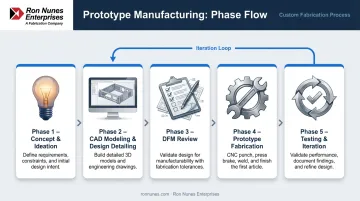
A concept becomes a physical part through five phases: digital design, manufacturability review, fabrication, testing, and iteration. Production approval only comes after the design meets documented specifications.
The process rarely runs in a straight line. Testing feedback loops back into design, which means DFM review and clearly defined testing criteria are active inputs at every stage, not just at the start.
Step 1: Concept and Ideation
Ideation formalizes the product need. Engineers and designers define functional requirements, use-case conditions, material constraints, and performance targets. This is typically documented as a design brief or requirements specification. Without it, there's no objective basis for evaluating whether a prototype passed or failed.
Step 2: CAD Modeling and Design Detailing
CAD models translate the concept into precise digital geometry — dimensions, tolerances, material callouts, and assembly interfaces. Simulation tools like FEA and CFD can stress-test performance before any physical part is made, which helps identify obvious failure points without consuming fabrication time or budget.
Step 3: Design for Manufacturability (DFM) Review
DFM review evaluates whether the CAD design can be produced using the intended fabrication method without costly modifications. Common flags include tight tolerances in hard-to-machine areas, wall thickness inconsistencies, and features that can't be replicated at production volumes.
Ron Nunes Enterprises offers formal DFM consultation and product development support as part of its custom fabrication process, helping engineers identify these issues before the first cut is made rather than after the first prototype fails inspection.
Step 4: Prototype Fabrication
This is the physical build phase. The chosen manufacturing method produces the prototype part or assembly.
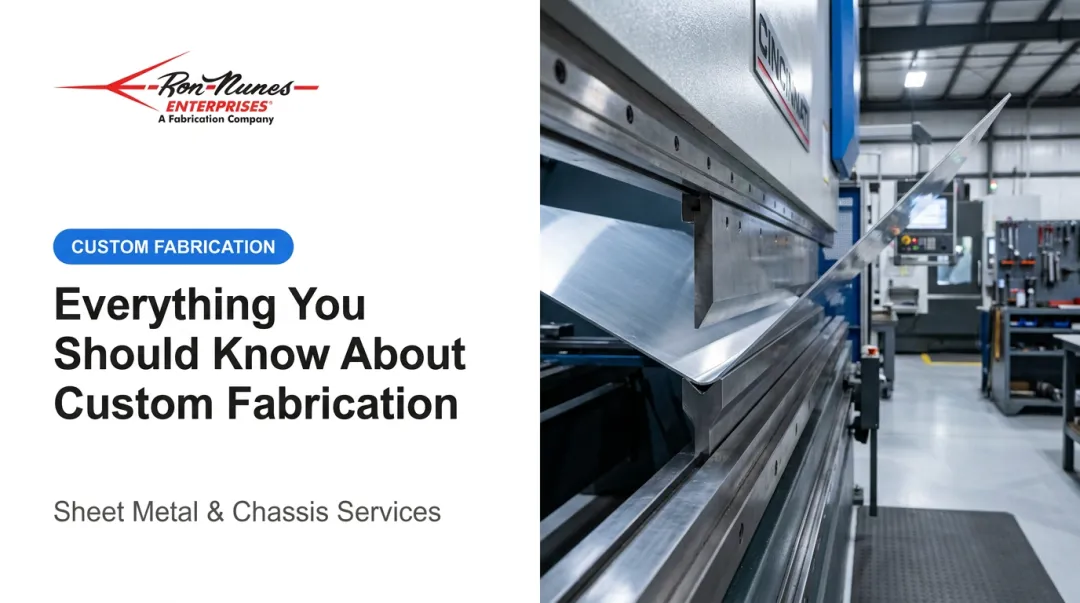
For precision metal applications — enclosures, chassis, and structural assemblies used in defense, telecom, and research — sheet metal fabrication is the most common path. A typical prototype run at Ron Nunes Enterprises moves through:
| Stage | Process | Equipment |
|---|---|---|
| Blanking | Shearing / Notching | Wysong 2500 HD CNC Shear, Amada CSW-220 Notcher |
| Feature Cutting | CNC Turret Punching | Amada Pega-357, Amada Octo-334 |
| Profile Cutting | Plasma Cutting | Komatsu Rasor Fine Plasma HD |
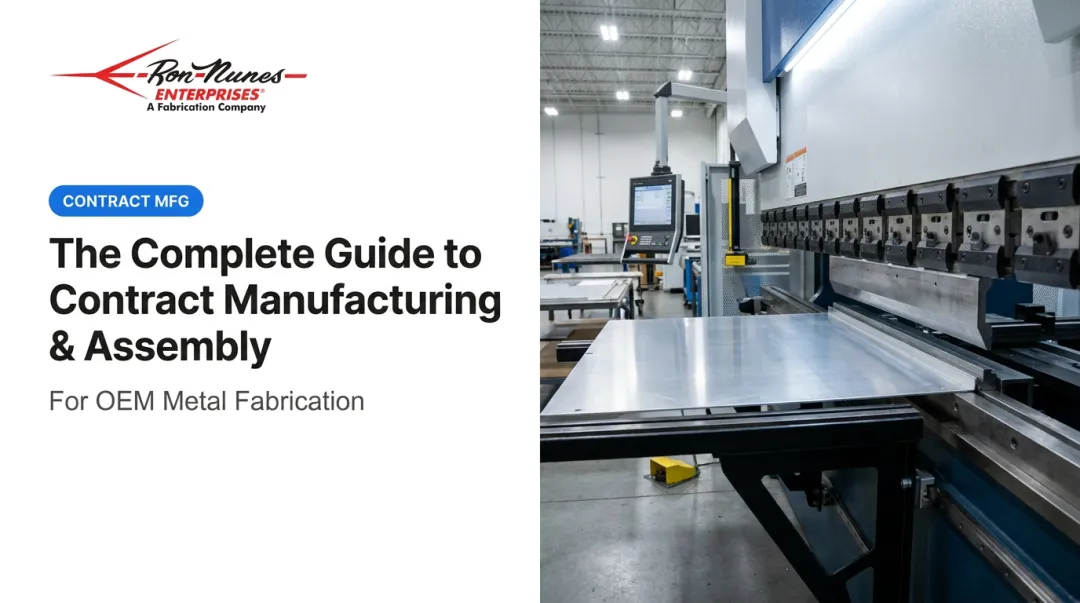
| Forming | Press Brake Bending | Cincinnati 175T Form Master II, 300T Cincinnati |
| Hardware | Fastener Installation | Auto-Sert AS 7.5 Hydraulic Press |
| Joining | TIG / MIG / Spot / Stud Welding | Miller TIG, Hobart MIG, Federal Spot Welder |
| Finishing | Deburring / Graining / Coating | Grindmaster Speed-Grainer, MIL-spec finishing |
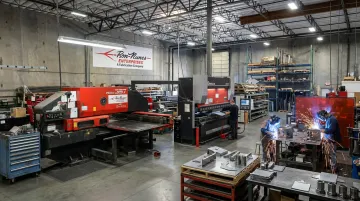
Finishing options, including MIL-C-5541E chromate conversion coating and MIL-A-8625E anodize, are available on prototype quantities, not just production runs.
Step 5: Testing, Evaluation, and Iteration
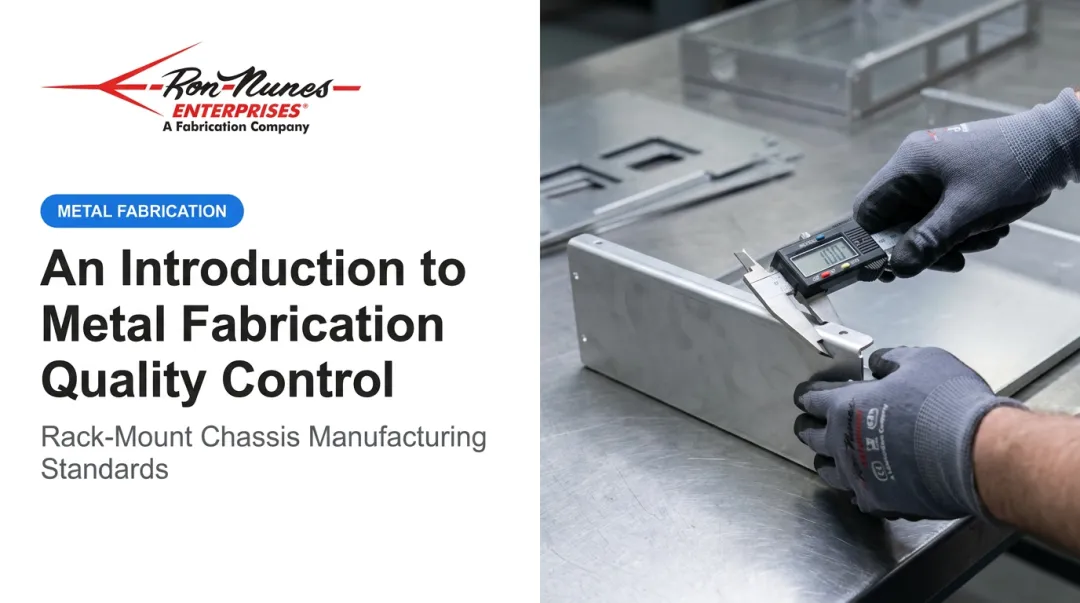
Once the part comes off the floor, it undergoes mechanical, dimensional, and environmental testing against the original requirements. Test results are documented, design changes are flagged, and the cycle repeats. An ASME longitudinal case study from 2020 recorded six development cycles with an average of 19 prototypes per cycle for a hardware startup — iteration can be extensive, especially for complex assemblies.
Prototype Manufacturing Methods: Choosing the Right Approach
Method selection is driven by the prototype's purpose (proof of concept, functional validation, or pre-production), required material properties, tolerance needs, and the downstream production process.
CNC Machining
A subtractive process that removes material from solid stock to produce high-precision metal or plastic parts. Best suited for functional and pre-production prototypes where tight tolerances, surface finish, and material integrity are required.
Published provider benchmarks from Protolabs indicate standard metal CNC tolerances of ±0.005 in, with precision machining options reaching ±0.002 in. Feature-specific capabilities like reamed holes can reach ±0.0005 in. These are provider capability figures — actual results depend on geometry, material, and feature type.
Common applications: aerospace, defense, medical device components.
Sheet Metal Fabrication
Cutting, forming, bending, punching, and welding flat metal sheet into structural components and enclosures. Particularly well-suited for chassis, rack-mount systems, panels, and housings.
A key advantage: when prototype and production use the same fabrication process, design transfer risk drops. Published sheet metal tolerances from Xometry document:
- ±0.010 in — sheet-cut edge to edge
- ±0.015 in — edge to bend
- ±0.030 in — across a bend
- ±1 degree — bend angle
Plan for tolerance accumulation across multi-bend assemblies — formed dimensions loosen as bends stack up.
3D Printing (Additive Manufacturing)
Builds parts layer by layer from digital files. Best for early-stage concept models, complex geometries, and rapid iteration.
Its limitations matter in metal applications:
- FDM parts are anisotropic, meaning strength varies by build orientation
- Surface finish differs substantially from machined or fabricated parts
- A 3D-printed plastic concept model will not validate the structural performance of a machined aluminum enclosure
Injection Molding for Prototyping
Aluminum-tooled prototype injection molds are used when the final product will be injection-molded plastic and early functional testing needs to use production-representative material properties. The tradeoff is upfront tooling cost (significantly higher than CNC or additive methods), so this approach makes sense only after production intent is confirmed and design changes are unlikely.
Key Factors That Affect Prototype Manufacturing Outcomes
Material Selection
Whether you use prototype-grade or production-grade materials affects how valid your test results actually are. Ron Nunes Enterprises uses the same production-grade alloys — 6061-T6 and 5052-H32 aluminum, stainless steel — across prototype and production builds. Using surrogate materials at the prototype stage is a common source of misleading test data when transitioning to volume production.
Tolerance and Precision Requirements
Tighter tolerances extend machining time and cost. The practical ranges differ significantly by method:
| Method | Published Benchmark | Key Limitation |
|---|---|---|
| CNC machining | ±0.005 in standard; ±0.002 in precision | Feature and geometry dependent |
| Sheet cutting | ±0.010 in edge to edge | Cut-face convention matters |
| Press-brake forming | ±0.015 in edge to bend; ±0.030 in across bend | Accumulates across multi-bend parts |
| Industrial FDM | ±0.005 in or ±0.002 in/in (whichever greater) | Anisotropic; geometry and system dependent |
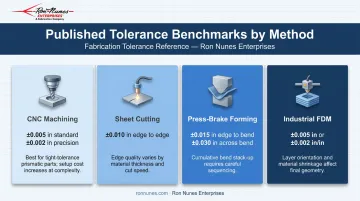
Spec tolerances to match what your production process can actually hold — not tighter than necessary, and not so loose that prototype test data doesn't translate.
Prototype Type and Testing Purpose
A proof-of-concept model has different requirements than a functional prototype or a pre-production unit. Conflating them leads to over-engineering early builds, which wastes budget, or under-specifying late-stage ones, which misses real failure modes.
Manufacturer Capability and Experience
Your manufacturer's equipment and process depth directly determine how fast you can iterate — and how closely your prototype reflects what production will actually deliver. For metal enclosures and structural assemblies, shops like Ron Nunes Enterprises that carry in-house sheet metal, CNC machining, and finishing under one roof cut the time between first build and production-ready part significantly.
Common Misconceptions About Prototype Manufacturing
A few assumptions tend to derail prototype projects before they gain traction. Here are the most common ones worth correcting early:
"One prototype is sufficient." The first build almost always surfaces fit, function, or manufacturability issues that weren't visible on paper. Expecting a single cycle sets unrealistic schedules — most development programs require two or three iterations before a design is ready to hand off.
"The cheapest method is the best choice for early-stage work." Low-cost additive methods work well for concept validation. But a 3D-printed plastic part won't validate the structural performance of a machined aluminum enclosure. Choosing the wrong method — even a cheap one — produces results that don't translate to your actual production process. Correcting that misalignment later costs more than the initial savings justified.
"Prototype manufacturing and production manufacturing are interchangeable." They serve different goals. Prototypes are built for validation and learning; production is built for efficiency and scale. The tooling, fixtures, quality controls, and batch sizes involved are fundamentally different. Treating them as equivalent leads to poor cost estimates, missed timelines, and hard surprises at the production gate.
Understanding these distinctions shapes how you select processes, allocate budget, and set realistic milestones from the first build onward.
Conclusion
Prototype manufacturing is the critical link between a design on paper and a product that functions reliably under real operating conditions. Skipping it, or treating it as a single-pass exercise, doesn't speed up production. It transfers the cost of design problems from a stage where they're cheap to fix to a stage where they aren't.
Success depends on matching the right fabrication method to the right prototype type, defining clear testing criteria before the first build, and working with a manufacturer who can iterate quickly on functional metal parts.
For teams in precision, defense, telecom, medical, or research environments, that means a shop with in-house sheet metal and CNC capabilities — and the process knowledge to catch fabrication problems before they reach production.
Ron Nunes Enterprises has supported custom metal fabrication from prototype through production for over 55 years. The shop serves defense contractors, semiconductor manufacturers, medical device teams, telecommunications equipment suppliers, and national laboratory programs. Custom chassis and fabricated assemblies ship within 15 working days. Contact the team at sales@ronnunes.com or call 1-877-800-RACK to discuss your prototype requirements.
Frequently Asked Questions
What is prototype parts manufacturing?
Prototype parts manufacturing is the process of building a small number of physical parts from a design file or concept to test fit, function, and manufacturability before committing to full production volumes. The output validates the design and identifies issues that aren't visible in a CAD model.
What are the main types of prototypes?
The three main types are: proof-of-concept (validates the core idea), functional prototype (tests real-world performance under actual use conditions), and pre-production prototype (validates the production process itself before scale-up). Each type has different fabrication and material requirements.
How much does prototype parts manufacturing cost?
Costs vary widely based on method, material, complexity, and quantity. As a reference, Protolabs publishes starting prices of approximately $65 for CNC machining, $95 for 3D printing, $100 for sheet metal fabrication, and $1,495 for injection molding (provider-specific floors, not market averages). Part complexity and tolerance requirements determine where your actual cost lands.
Who can manufacture prototype parts?
Prototype parts can be built by specialty prototyping shops, full-service precision fabricators, and digital manufacturing platforms. For metal structural components, enclosures, or chassis, a shop with in-house sheet metal and CNC capabilities is typically the most appropriate choice, ideally one that can carry the same process from prototype through production.
What is the difference between rapid prototyping and standard prototyping?
Rapid prototyping uses fast-turn digital manufacturing methods (3D printing, CNC) to produce iterations in hours or days, prioritizing speed and design exploration. Standard prototyping uses processes that more closely mirror production, with longer lead times but more production-representative materials and geometry.
How do you choose the right manufacturing method for a prototype?
Start with the prototype's purpose (concept validation, functional testing, or pre-production sign-off), then match the method to required material properties, tolerances, and the production process planned at scale. Aligning prototype and production methods reduces design transfer risk and keeps test results meaningful.