This guide is written for pipe fabricators, welding engineers, and QA managers working in semiconductor, defense, medical, and nuclear/physics research settings, where weld integrity, corrosion resistance, and code compliance aren't negotiable line items.
You've probably heard RMD called "the MIG that replaces TIG." That phrase gets thrown around a lot, but the operational details behind it get glossed over just as often. This article covers what RMD actually is, why and where shops use it, how it works step by step, and where its limits show up.
Key Takeaways
- RMD is a closed-loop, modified short-circuit MIG process built for stainless pipe root-pass welding
- It can eliminate back purging on many 300-series stainless grades, cutting setup time and gas cost
- Regulated short circuits limit puddle agitation, enabling faster, more consistent welds than TIG
- Wire, gas, and equipment selection matter; RMD complements TIG rather than replacing it on every job
What Is the RMD Process?
RMD is a patented, modified short-circuit GMAW process developed by Miller Electric. It anticipates each short-circuit event and controls it before it happens, producing a calm, stable arc rather than the erratic pulsing you get from standard short-circuit MIG. The goal is straightforward: consistent, code-quality root passes with minimal spatter and a shorter learning curve for welders.
Here's how it differs from what came before:
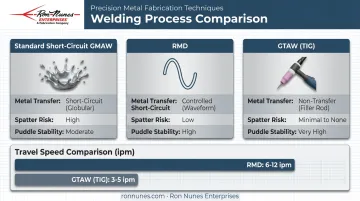
- Standard short-circuit GMAW: Metal transfer happens at irregular intervals. The droplet clears explosively, agitating the puddle and raising the risk of cold lap and spatter.
- RMD: The power source's closed-loop control tapers current as the short circuit begins, then smoothly re-ignites the arc. This produces small, uniform droplets instead of violent transfer.
- GTAW (TIG): Offers excellent puddle control and is the traditional benchmark for stainless root passes, but it's slow and typically requires back purging.
Miller's own published data puts RMD travel speeds at 6-12 inches per minute in fixed positions, compared to 3-5 ipm for GTAW. That's roughly double to triple the speed, according to the manufacturer's benchmark testing rather than an independent study.
One important caveat: RMD isn't a generic MIG setting you can dial in on any machine. It's proprietary technology available only on specific Miller power sources (the PipeWorx system and XMT models paired with ArcReach) running compatible wire feeders. If your shop doesn't have that equipment, you don't have access to RMD.
Why RMD Is Used for Stainless Steel Welding
Fabricators adopt RMD for one primary reason: it removes the back-purge step on many austenitic stainless jobs without sacrificing weld quality. That single change ripples through setup time, argon consumption, and shift output.
Miller's Dixie Mechanical case study documents the shift concretely. Back-purge setup dropped from 20-30 minutes down to 5 minutes or less, and one welder went from completing 10 TIG welds per shift to 20 with RMD. That's a named, documented shop result, not a universal guarantee, but a real data point worth paying attention to.
Regulated industries care about three things above almost everything else:
- Corrosion resistance in the finished joint
- Consistent, predictable penetration
- Welds that pass code-qualification testing (radiographic, bend, tensile, and corrosion testing where applicable)
RMD's controlled metal transfer directly supports all three by reducing the puddle agitation that causes cold lap and inconsistent fusion.
What goes wrong without it? Traditional short-circuit GMAW risks spatter and cold lap from erratic transfer. Conventional back purging, meanwhile, eats setup time, burns through argon, and introduces a genuine hazard: OSHA notes that inert gases including argon and CO2 can displace oxygen and cause asphyxiation, particularly in confined or enclosed spaces like pipe sections.
To be clear, RMD is not code-mandated. No welding code requires it by name. It's an approved procedure once a shop qualifies it through the appropriate destructive and non-destructive testing, but it's increasingly the preferred choice once that qualification is done.
Where RMD Is Applied
RMD shows up most often in:
- Pipe fabrication shops running shop-floor procedures on repeatable joint configurations
- Field pipe welding using engine-driven or portable power sources
- Pressure vessel and tube assembly lines
It's primarily used during new construction root-pass welding and procedure qualification, covering 1G rotating, 5G, and 6G positions. Once a procedure is qualified for a given pipe schedule and stainless grade, RMD becomes a repeatable, production-line process rather than a one-off technique.
Precision fabricators serving regulated sectors apply this same quality mindset even outside pipe work. Ron Nunes Enterprises, operating out of Livermore, California since 1969, staffs TIG and MIG welding stations with Class A/XX certified welders.
The company supports semiconductor, defense, and nuclear/physics research clients, where weld consistency is never optional. That standard holds whether the joint is a pipe root or a chassis seam.
How the RMD Process Works
At a conceptual level, the welding system continuously monitors arc voltage and current, anticipating each short circuit before it fully occurs. Three inputs drive the process:
- Stainless filler wire: typically high-silicon ER308L or ER316L
- Shielding gas: a tri-mix of helium/argon/CO2 or a simpler argon/CO2 blend
- A power source running RMD firmware: the machine's waveform control technology
As a short circuit begins, the machine tapers current to prevent an explosive metal transfer, then smoothly re-ignites the arc. The result is a small, uniform droplet instead of a splash. Wire feed speed and travel speed remain in the welder's hands, but the current waveform itself is machine-controlled.
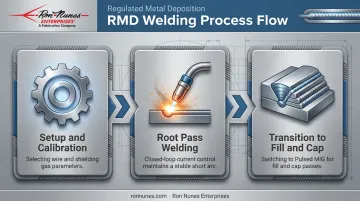
Step 1: Setup and Calibration
The welder selects the correct wire diameter and shielding gas for the pipe position and stainless grade, then sets the machine to its RMD welding program. This step determines much of the downstream success: wrong wire size or gas mix undercuts the process before the arc even strikes.
Step 2: Root Pass Welding
Once the arc initiates, RMD continuously adjusts current at each short-circuit event. The welder manages travel speed and torch angle while the process itself handles droplet control. This closed-loop behavior lets RMD bridge minor gaps or fit-up misalignment that would trip up a less forgiving process.
Step 3: Transition to Fill and Cap
After the root pass reaches sufficient throat thickness, the same wire and gas transition into a Pulsed MIG process for fill and cap passes. This eliminates a separate hot pass and reduces changeover time between passes, tightening the overall welding schedule.
Key Factors, Common Misconceptions, and When RMD May Not Be the Right Fit
Key Factors That Affect Weld Quality
Two variables drive most of RMD's success or failure:
- Filler wire and gas selection: High-silicon 308L/316L wire (0.9-1.2mm, equipment-dependent) pairs with a tri-mix helium/argon/CO2 blend or a simpler argon/CO2 mix. This choice directly affects puddle stability and no-purge reliability.
- Base material and wall thickness: RMD performs reliably on common 300-series stainless like 304 and 316. Duplex and super-duplex alloys often still need a back purge regardless of RMD's capabilities.
Common Misconceptions
Two myths keep circulating in shops:
- "RMD is just MIG with a different name." It isn't. Closed-loop current control at each short circuit is the defining difference from standard short-circuit GMAW.
- "RMD eliminates back purge, period." Not universally true; it depends on stainless grade, wall thickness, and joint fit-up. Equipment manufacturer guidance still recommends purge gas for duplex and super-duplex materials even when running RMD.
When RMD May Not Be Appropriate
Consider back purging or an alternative process when:
- You're welding thick-wall, duplex, or exotic alloy piping where reliability matters more than speed
- Field conditions provide inconsistent power access, and RMD's ArcReach systems require stable three-phase input
- Pipe diameter drops below roughly 2 inches, where welder experience requirements make RMD less practical without dedicated training
Conclusion
RMD is a regulated, closed-loop MIG process engineered to deliver faster, more consistent, and often purge-free root-pass welds on stainless steel pipe.
For industries where corrosion resistance and code compliance define whether a part passes inspection — semiconductor, defense, medical, and nuclear/physics research among them — the stakes are high. Understanding what this process can and can't do matters more than chasing the newest technique.
Matching the right welding process to the right application, rather than defaulting to whatever's trendy, is what separates a qualified procedure from a liability. Full-service fabricators who've spent decades in regulated industries bring that judgment to every project.
Ron Nunes Enterprises has supported semiconductor, defense, and nuclear/physics research clients since 1969. That same precision mindset applies whether the work involves specialized welding procedures or custom metal fabrication built to exact specifications.
Frequently Asked Questions
What is RMD in welding?
RMD (Regulated Metal Deposition) is Miller Electric's modified short-circuit MIG process. It precisely controls metal transfer at each short circuit to produce high-quality, low-spatter root-pass welds on stainless pipe.
What type of welding is best for stainless steel?
GTAW (TIG) remains the traditional choice for high-purity applications. Modified GMAW processes like RMD now deliver comparable root-pass quality with better productivity in many stainless pipe applications.
What gas is used in RMD welding?
Common choices are a tri-mix of helium/argon/CO2 or a simpler argon/CO2 blend. Selection depends on budget and the specific demands of the application.
Can RMD eliminate the need for back purging?
RMD can eliminate back purging on many 300-series stainless grades because undisturbed shielding gas reaches the joint backside. Thicker walls or exotic alloys like duplex stainless may still require a purge.
What filler wire is used with RMD welding?
High-silicon ER308L or ER316L MIG wire, typically in 0.9-1.2mm diameters depending on the equipment and welding position, offers the best weldability and puddle control.
Is RMD welding difficult to learn?
No — RMD's stable, controlled arc shortens the learning curve compared to standard short-circuit GMAW or traditional TIG root-pass technique. The machine handles much of the droplet control automatically.