The choice matters more than it might seem. Get it wrong and you're looking at inflated costs, parts that don't perform, or lead times that blow your schedule. Get it right and you've optimized for geometry, precision, volume, and budget simultaneously.
This guide covers a direct side-by-side comparison, what each process actually does well, and a practical decision framework so you can choose the right method for your specific project requirements.
TL;DR
- CNC machining is a subtractive process — it carves parts from solid material blocks with high precision using computer-controlled cutting tools
- Sheet metal fabrication shapes flat metal sheets through cutting, forming, and joining operations
- CNC machining suits complex 3D geometries and tight tolerances; sheet metal fabrication is better for enclosures, brackets, and high-volume hollow structures
- Sheet metal fabrication is generally more cost-effective for simpler designs at scale; CNC machining costs more per part but is justified when precision or geometry complexity demands it
- The right process depends on part geometry, tolerances, production volume, material, and budget; many projects combine both methods
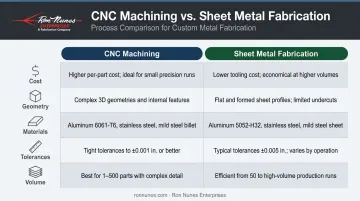
CNC Machining vs Sheet Metal Fabrication: Quick Comparison
| Factor | CNC Machining | Sheet Metal Fabrication |
|---|---|---|
| Cost | Higher per-part cost; cost-effective for low-volume, high-complexity work | Lower per-part cost at scale; setup varies by operations involved |
| Geometry | Complex 3D features, blind pockets, undercuts, threads, tight contours | Flat, hollow, angular, folded shapes; limited in solid 3D features |
| Materials | Metals, plastics, wood, glass, ceramics | Predominantly metals (aluminum, stainless, carbon steel, copper) |
| Tolerances | Very tight (5 µm machine positioning accuracy on high-end CNC equipment) | Reasonable but less tight; manual operations introduce more variability |
| Volume | Best for prototypes, one-offs, low-to-mid batch runs | Highly scalable; integrates into automated production lines |
What Is CNC Machining?
CNC (Computer Numerical Control) machining is a subtractive manufacturing process. Computer-controlled cutting tools remove material from a solid block until the finished part geometry is achieved. The machine follows a pre-programmed toolpath, holding tolerances that manual cutting cannot match.
Two primary operations cover most metal part applications:
- CNC milling — a rotating cutting tool removes material from a stationary workpiece, producing pockets, contours, flat surfaces, and holes
- CNC turning — the workpiece rotates in a chuck while a stationary tool cuts it, producing cylindrical, conical, and helical geometries
CNC drilling and routing handle additional feature types as supplementary operations.
Core Advantages for Industrial Applications
- Repeatable dimensional accuracy across production runs
- Complex geometry achievable without human intervention at the cutting stage
- Compatible with a broad material range: aluminum, stainless steel, titanium, tool steels, and non-metals
- DMG MORI's ULTRASONIC 60 Precision specifies 5 µm machine positioning accuracy — that's roughly the width of a human hair, split in half
Key Limitations
- Generates scrap on every job — parts are carved from solid stock, so material costs add up
- Processes one part at a time, which slows high-volume production runs
- Requires longer machine time and more programming as feature complexity increases
- Demands experienced operators for programming, fixturing, and setup
Use Cases for CNC Machining
CNC machining fits where geometry or precision rules out simpler processes:
- Rapid prototyping of precision components with complex features
- Engine components, jigs, fixtures, and tight-tolerance housings
- Aerospace: airframe brackets, turbine components
- Medical: implants and prosthetics requiring exact dimensional control
- Defense: precision housings and weapon system components
- Semiconductor equipment: vacuum chamber components, O-ring grooves, and sealing surfaces
When flat stock, bends, or enclosures are the goal rather than machined geometry, sheet metal fabrication takes over — often at lower cost and higher throughput.
What Is Sheet Metal Fabrication?
Sheet metal fabrication transforms flat metal sheets into functional parts, structures, and assemblies through a sequence of operations. Unlike CNC machining's subtractive approach, forming operations reshape material without removing it, which reduces waste and keeps per-unit costs lower at volume. Three operation categories drive the process:
- Cutting: Laser cutting, shearing, plasma cutting, and waterjet cutting produce shapes from flat sheet stock. TRUMPF defines laser cutting as contact-free slitting where a focused beam heats material until it melts or vaporizes.
- Forming: Press brake bending, stamping, and rolling alter sheet geometry without removing material
- Joining: TIG welding, MIG welding, spot welding, brazing, and mechanical fastening assemble separate pieces into finished structures
Core Advantages
- Large-scale parts that exceed CNC machine build envelopes
- Scalable and integrable into automated production lines
- Multiple material options: aluminum, stainless steel, cold rolled steel, galvanized steel, copper
- Lower per-unit cost at volume compared to subtractive processes
Key Limitations
- Limited to metal materials
- Hollow and flat geometries restrict design complexity
- Manual operations (welding, assembly) introduce more variability than CNC machining
- Forming can alter material properties through work hardening and stress concentration
Ron Nunes Enterprises' Sheet Metal Capabilities
Ron Nunes Enterprises, based in Livermore, California, has operated as a full-service sheet metal fabrication facility since 1969. Their in-house production sequence for a custom rack mount chassis illustrates how the operations chain together:
| Step | Operation | Purpose |
|---|---|---|
| 1 | Shearing | Cut raw aluminum or stainless sheet to blank size |
| 2 | Laser Cutting / N/C Punching | Create profiles, ventilation holes, cutouts, louvers |
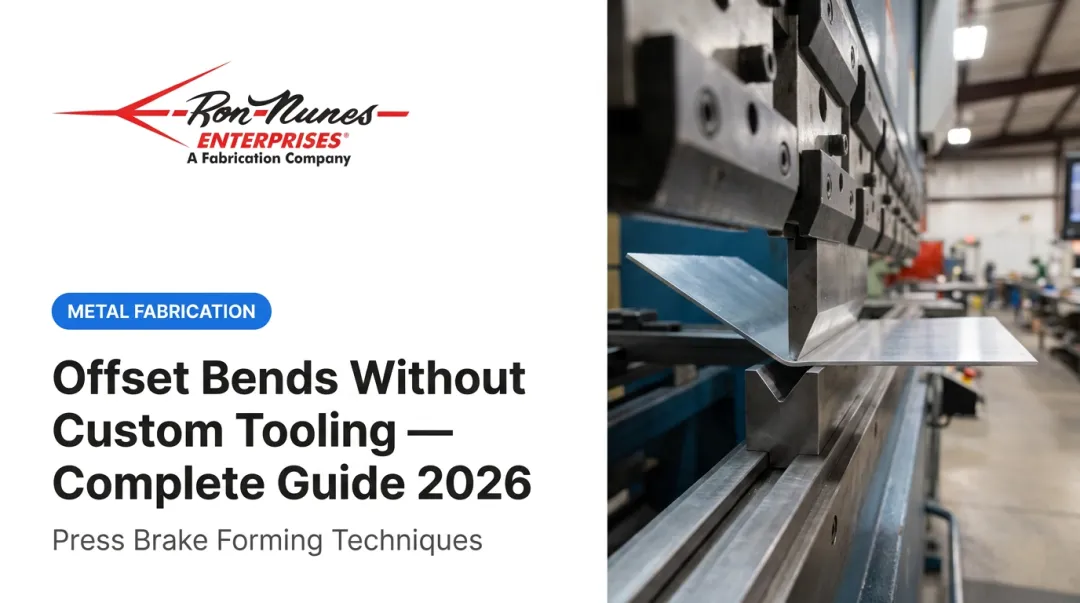
| 3 | Press Brake Forming | Bend flat panels into 3D chassis geometry |
| 4 | Hardware Installation | Insert fasteners and standoffs via hydraulic press |
| 5 | Welding | Join structural components (TIG, MIG, spot, or stud) |
| 6 | Finishing | Deburr, grain, apply MIL-spec chemical film or anodize |
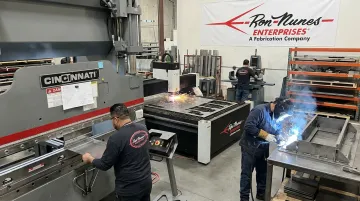
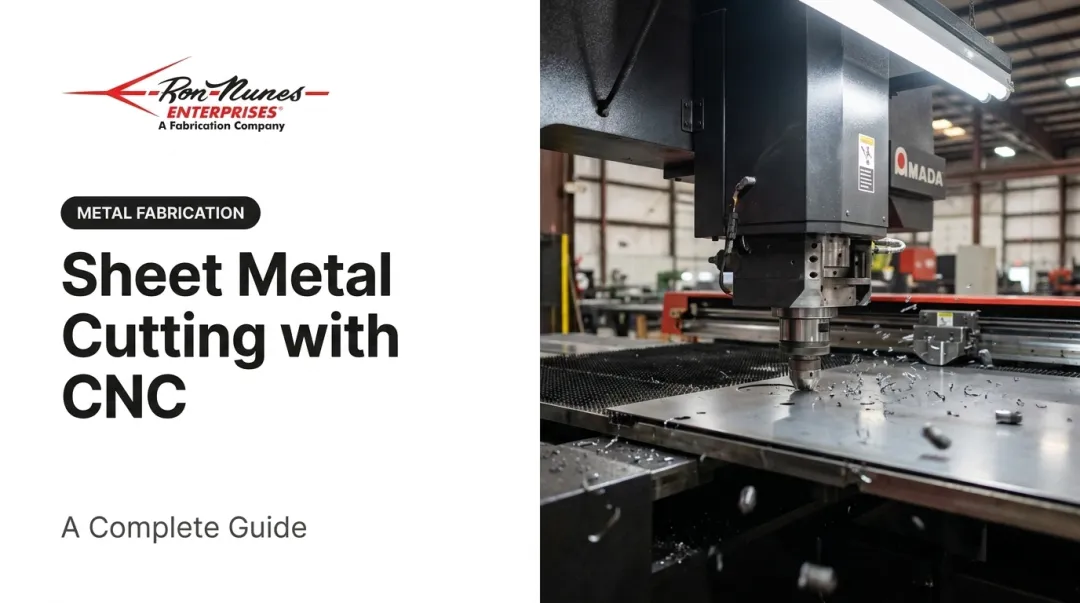
Their Amada CNC turret punch presses — including a 58-station Amada-Pega-357 with Auto Index — handle repetitive hole patterns, louvers, and complex angular features faster and more cost-effectively than laser cutting for high-volume runs. MIL-spec finishes (MIL-C-5541E chromate conversion, MIL-A-8625E anodize) are standard options for defense and government procurement.
Use Cases for Sheet Metal Fabrication
This same production sequence scales across industries wherever flat-form structures, hollow assemblies, or high-volume output are priorities:
- Telecommunications: rack mount chassis, server enclosures, 19-inch rack hardware
- Transportation: structural panels, brackets, mechanical assemblies
- Defense: equipment housings, MIL-spec enclosures
- Electronics: control cabinets, enclosures
- Nuclear and physics research: precision chassis for laboratory rack systems
- Construction: HVAC ductwork, architectural panels
CNC Machining vs Sheet Metal Fabrication: Which Is Better?
There is no universal winner. The right process is determined by the specific requirements of each project. Five factors should drive the decision:
Part geometry, required tolerances, material type, production volume, and budget.
Geometry Is the Primary Differentiator
This is where the decision usually gets made first.
- 3D solid features, deep pockets, integrated threads, undercuts, complex curved contours → CNC machining
- Flat, hollow, angular, or fold-achievable geometry → sheet metal fabrication
If your design can be built by bending and joining flat sheets, sheet metal fabrication is more cost-effective. If it can't, CNC machining is the right tool.
Production Volume and Scalability
CNC machining is cost-effective for low volumes — prototypes, custom one-offs, small batch runs. At high volumes, it becomes expensive because most machines process one part at a time.
Sheet metal fabrication scales efficiently. TRUMPF documents a customer — Airforce Laser — that achieved a 50% improvement in programming and production efficiency after implementing production automation. Operations like laser cutting, punching, and stamping integrate into automated lines without proportional cost increases at scale.
Clear Decision Rules
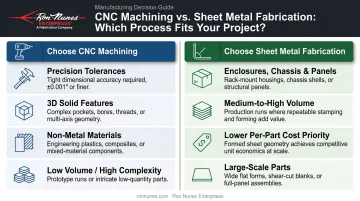
Choose CNC machining when:
- Tolerances require machine-level precision (5 µm positioning accuracy range)
- Part design includes 3D solid features, undercuts, or deep pockets
- Material is non-metal (plastic, ceramic, glass)
- Production volumes are low and complexity is high
Choose sheet metal fabrication when:
- Part is an enclosure, panel, bracket, chassis, or hollow structural assembly
- Production volume is medium to high
- Lower per-part cost is a priority and design allows flat-form construction
- Large-scale parts exceed practical CNC build limits
Real-World Industry Applications
Telecommunications and defense rely heavily on sheet metal fabrication for rack mount chassis, server enclosures, and equipment housings. The priority is flat-form construction, standardized 19-inch rack compatibility per IEC 60297-3-100, and high-volume production. Ron Nunes Enterprises has delivered EIA-310d compliant rack chassis — in configurations from 1U to 9U, depths from 8 to 26 inches — to telecom, defense, and national laboratory customers including Lawrence Livermore National Laboratory.
Aerospace and medical depend on CNC machining for brackets, implants, housings, and structural components where tight tolerances and complex geometries are non-negotiable. Makino documents aerospace interior component machining on automated horizontal machining centers, illustrating how CNC automation handles precision at scale.
Using Both Together
Many industrial products use both processes within the same program. A telecommunications rack enclosure is sheet metal fabricated for its chassis and housing, while precision internal mounting components, connector brackets, and sub-assemblies with tighter tolerances are CNC machined.
NASA Johnson Space Center lists precision machining, sheet metal fabrication, welding, and assembly within a single manufacturing organization — co-located hybrid capability is standard practice in high-precision environments.
Ron Nunes Enterprises has fabricated precision rack chassis and custom metal assemblies for defense, telecom, semiconductor, and industrial customers since 1969. Reach the team at sales@ronnunes.com or 1-877-800-7225.
Conclusion
CNC machining and sheet metal fabrication are complementary processes optimized for different design needs. The stronger choice depends entirely on what your part actually demands.
- CNC machining delivers unmatched accuracy for precision solid components with complex features, tight tolerances, and material versatility
- Sheet metal fabrication provides the efficiency, scalability, and cost-effectiveness that enclosures, chassis, panels, and structural assemblies demand at production volumes
The right choice comes down to geometry, tolerances, volume, and budget — evaluated against each project's specific requirements. For complex manufacturing programs, both processes are often deployed together — CNC machining for precision internals, sheet metal fabrication for the enclosures and structural assemblies surrounding them. Ron Nunes Enterprises has supported that kind of mixed-process work across defense, semiconductor, and industrial applications since 1969.
Frequently Asked Questions
What is CNC sheet metal?
CNC sheet metal fabrication refers to using CNC technology to automate and control sheet metal operations — including laser cutting, punching, and press brake bending. It combines the precision of computer-controlled automation with the versatility of sheet metal as a starting material form.
What is the cheapest metal to CNC machine?
Aluminum is one of the most cost-effective metals for CNC machining due to its fast cutting speeds and low material cost. Aluminum 6061 is the standard choice for prototypes and precision parts; 7075 offers higher strength but is harder to machine and costs more.
What are the main differences between CNC machining and sheet metal fabrication?
CNC machining is a subtractive process that carves parts from solid stock, excelling at complex 3D geometries and tight tolerances. Sheet metal fabrication shapes flat metal sheets through cutting, forming, and joining — making it better suited for enclosures, panels, chassis, and high-volume structural components.
Which is faster: CNC machining or sheet metal fabrication?
Speed depends on part type and volume. CNC machining can produce individual precision parts quickly, but sheet metal fabrication is faster for high-volume production runs because laser cutting, punching, and stamping integrate into automated production lines at scale.
Can CNC machining and sheet metal fabrication be used together?
Yes — many industrial products use both. A telecommunications rack enclosure may be sheet metal fabricated for its chassis and housing while precision internal mounting components or sub-assemblies are CNC machined to meet tighter tolerance requirements.
Is sheet metal fabrication cheaper than CNC machining?
Sheet metal fabrication is generally more cost-effective for simpler designs, large structures, and high-volume production. CNC machining carries higher per-part costs due to material waste and setup time, but is justified when part geometry, tolerances, or material requirements exceed what sheet metal processes can deliver.