Fiber laser cutting has become the go-to method for aluminum in industrial settings, and for good reason. Still, the process has real challenges that catch shops off guard if they're not prepared.
This guide covers why fiber lasers work well for aluminum, the specific challenges you'll encounter, what parameters matter most, how thick fiber lasers can realistically cut, and what separates a good outcome from a scrap bin.
Key Takeaways
- Fiber lasers operate at ~1070 nm — a wavelength aluminum absorbs far better than CO₂ laser wavelengths
- Nitrogen is the correct assist gas; oxygen causes burning and should be avoided entirely
- Aluminum's high reflectivity and thermal conductivity require careful parameter tuning per alloy
- Practical production cutting covers 1mm to approximately 25mm depending on laser power
- Material prep, focus position, and operator setup are just as important as machine specs
Why Fiber Lasers Work Well for Cutting Aluminum
Wavelength and Absorption
IPG's YLS fiber lasers operate at approximately 1070 nm, while CO₂ lasers like TRUMPF's TruFlow run at 10.6 µm — a wavelength roughly ten times longer. Aluminum absorbs the shorter fiber wavelength significantly better, and that difference shows up directly in cut quality and speed.
Research confirms this: cold-rolled commercially pure aluminum shows ~16% absorption at 1053 nm, while certain cold-rolled alloys like AA5251 and AA6082 reach 24% absorption at similar wavelengths. These numbers may seem low in absolute terms, but they represent a substantial edge over CO₂ absorption on aluminum — enough to translate into faster cutting speeds, cleaner edges, and more consistent results across aluminum alloys.
Precision and Efficiency Advantages
That absorption advantage carries through to real production benefits. Fiber lasers deliver:
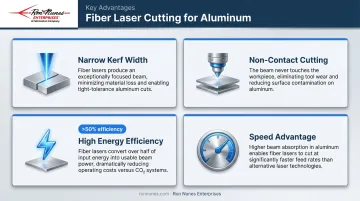
- Narrow kerf widths from a tightly focused beam — critical for tight-tolerance defense, semiconductor, and telecom components
- Non-contact cutting that eliminates tool wear and keeps parts uncontaminated between runs
- High energy efficiency — IPG's standard high-power fiber lasers exceed 40% electrical efficiency, with their YLS-ECO series topping 50%. Bystronic reports fiber electrical efficiency can reach up to five times that of CO₂ systems. At production volumes, that gap has a direct impact on operating costs.
- Speed advantage — fiber is consistently faster than CO₂ on aluminum, particularly at thinner gauges where the speed gap is most pronounced
Key Challenges of Fiber Laser Cutting Aluminum
Aluminum isn't a forgiving material to laser cut. These are the four issues that cause the most problems.
Reflectivity
Aluminum's polished surface reflects laser energy — including back toward the cutting head. Modern fiber laser systems address this with hardware-based back-reflection protection. nLIGHT explicitly builds this into their systems, and Coherent claims back-reflection immunity on their fiber laser line.
The practical takeaway: mirror-finish or highly polished aluminum remains more challenging than mill-finish stock. Always confirm your cutting system has back-reflection protection before running these materials.
Thermal Conductivity
Aluminum dissipates heat fast. Compare the thermal conductivity of common alloys:
| Alloy | Thermal Conductivity |
|---|---|
| 6061-T6 | 167 W/m·K |
| 3003-H14 | 159 W/m·K |
| 5052-H32 | 138 W/m·K |
That rapid heat dissipation means the cutting zone cools quickly. If power, speed, and focus aren't properly balanced, you get incomplete penetration, excess burr formation, or warping — especially on thin gauges.
Burr and Dross Formation
Dross — resolidified metal along the cut edge — is a direct result of incorrect cutting parameters. It requires secondary finishing to remove, adding time and cost. The three main causes:
- Assist gas pressure too low to clear molten material from the kerf
- Cutting speed mismatched to material thickness and power level
- Focus position shifted off the optimal depth for the alloy
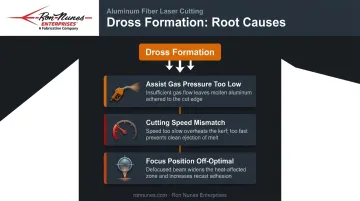
Dialing in these variables during test cuts — before committing to a production run — is the most reliable way to eliminate dross.
Alloy Variation and Surface Condition
Different alloys have different thermal and optical properties, so parameters that work for 5052-H32 may not transfer directly to 6061-T6. Each alloy warrants its own test cuts.
Surface condition matters equally. Any of the following will change how the beam interacts with the metal:
- Oxidation or anodized coatings
- Oil residue or forming lubricants
- Painted or coated surfaces
Start with clean, degreased stock for consistent, repeatable results.
Recommended Fiber Laser Settings for Aluminum
Five parameters govern cut quality: laser power, cutting speed, focus position, assist gas type and pressure, and nozzle standoff distance. They interact — adjusting one affects the others. Tune them together.
Assist Gas: Always Nitrogen
TRUMPF's fusion cutting documentation confirms that nitrogen at 2–20 bar performs inert-gas fusion cutting, expelling molten material while shielding edges from oxidation. The result is a bright, oxide-free edge.
- Nitrogen is the standard choice: it prevents oxidation and produces clean, bright edges
- Compressed air works for non-critical cuts where slight oxidation is tolerable and cost matters
- Avoid oxygen entirely — it causes burning and heavy discoloration
Focus Position
The Fabricator's documentation on aluminum cutting describes setting the focal point deep below the surface, so molten material passes through the beam's highest-intensity region as it exits. Incorrect focus is one of the most common causes of poor edge quality.
For aluminum, set a slightly negative focus and adjust depth based on material thickness.
Power, Speed, and Iterative Testing
Higher laser power allows faster cutting speeds while maintaining quality — no universal chart covers every machine, alloy, and thickness combination. Manufacturer presets give you a baseline; from there, dial in through testing:
- Run test cuts on the specific alloy and thickness
- Evaluate edge quality: check for smoothness, absence of dross, and a square cut face
- Adjust one variable at a time, systematically
- Confirm results at production speed before committing — a clean test cut at reduced speed doesn't guarantee production performance
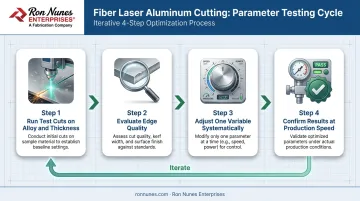
Shops with deep aluminum experience compress this cycle significantly. New setups can take multiple iterations.
How Thick Can a Fiber Laser Cut Aluminum?
The capability depends on machine power. Published maximums from leading manufacturers:
| Laser Power | Maximum Aluminum Thickness |
|---|---|
| 4 kW | 20 mm |
| 6 kW | 25 mm |
| 9 kW | 30 mm |
| 12 kW | 40 mm (with thick-sheet package) |
| 24 kW | 40 mm |
| 30 kW | 50 mm |
Source: TRUMPF TruLaser 3030 series and Bystronic ByStar Fiber
These are rated maximums — not optimal production operating points. Beyond 8–10mm, edge quality management becomes more demanding: nitrogen pressure and focus calibration require tighter control, and cutting speed drops substantially.
Practical production sweet spot: 1mm to approximately 12mm covers the vast majority of industrial aluminum cutting work at reasonable speed, quality, and cost.
Industries and Applications
Precision fiber laser cut aluminum sits at the center of several demanding industries:
- Aerospace and defense — structural brackets, enclosures, MIL-spec chassis systems
- Semiconductor — equipment housings, precision structural components
- Telecommunications and data centers — rack mount chassis, 19-inch rack enclosures, equipment panels
- Transportation — structural panels, brackets, infrastructure components
- Medical devices — equipment housings and instrument components
In defense and telecom specifically, dimensional precision and edge quality are hard requirements, not preferences. Components feed directly into assemblies with tight tolerances, and a poor cut edge can compromise downstream forming, welding, or assembly.
Ron Nunes Enterprises has served these sectors for over 55 years from their Livermore, California facility. Their standard rack mount chassis systems — built from 6061-T6 and 5052-H32 aluminum to EIA-310d specifications with MIL-C-5541E chromate conversion finishes — go directly into defense electronics, semiconductor equipment, and telecom rack installations.
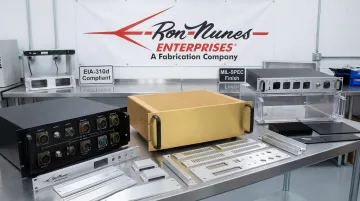
Specification documents reference Lawrence Livermore National Laboratory stock numbers, reflecting long-standing supply relationships with government research facilities.
Their downstream capabilities — press brake forming, TIG and MIG welding, hardware installation, and MIL-spec finishing — mean customers receive finished assemblies rather than raw parts that require additional vendor coordination.
Best Practices for High-Quality Aluminum Laser Cuts
Start With Clean, Flat Material
Surface contamination, oxidation, or warped sheet stock will degrade cut quality regardless of how well the laser is dialed in. Flat, degreased aluminum is the baseline.
Design Parts for the Process
Part designers can reduce cost and improve cut quality by following a few guidelines:
- Maintain minimum feature sizes relative to material thickness — very small features in thick material are difficult to cut cleanly
- Avoid extremely tight inside radii in heavier gauges
- Minimize unnecessary geometry complexity that adds cut time without functional benefit
- Consult the fabricating shop early — design for manufacturability (DFM) input before finalizing drawings prevents expensive redesigns
Partner With Shops That Know Aluminum
Achieving consistent results across different alloys and thicknesses requires accumulated process knowledge, not just capable equipment. Shops that cut aluminum regularly know how to dial in parameters quickly, which reduces scrap and rework on your parts.
That process depth matters even more when you need more than a cut part. For buyers outsourcing laser cutting, a fabrication partner with full downstream capabilities — forming, welding, finishing, and assembly — reduces handoffs, compresses lead times, and provides a single point of accountability. Ron Nunes Enterprises has operated as that kind of full-service shop since 1969, handling laser cutting alongside forming, welding, and finishing under one roof in Livermore, California.
Frequently Asked Questions
Can a fiber laser cut aluminum?
Yes. Fiber lasers operating at approximately 1070 nm are far better absorbed by aluminum than CO₂ wavelengths at 10.6 µm, making them the preferred technology for industrial aluminum fabrication today.
How thick can a fiber laser cut aluminum?
At 6 kW, fiber lasers reach 25mm; at 30 kW, up to 50mm is achievable. For production work, the most practical and cost-efficient range is 1mm to approximately 12mm, where speed and edge quality are well-balanced.
What are the recommended fiber laser cutting settings for aluminum?
Five parameters must be tuned together and validated with test cuts before production runs:
- Laser power matched to material thickness
- Cutting speed
- Slightly negative focus position
- Nitrogen assist gas at appropriate pressure
- Correct nozzle standoff distance
What assist gas should be used when fiber laser cutting aluminum?
Nitrogen is the standard choice: it prevents oxidation and produces clean, bright edges. Compressed air works for less critical applications. Oxygen should never be used on aluminum; it causes burning and discolors the cut edge.
How does fiber laser cutting compare to plasma or waterjet for aluminum?
Fiber laser offers superior precision — tolerances around ±0.001 inch versus ±0.010 inch for plasma. Compared to waterjet, fiber laser is faster and more cost-effective for thin-to-medium thicknesses, though waterjet handles very thick stock and leaves no heat-affected zone.