Choosing the wrong fabrication partner in this environment means missed deadlines, out-of-spec components, and costly re-qualification cycles. Choosing the right one means a supplier who understands your tolerances, your industry's documentation requirements, and your production schedule.
This guide covers everything buyers need to know: the core fabrication processes, rack mount chassis specifics, the industries that depend on them, and the criteria that separate a reliable Bay Area fabricator from a generic job shop.
Key Takeaways
- Full-service shops handle cutting, forming, welding, and finishing under one roof
- Rack mount chassis require tight EIA-310 dimensional compliance for universal 19-inch rack compatibility
- Defense, telecom, semiconductor, and research sectors drive steady demand for precision-built enclosures
- Stock chassis can ship within 3 working days; custom chassis typically deliver within 15 working days
- Caltrans DBE certification enables access to government and public-agency contracts
What Is Metal Fabrication and Why It Matters in the Bay Area
Metal fabrication is the process of transforming raw metal stock — sheet, plate, tube, bar — into functional components or complete assemblies through cutting, shaping, joining, and finishing operations. The output ranges from a single prototype bracket to full production runs of complex enclosures.
The Bay Area creates a uniquely concentrated demand for this work. The San Francisco Bay Region generated $6.8 billion in direct national-security spending and supported 49,000 total FTE jobs in FY2019, according to a California statewide national security economic impact report.
Add California's 627 semiconductor manufacturing establishments and the region's dense telecom infrastructure buildout, and the demand profile becomes specific: this market needs fabricators who can meet strict dimensional, material, and finish specifications — not just cut metal.
Metal fabrication also spans a wide range of distinct processes. A shop with end-to-end capabilities — covering all of the following under one roof — removes the vendor handoffs that introduce delays and quality gaps:
- Cutting: laser, plasma, punching, shearing
- Forming: press brake bending, stamping
- Joining: TIG/MIG welding, hardware installation
- Finishing: chromate conversion, powder coat, passivation, plating
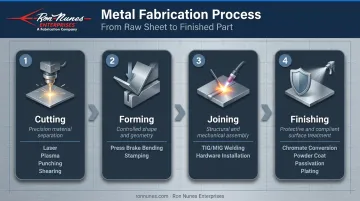
Core Metal Fabrication Processes: From Cutting to Finishing
Laser Cutting and N/C Punching
Laser cutting delivers high-accuracy cuts on sheet metal with minimal material waste, handling complex geometries and tight tolerances that conventional cutting can't achieve. It's the preferred method for defense and telecom components where profile accuracy is critical. Modern laser equipment routinely holds a mean bidirectional positioning error of 0.05 mm — positioning precision that matters when cutting defense-grade panels or telecom chassis with tight hole tolerances.
N/C (numerically controlled) punching complements laser cutting for high-volume work. Where laser cutting excels at complex profiles, CNC turret punch presses excel at repeatable hole patterns, louvers, and cutouts across large panel runs. For customers running high-volume rack panel or enclosure programs, Ron Nunes Enterprises operates Amada Pega-357 and Amada Octo-334 CNC turret punch presses, both with Auto Index capability — enabling complex hole patterns on rack panels and enclosure faces without manual repositioning between operations.
Shearing and Press Brake Forming
Shearing is the first step in most fabrication workflows: straight-line blanking of sheet and plate stock to size. It's fast, cost-effective, and sets the foundation for downstream operations.
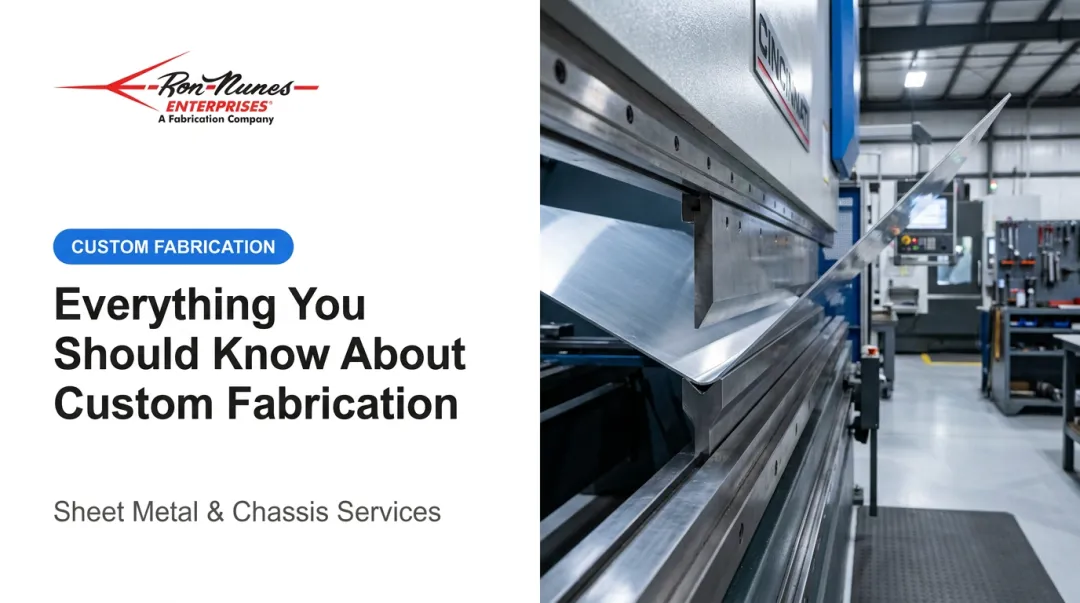
Press brake forming takes flat blanks and bends them into angles, channels, boxes, and multi-bend profiles. Forming accuracy directly affects how well components fit together — even a slight deviation in a chassis bend translates to misalignment at assembly.
The Cincinnati 175T Form Master II hydraulic press brake (one of several forming machines at Ron Nunes Enterprises) uses servo-controlled linear encoders to continuously monitor bed-to-ram position, delivering the repeatability that defense, semiconductor, and medical customers require.
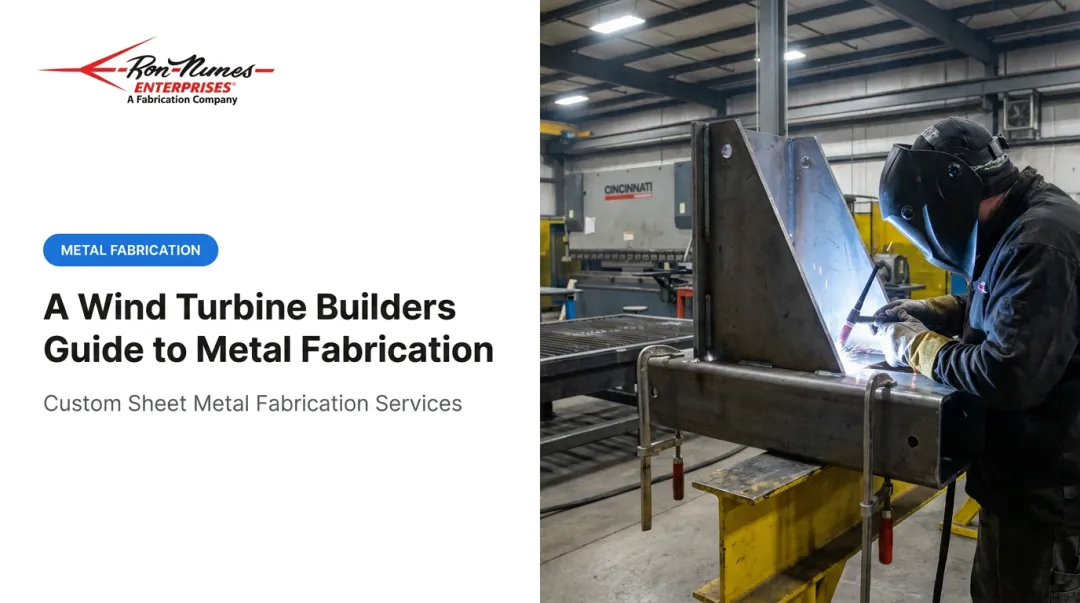
Welding
Welding joins fabricated components into complete assemblies. Two distinct approaches matter here:
- Structural welding — MIG and spot welding for load-bearing joints in frames, cabinets, and heavy enclosures
- Precision welding — TIG welding for thinner-gauge materials, cosmetic joints, and sealed enclosures where appearance and weld integrity both matter
Ron Nunes Enterprises fields five Miller TIG welders, five Hobart MIG units, Federal spot welding equipment, and TRW Nelson stud welders — operated exclusively by Class A/XX certified welders.
Assembly and Finishing
Finishing completes the part for end-use. The choice of finish depends heavily on the application:
- MIL-DTL-5541F chemical conversion coating (current designation, superseding MIL-C-5541E) for aluminum chassis requiring corrosion protection and electrical conductivity
- Anodizing per MIL-A-8625E for wear-resistant surfaces on hardware components
- Powder coat and wet paint for aesthetic and environmental protection requirements
In-house assembly (hardware installation, riveting, weldments) eliminates the outsourced finishing step that extends lead times at other shops.
Rack Mount Chassis and Precision Assembly: A Bay Area Specialty
What Rack Mount Chassis Are
Rack mount chassis are standardized enclosures designed to fit 19-inch equipment racks, defined by the EIA/ECA-310-E standard (the active edition maintained by ECIA's EIA Standards Committee). They're used in telecom switching, data infrastructure, defense electronics packaging, and research instrumentation — anywhere equipment needs to mount consistently in a standardized rack environment.
That standardization has a precise dimensional basis: the 17-inch panel width is the industry standard for equipment that fits inside 19-inch racks, with the 2-inch difference accounting for mounting rail hardware on each side.
Engineering Considerations
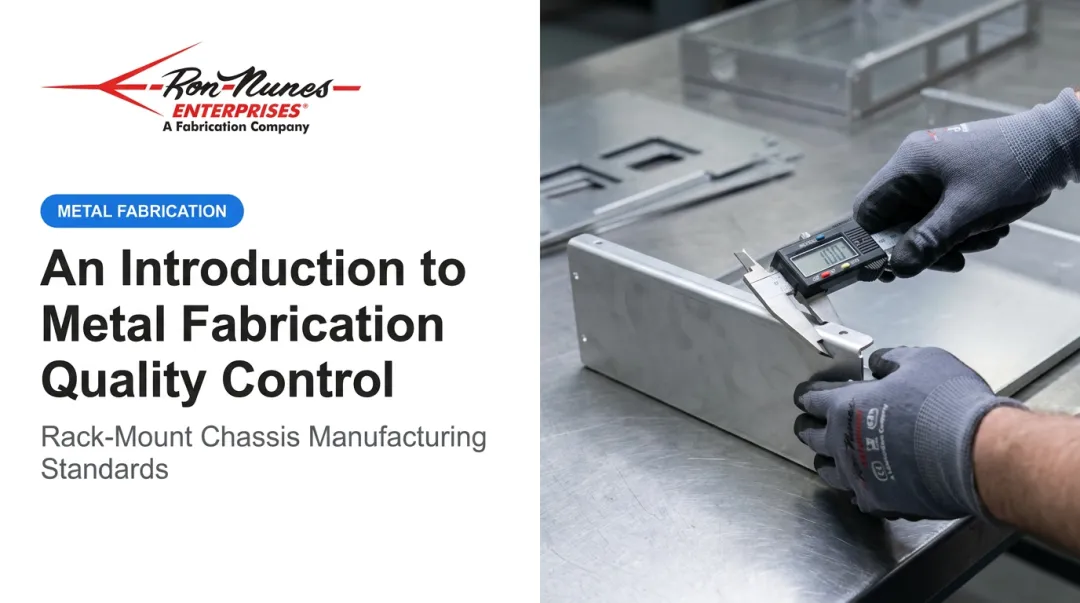
Rack chassis fabrication isn't simply sheet metal bending. The tolerances and consistency requirements are precise:
- Hole pattern accuracy for mounting rails must align with EIA rack unit increments (1.75 inches per U)
- Panel cutout precision for connectors, displays, and cable access affects both fit and appearance
- Material selection — aluminum for weight-sensitive or RF-shielded applications; steel for structural load or cost-sensitive configurations
- Finish selection — MIL-spec chromate conversion for government and defense environments; anodize or paint for commercial applications
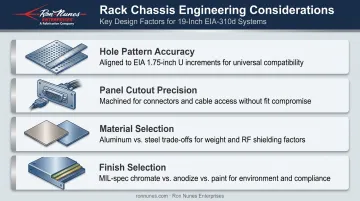
Ron Nunes Enterprises' Rack Chassis Capability
Ron Nunes Enterprises, based in Livermore, CA, specializes in 17-inch chassis configured for standardized 19-inch racks. The standard product line spans:
- Heights: 1U through 9U (1.75" to 15.75"), plus extended configurations to 12U
- Depths: 8", 14", 20", and 26" standard; custom depths available
- Materials: Aluminum 6061-T6 (0.125") for main chassis structure; 5052-H32 for brackets and plates
- Standard finish: Chemical Film per MIL-C-5541E, Type I, Class 3 (Gold)
- Compliance: EIA-310d for universal 19-inch rack compatibility
Stock chassis ship within 3 working days. Custom rack chassis mounts deliver within 15 working days — a guaranteed commitment, not an estimate.
Working with a single fabricator from initial chassis design through volume production eliminates re-qualification steps and maintains dimensional consistency across every run — a direct advantage when tolerances are tight and schedules aren't flexible.
Industries That Rely on Bay Area Metal Fabrication
Defense and National Security
Defense contractors and national labs require fabricators who can hold strict dimensional and material specifications, maintain traceability documentation, and work within ITAR-sensitive environments when applicable. Under 22 CFR 122.1, U.S. businesses manufacturing defense articles must generally register with DDTC. Fabricators serving this sector carry real regulatory obligations, not just quality preferences.
Ron Nunes Enterprises operates in the Lawrence Livermore National Laboratory corridor. Their chassis specification sheets reference LLNL stock numbers and cite LLNL-specific finish specifications (LED 67-9092), documenting an active supply relationship with one of the nation's leading national security research facilities.
Telecommunications and Semiconductor
U.S. broadband providers invested $94.7 billion in communications infrastructure in 2023, according to USTelecom's 2024 Broadband Capex Report. That level of infrastructure investment generates consistent demand for precision enclosures, chassis, and structural assemblies — and for fabricators who can handle rapid iteration when design specs change.
California's semiconductor sector adds further demand: 63,251 semiconductor jobs and 627 manufacturing establishments statewide create a steady need for equipment enclosures, card cages, and structural assemblies built to exacting tolerances.
Transportation, Medical, and Research
Beyond tech and defense, several other regulated industries depend on Bay Area fabricators with documented quality systems:
- Transportation agencies (Caltrans-funded projects) require DBE-certified suppliers with full documentation and traceability
- Medical device manufacturers need tight tolerances, material certifications, and burr-free finishes
- Nuclear and physics research institutions require EIA-compliant rack chassis with MIL-spec finishes for sensitive instrumentation
Ron Nunes Enterprises serves all of these sectors from its Livermore facility.
Custom Fabrication vs. Standard Stock: Choosing the Right Approach
The choice comes down to three variables: configuration, timeline, and fit.
| Criteria | Standard Stock | Custom Fabrication |
|---|---|---|
| Configuration | Known dimensions, EIA-standard heights/depths | Unique form factor, non-standard dimensions |
| Timeline | Ships in 3 working days | Delivers in 15 working days |
| Cost | Lower per-unit, no tooling setup | Setup costs offset by exact fit |
| Best for | Replacement units, known specs, urgent needs | New product development, unique applications |
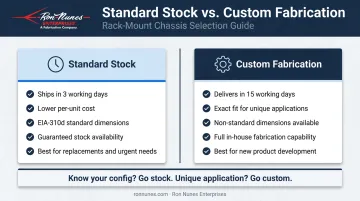
Standard stock is the right fit when you know the configuration, have a tight timeline, and EIA-standard dimensions match your rack infrastructure. Stock chassis from Ron Nunes Enterprises cover 36-plus height/depth combinations and can be in transit within 3 days.
Custom fabrication makes sense when you're developing a new product, your application requires non-standard dimensions, or your material and finish requirements fall outside standard catalog options. It's also the right path when your enclosure needs integrated features: specific cutout patterns, unique hardware installations, or assemblies that go beyond a stock chassis kit.
Ron Nunes Enterprises provides DFM (design-for-manufacturability) consultation as part of the custom quoting process. Their engineering team reviews designs to reduce material waste, tighten tooling, and flag cost reductions before production begins — keeping projects on budget before anything is cut.
How to Choose a Bay Area Metal Fabrication Partner
Full-Service Capability Under One Roof
Prioritize fabricators who perform the complete process chain in-house: cutting, forming, welding, assembly, and finishing. Shops that subcontract major operations add lead time at every handoff and introduce quality risks that are difficult to trace.
Evaluating Experience and Performance
ASQ identifies quality, cost, and delivery as the core indicators of supplier performance — and NIST's supplier selection guidance calls for defined criteria, scoring, and ongoing performance review. For precision fabrication, relevant evaluation criteria include:
- Industry-specific experience (defense, telecom, semiconductor, medical)
- Familiarity with applicable specifications (MIL-DTL-5541F, EIA-310, ITAR)
- On-time delivery track record
- Documentation and material traceability practices
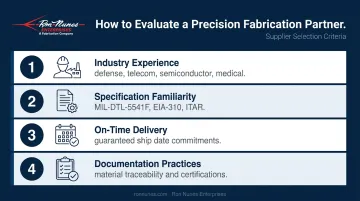
Scheduling Integration and Turnaround Commitments
The best fabricators don't just quote lead times — they integrate with your production schedule. Ask specifically: Do they guarantee ship dates? Do they proactively flag delays?
Ron Nunes Enterprises guarantees stock items within 3 working days and custom chassis within 15 working days, and offers scheduling integration as a formal service for OEM and contract manufacturing programs.
Certifications and Sourcing Qualifications
Caltrans DBE certification matters for buyers sourcing from government primes or public-agency contracts. When a federal-aid contract carries a DBE goal, the prime contractor must document sufficient DBE participation. Sourcing from a certified DBE directly counts toward that requirement — provided the firm performs a commercially useful function on the contract.
For buyers working on those programs, Ron Nunes Enterprises offers:
- Caltrans DBE certification as a minority-owned business
- Livermore, CA location — within the Bay Area's Tri-Valley defense and research corridor
- 55+ years serving both public and private sector customers across defense, transportation, semiconductor, and telecom programs
Frequently Asked Questions
What are the types of metal fabrication?
The main categories are cutting (laser, shearing, punching), forming (bending, rolling), joining (welding, fastening), and finishing (coating, plating, anodizing). Full-service shops perform all of these under one roof, eliminating the vendor handoffs that add lead time and quality risk.
What is a metal fab shop?
A metal fab shop is a facility equipped to transform raw metal stock — sheet, plate, tube, bar — into finished components through cutting, shaping, welding, and finishing operations. They range from small job shops handling single operations to full-service production facilities managing complete assemblies.
What is sheet metal fabrication?
Sheet metal fabrication refers specifically to working with thin, flat metal stock (typically under 6mm) using processes like laser cutting, shearing, punching, and press brake forming. The result: enclosures, chassis, panels, and brackets used across industrial and electronics applications.
How do I choose a metal fabrication company in the Bay Area?
Evaluate full-service capability, industry-specific experience, and guaranteed turnaround commitments. For government or public-sector work, DBE certification matters — it qualifies certain contracts and simplifies compliance. Shops with decades of sector-specific work, like those operating since 1969, understand the tolerance, finish, and documentation standards your industry demands.
What industries use custom metal fabrication?
Defense, telecommunications, semiconductor, medical, transportation, and nuclear/physics research all rely on custom fabrication. Each brings distinct demands — defense work may require MIL-spec finishes and traceability, while semiconductor equipment needs tight dimensional tolerances and specific alloys like 6061-T6 aluminum. Off-the-shelf parts rarely meet these requirements.
How long does custom metal fabrication take?
Lead times vary by complexity, volume, and finish requirements. Custom rack chassis mounts typically deliver within 15 working days; standard stock items ship within 3 working days.