Confusing the two creates real problems: procurement mismatches, vendor scope gaps, cost overruns, and production delays that compound quickly in high-stakes industries. For engineers and sourcing teams, knowing exactly what each process delivers — and when you need each one — is a practical necessity.
This article breaks down both processes clearly, compares them side by side, and provides sourcing guidance for projects where getting it right the first time matters.
Key Takeaways
- PCB fabrication builds the bare physical board; assembly populates it with components
- Fabrication always comes first — assembly cannot begin without a completed board
- Both processes require distinct equipment, documentation, and quality standards
- Turnkey sourcing simplifies logistics by having one vendor handle both processes; consigned sourcing gives you more control over component selection
- Design decisions made before fabrication directly affect assembly yield and overall cost
PCB Fabrication vs. PCB Assembly: Quick Comparison
| Attribute | PCB Fabrication | PCB Assembly |
|---|---|---|
| Process Goal | Build the bare physical board | Populate the board with components |
| Input Materials | Laminate, copper foil, chemicals | Fabricated bare board, components, solder |
| Key Steps | Lamination, etching, drilling, solder mask, silkscreen | Paste printing, pick-and-place, reflow/wave soldering |
| Output | Bare printed circuit board | Functional populated circuit board (PCBA) |
| Primary Cost Drivers | Layer count, via complexity, surface finish | Component count, package complexity, volume |
| Required Files | Gerber files, drill files, stackup data | Bill of Materials (BOM), pick-and-place file |
| Quality Standard | IPC-A-600M | IPC-A-610J |
These two processes are strictly sequential. Assembly cannot begin until the fabricated board clears inspection — which means delays or defects at the fabrication stage push back your entire production schedule. For procurement and project planning, treat them as separate phase gates with distinct lead times, vendors, and file requirements.
What Is PCB Fabrication?
PCB fabrication is the process of manufacturing the bare circuit board itself — transforming raw substrate materials into a multi-layered, copper-traced, drilled, and surface-finished board with no components attached. Without a precisely fabricated board, no circuit can be reliably assembled.
The Core Fabrication Steps
The process follows a defined sequence, and each step builds on the last:
- Substrate lamination — Core layers of FR-4 fiberglass (epoxy resin reinforced with woven glass) are bonded together under heat and pressure
- Copper layer etching — Gerber files guide the selective removal of copper to form the circuit traces on each layer
- Drilling — Mechanical or laser drilling creates vias and through-holes that connect layers electrically
- Plating and desmear — Hole walls are plated with copper and cleaned of resin debris
- Solder mask application — A protective layer covers copper traces, leaving only pads exposed
- Silkscreen printing — Component reference designators and markings are applied to the board surface
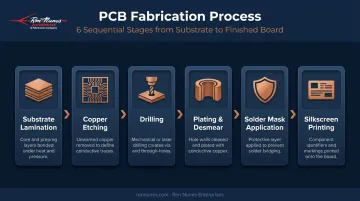
Gerber files serve as the complete manufacturing blueprint for this process — specifying each copper layer, drill locations, board outline, and surface finish. According to Ucamco, the format's developer, Gerber is the de facto standard for PCB design-data transfer. Inaccurate or incomplete Gerber files remain one of the most common causes of fabrication errors.
Fabrication Quality Control
Three inspection methods govern bare board acceptance:
- Automated Optical Inspection (AOI) — Detects surface-level defects in copper layers and mask application
- Electrical continuity testing — Confirms all nets are connected and no shorts exist
- X-ray inspection — Used for multilayer boards to verify internal layer registration
IPC-A-600M (published May 2025) is the governing acceptance standard for fabricated boards, covering both internally and externally observable conditions.
Common Fabrication Defects and Their Downstream Impact
Fabrication defects don't stay in fabrication — they travel downstream and inflate assembly costs. Key failure types include:
- Delamination — Layer separation that compromises structural integrity
- Over-etching or under-exposure — Trace width errors that affect impedance
- Drill registration errors — Misaligned holes that reduce annular ring integrity
- Plating voids — Incomplete copper coverage in drilled holes
IPC notes that assembly companies use IPC-A-600 for incoming inspection specifically to avoid mounting expensive components on defective boards.
Where Fabrication Fits in High-Stakes Industries
Fabrication is the foundation stage, performed by specialized houses equipped with chemical processing lines, precision drilling, and lamination presses. The industries where tight fabrication tolerances matter most include:
- Defense electronics — MIL-SPEC performance requirements (MIL-PRF-31032, MIL-PRF-55110) and AS9100D quality management
- Medical devices — ISO 13485:2016 quality systems; FDA's QMSR (effective February 2026) incorporates ISO 13485 by reference
- Telecommunications infrastructure — RoHS (EU Directive 2011/65/EU) compliance; IPC Class 2 or Class 3 depending on reliability tier
- Semiconductor test equipment — Controlled impedance requirements for probe card environments
These same industries also require rugged enclosures that can withstand the environments their PCBs operate in. Ron Nunes Enterprises supplies rack mount chassis in 6061-T6 aluminum with MIL-C-5541E chemical film finishes to defense, medical, and semiconductor customers — the same sectors where fabrication precision is non-negotiable.
What Is PCB Assembly?
PCB assembly (PCBA) is the process of populating the fabricated bare board with electronic components — resistors, capacitors, ICs, connectors — and securing them through soldering to create a functional circuit. This is where the board transitions from a physical structure to a working electronic device.
Two Primary Assembly Methods
Surface Mount Technology (SMT):
- Components are placed directly onto pads on the board surface
- Solder paste is applied via stencil printing
- Boards pass through a reflow oven to melt and solidify solder joints
- Handles the majority of modern components, including fine-pitch ICs and BGAs
Through-Hole Technology (THT):
- Component leads are inserted through drilled holes
- Wave soldering or selective soldering secures the joints
- Used for connectors, large capacitors, and components requiring mechanical strength
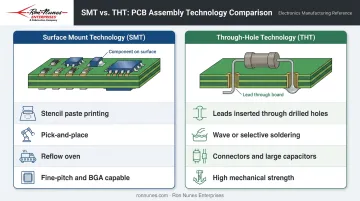
Most modern assemblies combine both methods depending on component mix.
The Role of Documentation
Two documents drive the entire assembly process:
- Bill of Materials (BOM) — Specifies every component's part number, value, and package type
- Pick-and-place file — Tells automated machinery exactly where each component goes on the board
Errors in either document cause costly rework or scrapped assemblies. The BOM must match the pick-and-place file precisely; a single part number discrepancy can halt an entire production run.
Assembly Quality Control
Assembly inspection follows a layered approach, as identified in IPC-1782A:
- AOI after placement — Catches missing, misaligned, or wrong components
- X-ray inspection — Examines hidden solder joints under BGAs and area-array packages that optical inspection cannot reach
- In-Circuit Testing (ICT) — Electrically verifies component values and connections
- Functional testing — Confirms the assembled board operates as designed
IPC-A-610J (published March 2024) is the acceptance standard governing solder quality and assembly workmanship. IPC specifies that a PCBA's performance class cannot exceed its bare board's class — so a Class 3 assembly requires a Class 3 fabricated board.
High-Reliability Assembly Requirements
In defense, aerospace, and medical electronics, standard assembly specifications are a floor, not a ceiling. Additional requirements in these sectors include:
- Conformal coating — Governed by IPC-CC-830C; must be separately specified (not automatic for Class 3)
- IPC-1782A traceability — Risk-based tracking covering serial numbers, lot codes, date codes, and process records
- IPC Class 3 — The high-reliability designation for equipment where failure is not an option
Class 3 assemblies typically live inside rack-mounted electronic systems where the enclosure itself is part of the reliability equation. Ron Nunes Enterprises' rack chassis are built for these environments: perforated ventilation covers manage thermal load, tri-sectional slides rated to 175 lbs per pair handle shock and vibration, and MIL-C-5541E conductive finishes maintain EMI shielding continuity across the enclosure.
PCB Fabrication vs. Assembly: Which Do You Need and When?
Most projects need both, in sequence. The real decision is how to source them.
Turnkey vs. Consigned: The Core Tradeoff
| Turnkey | Consigned | |
|---|---|---|
| Who sources components | EMS vendor | You (the OEM) |
| Coordination effort | Low — single point of contact | Higher — you manage procurement |
| Quality accountability | Unified | Split between parties |
| Component control | Limited visibility into bare board spend | Full control over sourcing |
| Best for | Fast cycles, no existing supplier relationships | Proprietary components, approved vendor lists |
Turnkey PCBA gives the EMS provider control over material purchasing through delivery of the completed unit. This reduces purchasing workload but can reduce visibility into markups, rebates, and excess inventory. Consigned assembly keeps material control and transparency with the OEM, but transfers procurement responsibility back to your team.
Situational Guidance
Choose turnkey if:
- You're in a fast product development cycle
- You need a single point of accountability for quality
- You have no existing component supplier relationships
Choose consigned if:
- You have specialty or long-lead components already sourced
- Your program requires specific Approved Vendor Lists (AVLs)
- You need to separate cost centers for fabrication and assembly
Design Decisions That Affect Both Processes
What happens at the design stage echoes through both fabrication and assembly. IPC-2231 establishes a formal DFX (Design for Excellence) methodology covering manufacturability, fabrication, assembly, test, cost, and reliability considerations.
Practical implications:
- Component placement strategy (spacing, orientation, pad design) directly affects assembly yield
- Via type selection (blind, buried, stacked) adds fabrication complexity — PCB007 reports each required sequential-lamination process adds roughly one week as a rule of thumb
- Surface finish choice (HASL vs. ENIG) impacts solderability and assembly defect rates
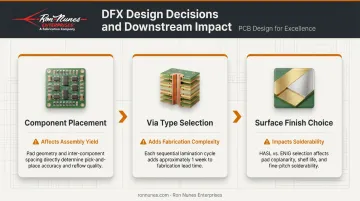
Engaging fabrication and assembly partners early (before design freeze) prevents the most expensive category of errors: those discovered after tooling has been cut.
Key Cost Drivers to Watch
Fabrication costs scale with:
- Layer count and stackup complexity
- Via type (through-hole vs. blind/buried vs. stacked microvias)
- Sub-3-mil features and tight annular rings
- High-Tg or low-loss specialty materials
- Surface finish specification
Assembly costs scale with:
- Total component count
- Fine-pitch SMT and BGA package density
- Number of distinct component types (affects changeover and kitting)
- Production volume (per-unit costs drop with scale)
- Test coverage required (ICT, functional, burn-in)
PCB assembly programs often run parallel to chassis procurement, and timing mismatches between the two create costly delays. Ron Nunes Enterprises coordinates chassis delivery schedules to match PCB production timelines — stock chassis ship within 3 working days, and custom fabrications are guaranteed within 15 working days, fitting comfortably within most PCB assembly program windows.
Conclusion
PCB fabrication and PCB assembly are two distinct, sequential, and equally essential manufacturing phases — not synonyms. Fabrication builds the physical board. Assembly populates and activates it. Confusing them — or failing to source them correctly — adds sourcing and quality risk downstream.
For manufacturers in defense, medical, telecom, and semiconductor markets, the tradeoffs are direct: a well-fabricated board reduces assembly defect rates, and a well-assembled board reduces field failures. The right sourcing strategy — turnkey or consigned, and with DFM review built in — depends on your timeline, component control requirements, and quality tier.
For teams that also need precision metal chassis to house those assembled PCBs, Ron Nunes Enterprises has been building EIA-310d compliant, MIL-spec finished rack mount enclosures since 1969. Stock chassis ship in 3 working days; custom fabrications are guaranteed in 15.
Contact the team at 1-877-800-RACK or sales@ronnunes.com to discuss your specific chassis requirements.
Frequently Asked Questions
What is fabrication and assembly?
Fabrication is the process of building components or structures from raw materials — in PCB manufacturing, it creates the bare board from laminate, copper, and chemicals. Assembly is the process of joining fabricated parts into a functional whole, meaning mounting and soldering electronic components onto that board.
Is fabrication the same as assembly?
No. Fabrication creates the physical structure; assembly joins components onto it to create a working product. In PCB manufacturing, you cannot assemble a board that hasn't been fabricated first, and a fabricated board with no components is not a functional circuit.
What do fabricators and assemblers do?
Fabricators use etching, drilling, lamination, plating, and chemical treatment to produce bare boards from raw materials. Assemblers use stencil printing, pick-and-place machinery, reflow ovens, and wave soldering — then run multi-stage inspection to confirm the board functions correctly.
Can PCB fabrication and assembly be handled by the same vendor?
Yes — this is called turnkey PCBA service. The vendor manages fabrication, component sourcing, and assembly under one roof, which simplifies project management, reduces lead time, and creates a single point of quality accountability. The tradeoff is reduced OEM visibility into component sourcing and bare board spend.
What files are needed for PCB fabrication and assembly?
Fabrication requires Gerber files (layer artwork, drill files, board outline) plus stackup and material specifications. Assembly requires a Bill of Materials (BOM), pick-and-place file, and assembly drawings. Accurate, complete documentation for both processes is essential — errors in either cause costly rework or production stoppages.
What are the four types of assembly lines?
The four common types are continuous flow, intermittent (batch-based), lean/cellular, and automated/robotic. PCB assembly relies primarily on automated lines — pick-and-place machines, stencil printers, and reflow ovens form the core SMT sequence.