Pick the wrong process for a given aluminum part, and you're looking at warping, porosity, or joints that fail under load. Every one of those problems means rework, missed deadlines, and added cost to a production run.
Ron Nunes Enterprises has run both TIG and MIG welding stations at its Livermore, California facility since 1969, fabricating aluminum assemblies for defense, semiconductor, and telecommunications customers. This guide breaks down when each process earns its place on the shop floor.
Key Takeaways
- MIG welding uses a spool gun or push-pull system for soft aluminum wire, ideal for thick sections and production runs
- TIG welding uses AC current to break aluminum's oxide layer, delivering precise heat control for thin, cosmetic welds
- Neither process is inherently "stronger" — weld quality depends on proper heat control, cleaning, and technique
- Your best choice hinges on aluminum thickness, production volume, appearance requirements, and operator skill
TIG vs MIG Welding Aluminum: Quick Comparison
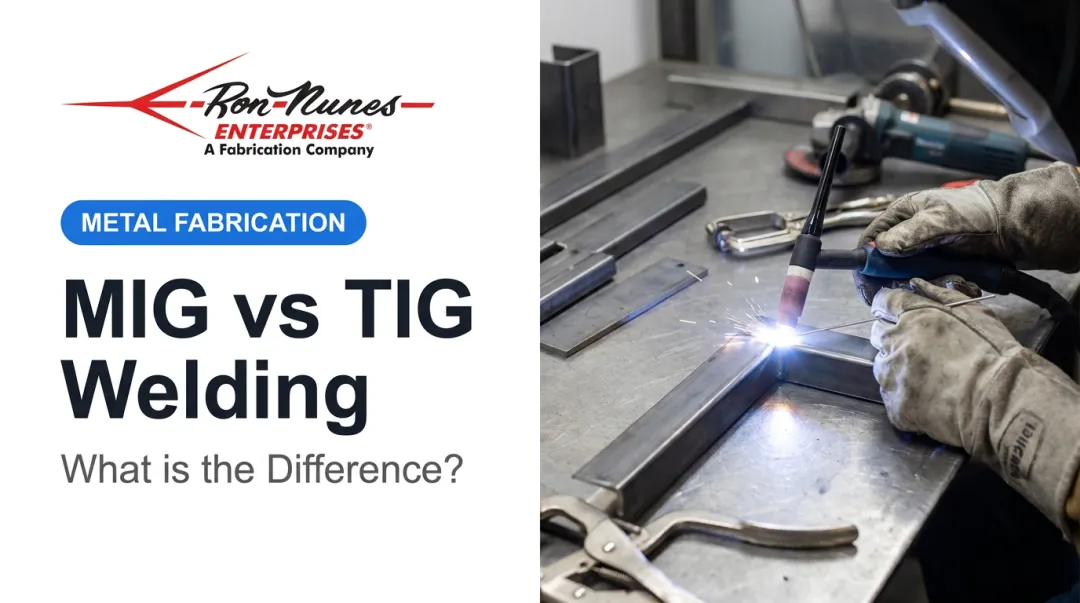
Here's how MIG and TIG stack up across the factors that matter most when welding aluminum on the shop floor.
| Factor | MIG (GMAW) | TIG (GTAW) |
|---|---|---|
| Heat control | Constant-voltage output; wire feed speed sets current, limiting mid-weld adjustment | Constant-current output with foot pedal control, letting operators taper heat in real time |
| Equipment | Needs a spool gun or push-pull gun; standard drive rollers crush soft aluminum wire | Needs an AC/DC-capable machine, since only alternating current breaks down the oxide layer |
| Speed | Higher deposition rate, better suited to thicker material and longer welds | Slower, manual filler addition prioritizes precision over throughput |
| Appearance | More spatter and soot; often needs post-weld cleanup | Clean, narrow beads with minimal spatter, ideal for visible welds |
| Skill required | Easier to learn once the spool gun is set up | Requires coordinated hand-and-foot control; typically an experienced-operator process |
Why Heat Control Matters More on Aluminum
Aluminum conducts heat roughly four times faster than steel, so it can go from cherry-red-hot to melted in seconds. TIG's foot-pedal control lets welders back off amperage as the part heats up mid-weld.
MIG's constant wire feed doesn't offer that same real-time adjustment, which is why travel speed and pre-heating become the workarounds on thicker MIG jobs. At Ron Nunes Enterprises, our welding stations run both processes, so we can match TIG or MIG to the aluminum alloy and part thickness on each job.
What Is MIG Welding for Aluminum?
MIG welding (technically GMAW) feeds a continuous aluminum wire electrode through a gun, shielded by 100% argon gas. Manufacturers lean on it because it moves fast: high deposition rates cut labor time per part, which matters when you're running dozens or hundreds of identical aluminum assemblies.
There's a catch, though. Aluminum wire is soft. Push it through a standard steel-rated MIG gun and it buckles or birdnests inside the liner before it ever reaches the arc.
That's why aluminum MIG welding requires a spool gun (which keeps the feed path down to a few inches) or a push-pull system that synchronizes motors at both the feeder and the gun.
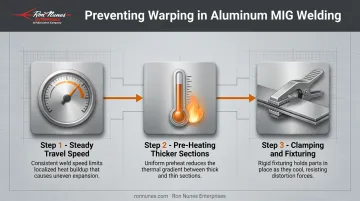
Warping is the other persistent challenge. Aluminum dissipates heat so quickly that inconsistent travel speed causes uneven cooling and distortion, especially on thinner stock. Fabricators combat this with:
- Steady, practiced travel speed
- Pre-heating for thicker sections
- Clamping and fixturing to control movement during cooling
Mastering these fundamentals matters more each year, as demand for aluminum welding proficiency keeps climbing. North American automakers project aluminum content per vehicle will grow by 56 pounds between 2020 and 2025, according to Drive Aluminum's 2023 industry survey. This trend pushes more shops toward high-throughput aluminum welding capability.
Use Cases of MIG Welding Aluminum
MIG earns its place wherever speed matters more than a mirror-finish bead. Think structural frames, equipment chassis, and enclosures that get painted or powder-coated after welding anyway, so a little post-weld cleanup doesn't hurt the final product.
Common applications include:
- Automotive aluminum panels and structural components
- Trailers and transportation equipment frames
- Larger rack and enclosure structures where thickness exceeds thin-gauge territory
Miller's own guidance places conventional aluminum MIG in the sweet spot at 14 gauge (0.074 inches) and heavier — below that, pulsed MIG or TIG typically takes over to avoid burn-through.
What Is TIG Welding for Aluminum?
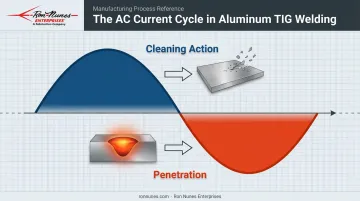
TIG welding (GTAW) uses a non-consumable tungsten electrode and AC current rather than straight DC. Aluminum's surface oxide melts at roughly 3,700°F, compared to about 1,200°F for the aluminum underneath it, according to Lincoln Electric. DC alone can't strip that oxide consistently. The alternating current's cathodic cleaning action does — sweeping the surface clean during each cycle before fusion occurs.
That cleaning action is also TIG's biggest operational advantage. Because the operator adds filler manually and controls current through a foot pedal, heat input can be dialed back precisely as the part warms up. That precision reduces distortion, porosity, and visible defects, which matters on parts headed into finishing lines or high-scrutiny final assembly.
Modern inverter-based TIG machines take this further with AC balance and frequency controls, letting welders fine-tune the ratio of oxide-cleaning action to penetration depth for different aluminum thicknesses.
The trade-off is speed. Manual filler feeding and slower, more deliberate travel increase labor time per weld, and the process demands more operator skill than MIG. That's the exchange you make for control.
Use Cases of TIG Welding Aluminum
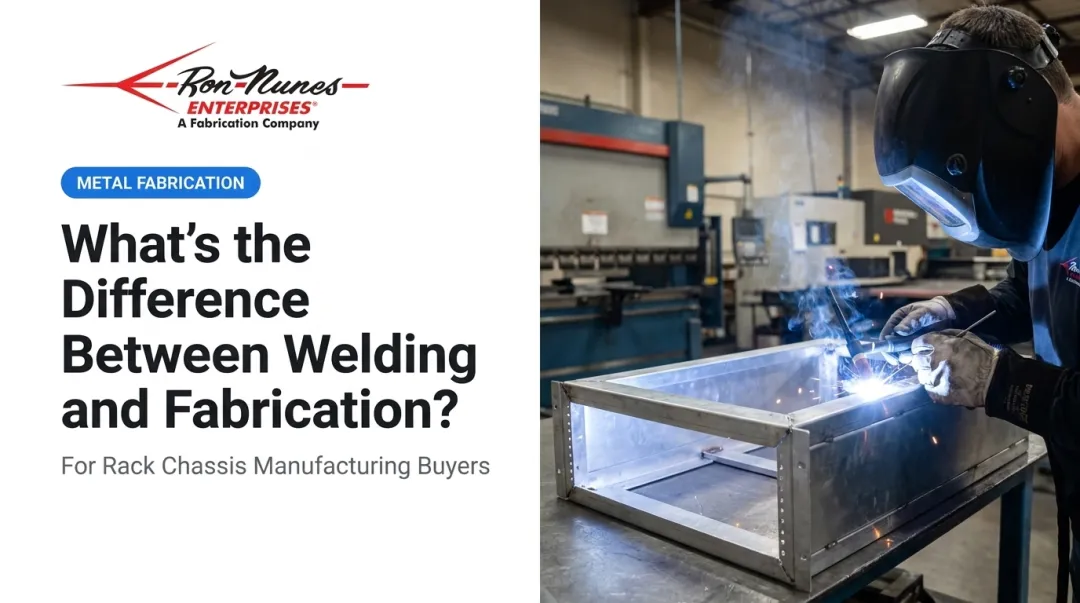
TIG fits where appearance and dimensional accuracy carry as much weight as structural integrity. Ron Nunes Enterprises builds rack mount chassis from 0.125-inch 6061-T6 aluminum, exactly the thin-gauge territory where TIG's controlled heat input prevents warping and burn-through.
Typical TIG applications include:
- Aerospace and defense structural components
- Medical device housings requiring tight tolerances
- Rack mount chassis and communications equipment enclosures
- Precision brackets and instrumentation housings
On thin material, a slightly hotter pass or a moment of hesitation can blow through the metal entirely. TIG's real-time heat tapering gives operators the margin to hold tight tolerances on parts that simply won't tolerate rework.
TIG vs MIG for Aluminum: Which Method Is Best?
There's no universal winner here. The right process depends on five practical factors:
- Aluminum thickness: thinner material favors TIG; thicker sections favor MIG
- Weld appearance requirements: cosmetic, visible welds lean TIG
- Production volume: high-volume runs favor MIG's speed
- Operator skill and equipment availability: TIG demands more trained hands
- End use: structural vs. precision/cosmetic assemblies
Choose MIG when:
- You're welding thicker aluminum sections
- Production volume is high and turnaround matters
- Speed outweighs a cosmetic finish
Choose TIG when:
- You're working with thin-gauge aluminum
- The part is appearance-critical or heading into a visible assembly
- Tight heat control is needed to prevent warping or burn-through
The Strength Myth, Debunked
Here's something worth clearing up: neither process is inherently stronger than the other. Weld strength depends far more on base alloy, heat-affected zone behavior, filler selection, joint design, and execution than on whether the arc came from a spool gun or a tungsten tip.
A poorly executed TIG weld will lose to a properly executed MIG weld every time, and vice versa. Procedure beats process label.
How Ron Nunes Enterprises Helps You Choose the Right Aluminum Welding Process
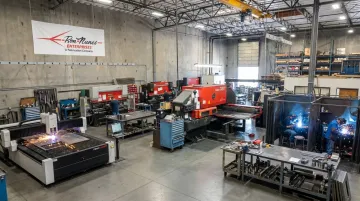
Since 1969, Ron Nunes Enterprises has operated as a full-service precision metal fabricator, running dedicated TIG and MIG welding stations alongside spot and stud welding equipment at its Livermore facility. That matters because customers don't need to guess which process fits their part, or juggle separate vendors for TIG and MIG work.
The facility's capabilities extend well beyond welding itself:
- Laser cutting and N/C punching for dimensionally accurate blanks before any joining happens
- Press brake forming that shapes chassis and enclosure geometry
- Welding matched to the part (TIG for thin, precision work; MIG for structural speed)
- Finishing including MIL-C-5541E chromate conversion, powder coat, and deburring
For customers in semiconductor, defense, medical, and telecommunications sectors, this often means TIG welding for thin rack mount chassis and enclosures where tolerances and appearance are non-negotiable. Transportation and structural aluminum projects, on the other hand, frequently benefit more from MIG's speed on thicker material.
Not sure which process your project needs? Contact the Ron Nunes Enterprises team to discuss your aluminum part's thickness, finish requirements, and production volume for a straight answer instead of a guess.
Conclusion
There's no single "better" process between TIG and MIG for aluminum. MIG wins on speed, thickness capacity, and production volume. TIG wins on precision, thin-gauge control, and appearance. The right call depends on matching the process to what the part needs.
Manufacturers who partner with a fabricator running both processes under one roof avoid the guesswork and the rework. With over 55 years of fabrication experience, Ron Nunes Enterprises has made that judgment call on aluminum parts for defense, semiconductor, and telecommunications customers. The company can do the same for your next project.
Frequently Asked Questions
Which is best for welding aluminum, TIG or MIG?
TIG is generally best for thin, cosmetic, or precision aluminum parts due to superior heat control. MIG is best for thicker aluminum and higher-volume production due to its speed. At Ron Nunes Enterprises, we choose between the two based on the rack-mount chassis application, using TIG for precision panels and MIG for higher-volume runs.
What are the main differences between TIG and MIG welding for aluminum?
TIG uses a non-consumable tungsten electrode, AC current, and manual filler feeding. MIG uses continuously fed consumable aluminum wire through a spool gun with argon shielding gas.
Can you MIG weld aluminum without a spool gun?
Standard MIG guns struggle to feed soft aluminum wire without buckling or birdnesting in the liner. We strongly recommend a spool gun or push-pull system for reliable results.
Why does TIG welding aluminum require AC current?
AC current's cleaning action breaks down aluminum's oxide layer, which melts at a much higher temperature than the base metal. DC alone can't consistently achieve that cleaning action.
Is TIG welding aluminum stronger than MIG?
Neither process is inherently stronger. Weld strength depends more on proper parameters, cleaning, and technique than on which process you choose.
What aluminum thickness works best with MIG versus TIG?
MIG becomes more practical as thickness increases, thanks to faster deposition rates. TIG is often preferred for thinner sections, where burn-through and warping pose bigger risks.