Getting this distinction right matters more than it might seem. Choosing between a welding specialist and a full-service fabricator affects your project cost, your lead time, and whether one vendor can take your part from raw metal to finished product.
This article breaks down what each term actually means, where they overlap, and how to decide which service your project needs.
Key Takeaways
- Fabrication is the umbrella process (cutting, forming, welding, assembly); welding is just one step inside it.
- Every welding job counts as fabrication, but plenty of fabrication jobs never touch a welder.
- Full-service fabricators with in-house welding cut down on vendor handoffs and delays.
- Your choice depends on scope: simple joining versus a complete build from raw stock.
Welding vs Fabrication: Quick Comparison
Here's the side-by-side breakdown before we dig into details:
| Factor | Welding | Fabrication |
|---|---|---|
| Scope | Joining metal pieces; one step in a larger process | Full process from raw metal to finished, assembled product |
| Core tools | MIG/TIG welders, arc welders, consumable electrodes, clamps | Shears, press brakes, N/C punches, laser and plasma cutters |
| Skillset | Specialized joining techniques (MIG, TIG, SMAW, laser beam) | Blueprint reading plus cutting, forming, and assembly |
| Output | A permanent joint or seam | A complete component ready for use |
| Best fit | Joining pre-cut or pre-formed pieces | Building custom parts from concept to finish |
If your part already exists and just needs joining, you need a welder. If you're starting from raw sheet stock, you need a fabricator.
What Is Fabrication?
Fabrication is the entire manufacturing process of turning raw metal into a finished product. It covers cutting, punching, forming, welding, assembly, and finishing, often within a single facility.
That's a broader category than welding alone. Fabrication can include welding, or it can skip it entirely — a bracket that's punched, bent, and riveted together never needs a weld bead.
For buyers sourcing custom parts, this distinction has real operational consequences. A shop that only welds can't help you if your project starts as flat sheet stock. A full-service fabricator handles the entire sequence, which typically means fewer vendor handoffs and faster turnaround.
Common Fabrication Techniques
Full-service fabricators distinguish themselves through the breadth of machinery on their floor:
- Laser and plasma cutting for tight-tolerance profiles
- Shearing for straight-line blanking of raw stock
- N/C (CNC) punching for high-speed hole patterns and cutouts
- Press brake forming for bends, channels, and boxes
- Welding and assembly to join and complete the part
- Finishing: deburring, plating, powder coat, or MIL-spec coatings
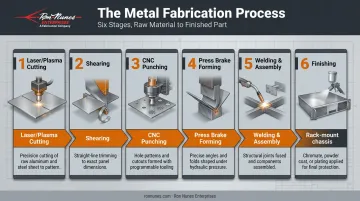
At Ron Nunes Enterprises, this full sequence runs on equipment like Amada CNC turret punch presses, a Komatsu HD plasma cutter, and Cincinnati hydraulic press brakes, all under one roof in Livermore, California, before parts ever reach the welding stations.
Use Cases of Fabrication
Fabrication typically enters a buyer's supply chain early, from prototype development through full production runs of custom metal parts. It's the backbone of industries where off-the-shelf components simply don't fit:
- Semiconductor equipment housings requiring tight tolerances
- Transportation infrastructure components
- Defense electronics enclosures needing MIL-spec compliance
- Medical device chassis and structural parts
- Telecommunications and data center rack systems
The scale of this industry is substantial. According to Bureau of Labor Statistics data, U.S. fabricated metal product manufacturing (NAICS 332) employed 1,446.3 thousand workers across 61,460 private establishments as of late 2025 and early 2026. That footprint spans everything from small custom job shops to large OEM contract manufacturers.
What Is Welding?
Welding is a joining process that uses heat, pressure, or both to permanently fuse two or more metal pieces together. Unlike fasteners or adhesives, a proper weld becomes structurally part of the base metal.
That permanence is exactly why welding matters. It creates structural strength, airtight or watertight seals, and repair capability that mechanical fastening can't always match.
Two Main Categories
Welding splits into two broad families:
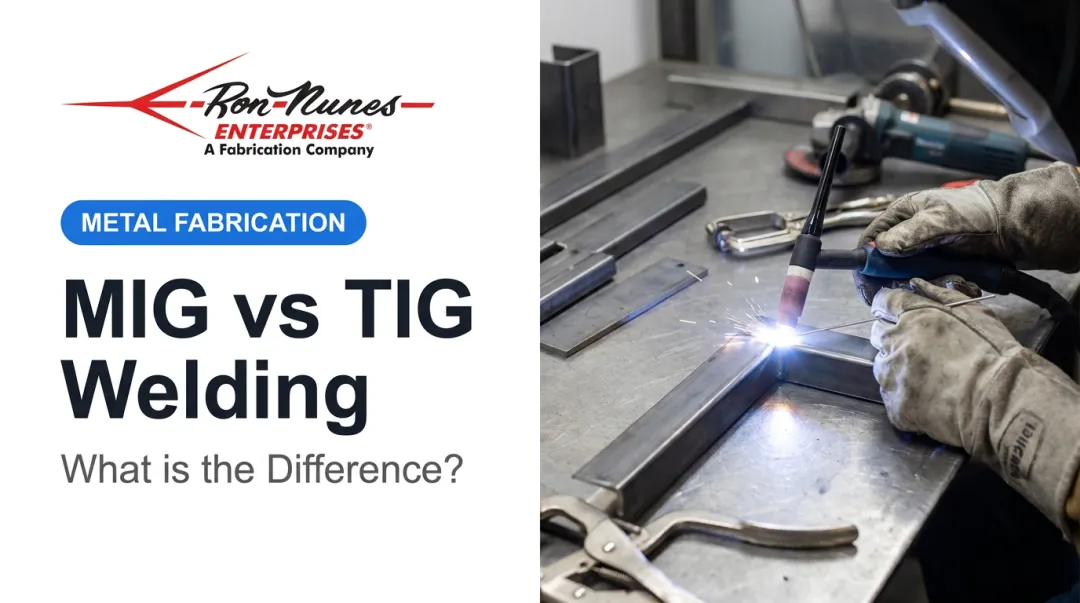
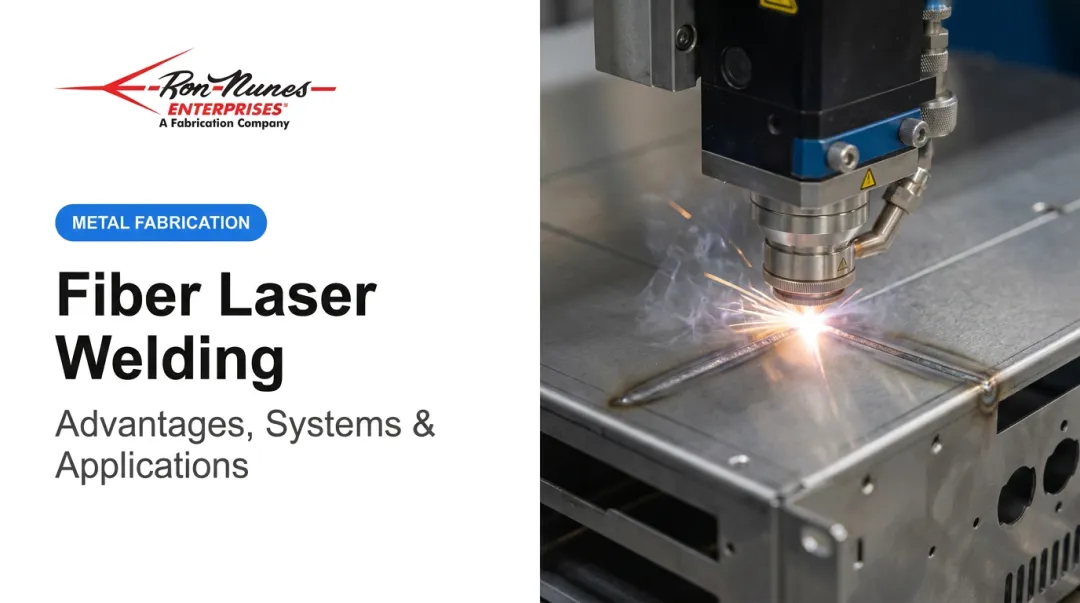
- Fusion welding: heats materials to their melting point to form a joint. This includes MIG, TIG, SMAW (stick), and laser beam welding.
- Solid-state welding: joins base materials without reaching melting-point temperatures and without filler material, such as friction stir or resistance welding.
Each family breaks down into specific techniques, summarized below:
| Technique | Key characteristic |
|---|---|
| SMAW (stick) | Electrode supplies both flux and filler material |
| MIG (GMAW) | Consumable filler electrode with external gas shield |
| TIG (GTAW) | Nonconsumable electrode, inert-gas shielding, superior finish |
| Spot welding | Resistance-based; joins panels at discrete points, no filler |
| Stud welding | Fuses fasteners directly to a surface in one operation |
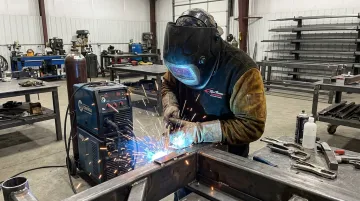
Ron Nunes Enterprises runs all of these process types across its welding stations, including five Miller TIG welders, five Hobart MIG units, a Federal spot welder, and dual TRW Nelson stud welders. This equipment supports everything from cosmetic sealed welds on enclosures to structural joints on chassis frames.
Use Cases of Welding
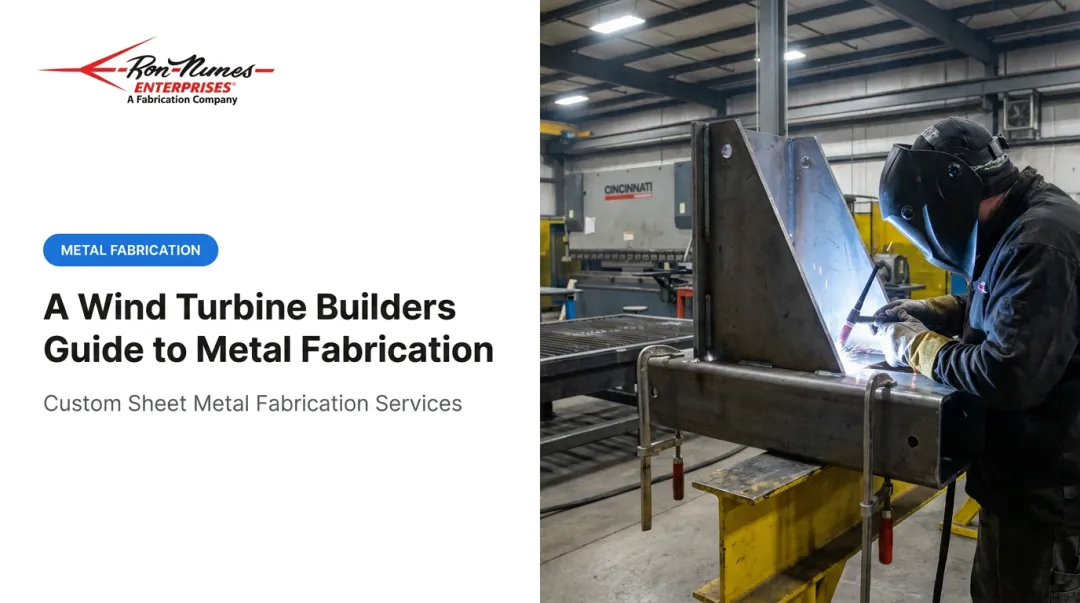
Welding usually enters the process late, after parts have already been cut and shaped. It's the assembly step that turns individual pieces into one solid unit.
Industries where welding is the dominant, most critical step include:
- Structural steel for buildings and bridges
- Automotive frames and chassis
- Pressure vessels requiring airtight seams
- Rack-mount chassis assemblies requiring both structural and cosmetic welds
Weld quality isn't informal. Structural steel welding, for example, falls under AWS D1.1/D1.1M, the Structural Welding Code, which defines exactly how steel welds must be qualified and inspected for buildings, bridges, and infrastructure.
On the labor side, BLS reports 457,300 welding, cutting, soldering, and brazing jobs in the U.S. in 2024, with median pay around $51,000 a year. That's a sizable, ongoing occupational category even as growth projections stay modest.
At Ron Nunes Enterprises, welding and assembly on rack chassis products are performed specifically by Class A/XX certified welders, a quality benchmark that matters for defense and medical customers who need documented compliance.
Welding vs Fabrication: Which Do You Need?
The right answer depends on four factors: scope of the project, required tools and expertise, budget, and timeline.
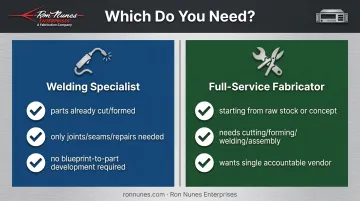
Choose a welding specialist if:
- Your parts are already cut and formed
- You only need joints, seams, or repairs
- The job doesn't require blueprint-to-part development
Choose a full-service fabricator if:
- You're starting from raw stock or a concept sketch
- The project needs cutting, forming, welding, and assembly
- You want one vendor accountable for the whole build
There's a real advantage to consolidating both under one roof. Ron Nunes Enterprises has operated as a full-service fabricator in Livermore, California since 1969 (over 55 years) with laser cutting, shearing, N/C punching, forming, welding, assembly, and finishing all handled in-house.
That means no shipping parts to a separate welding subcontractor and back, and no second production schedule to coordinate.
The practical payoff shows up in turnaround. Ron Nunes guarantees shipment of stock chassis items within 3 working days and custom rack chassis mounts within 15 working days. Those timelines are hard to hit when cutting, forming, and welding happen at three different addresses.
Have a project that needs cutting, forming, welding, or all three? Request a quote from Ron Nunes Enterprises or call 1-877-800-RACK to talk through your specs with the team.
Conclusion
Welding is a specialized joining technique. Fabrication is the complete process of building a metal product from raw material to finished part. The right choice comes down to scope: does your project just need two pieces joined, or does it need to be built from scratch?
Partnering with a full-service fabricator that also welds in-house removes a layer of vendor coordination and closes the quality-control gaps that appear when parts change hands between shops. Ron Nunes Enterprises has offered this combined welding and fabrication capability from its Livermore, California facility since 1969.
For most custom metal projects, that consolidation pays off in both cost and speed.
Frequently Asked Questions
Is welding the same as fabrication?
No. Welding is one step within the broader fabrication process. All welding is fabrication, but not all fabrication involves welding.
Can a fabricator also weld metal parts?
Yes. Many fabricators are cross-trained in welding, and full-service shops typically handle cutting, forming, and welding under one roof.
Which is more cost-effective: hiring a welder or a full-service fabricator?
It depends on scope. Simple joining jobs may only need a welder, while multi-step builds save money with a fabricator's broader in-house capabilities.
Do all fabrication projects require welding?
No. Many fabrication projects rely only on cutting, bending, or fastening. Welding gets added when a permanent metal bond is needed.
What skills differentiate a welder from a fabricator?
Welders specialize in joining techniques like MIG and TIG. Fabricators need broader skills, including blueprint reading, cutting, forming, and assembly.
How do I know if my project needs a welder, a fabricator, or both?
If your project starts from raw material, you need a fabricator. If it only requires joining existing parts, a welder suffices. For complex builds, a full-service provider covering both is usually the simplest route.