Introduction
A shipment of structural steel brackets arrives at a job site looking fine. Six months later, rust blisters push through a thin paint layer, and the whole batch fails inspection. Now there's rework, schedule delays, and an unhappy customer.
This scenario plays out constantly in manufacturing and construction. Steel reacts with oxygen and moisture the moment it's exposed, and that reactivity doesn't pause for production schedules or budgets.
That urgency shows up most in transportation, defense, and communications infrastructure, where a failed coating means more than an aesthetic problem. This article breaks down the major protective coating types for steel, how they differ, and a practical framework for choosing the right one for your application.
Key Takeaways
- Protective coatings prevent corrosion, extend component life, and lower maintenance costs
- Four core coating types: hot-dip galvanizing, powder coating, liquid paint, and electroplating
- Coating choice depends on environment, substrate, performance needs, and budget
- Surface preparation is the biggest factor in coating performance
What Are Metal Coatings and Why Do They Matter for Steel?
A metal coating is a thin protective or functional layer applied to a metal substrate. It changes surface properties, such as corrosion resistance, hardness, or appearance, without altering the structural integrity of the part underneath.
Coatings for steel fall into two categories:
| Coating Type | Description |
|---|---|
| Organic | Paint and powder systems that create a polymer barrier between the steel and the environment |
| Inorganic | Metallic and plated layers (zinc, nickel, chrome) that sacrifice themselves to protect the steel or form a hard, functional surface |
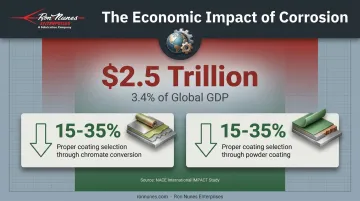
The financial stakes here are larger than most people assume. According to NACE International's IMPACT study, corrosion costs the global economy $2.5 trillion annually - about 3.4% of global GDP. The same research found that better corrosion-control practices, including proper coating selection, could cut that cost by 15% to 35%.
Coatings serve several core functions for steel:
- Prevents corrosion
- Resists wear and abrasion
- Reduces surface friction
- Improves aesthetics and color consistency
- Meets industry or defense finishing standards
Ron Nunes Enterprises handles these finishing functions in-house, from MIL-C-5541E chromate conversion to powder coating and plating, keeping quality control consistent from raw metal to finished part. Skip proper coating, and the consequences show up fast: premature rust, weakened load-bearing capacity, failed inspections, and expensive replacement work that could have been avoided with the right process from the start.
Types of Protective Coatings for Steel
Coatings aren't one-size-fits-all. The right type depends on the environment a part will face, its geometry, how it's applied, and what you're willing to spend upfront versus over the part's service life.
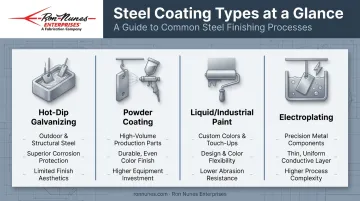
Hot-Dip Galvanizing
Steel gets fully immersed in a bath of molten zinc, forming a metallurgically bonded zinc-iron alloy layer on the surface. The zinc-iron layer is metallurgically bonded to the steel rather than simply sitting on its surface.
The protection mechanism is sacrificial. Zinc has a more negative electrochemical potential than steel, so it corrodes preferentially, protecting the base metal even if the surface gets scratched.
Where it wins:
- Outdoor structural steel and infrastructure
- Large fabricated assemblies facing atmospheric or moderate corrosive exposure
- Applications where maintenance access is difficult or expensive
Because the zinc layer is metallurgically bonded rather than applied, it resists chipping in ways painted or powder-coated surfaces can't match.
The American Galvanizers Association's atmospheric data shows one industrial-exposure case with roughly 72 years to first maintenance at a 3.9-mil zinc thickness, illustrating multi-decade atmospheric protection. Actual results vary by thickness and local conditions.
The trade-offs: North American galvanizing kettles average around 40 feet, so oversized fabrications may need to be dipped in sections. Color options are also limited: galvanized steel starts bright and weathers to a uniform dull gray within about a year, so paint or powder over galvanizing is required if a specific color is non-negotiable.
Powder Coating
Dry polymer powder gets electrostatically applied to a grounded steel part, then cured in an oven where it melts and fuses into a hard, continuous finish. No solvents are involved in the process.
That solvent-free chemistry is the big differentiator. The EPA notes that powder coatings emit virtually no VOCs, and the Powder Coating Institute confirms the process produces negligible emissions compared to solvent-based paints, and overspray can often be recovered and reused, cutting material waste.
Best suited for:
- Industrial equipment and enclosures needing high durability
- Parts requiring a wide range of color and finish options
- Manufacturers prioritizing low VOC output on the production floor
Strengths: Excellent chip and scratch resistance, minimal waste, consistent film thickness.
Limitations: Oven size caps the part dimensions you can process, and the electrostatic application method needs line-of-sight access, so recessed or complex geometries can end up under-coated.
Liquid and Industrial Paint Coatings
Liquid systems typically involve multiple coats (primer, mid-coat, topcoat) using epoxy, polyurethane, or specialty formulations applied by spray, brush, or roller. A common atmospheric system pairs a zinc-rich primer for sacrificial protection with an epoxy intermediate coat for barrier protection, topped with an aliphatic polyurethane for UV and color retention.
Unlike powder or dip processes, liquid coatings can be field-applied. That makes them the go-to option for structures too large to transport to a coating facility.
Best suited for:
- Marine and industrial structural steel
- Field repair work on installed assemblies
- Large structures requiring UV-resistant topcoats
Trade-offs: Multi-coat systems mean longer project timelines. Cure times stretch out significantly in cold weather: a polyurethane topcoat that cures in about 7 days at 75°F can take 14 days at 35°F, according to manufacturer product data. Labor costs also run higher with multiple coats and inspection steps between layers.
Electroplating and Electroless Plating
Electroplating uses an electric current to deposit a precise, thin metallic layer (nickel, chrome, or zinc) onto a conductive steel surface. Electroless plating skips the current entirely, using a chemical bath to deposit metal uniformly, even into recessed or intricate geometries where current-based plating would build unevenly.
Both processes offer thickness control that paint and powder simply can't touch. ASTM B633 defines zinc electroplating service classes from 5 to 25 microns minimum thickness depending on the severity of the intended service, while ASTM B733 sets similar minimum classes for electroless nickel.
Best suited for:
- Precision components and fasteners
- Parts with recessed features or complex internal geometry
- Applications needing functional properties like hardness or conductivity, not just corrosion resistance
Strengths: Tight dimensional tolerances, functional performance beyond basic corrosion protection.
Limitations: Higher per-part cost and process complexity. Bath chemistry has to be tightly controlled, and specs need to state minimum thickness, post-plating heat treatment, and inspection method explicitly, since vague plating callouts lead to inconsistent results.
How to Choose the Right Coating for Steel Applications
Picking a coating because it's familiar or because a vendor defaults to it isn't a strategy. The right choice comes down to environment, function, and total lifecycle cost.
Operating environment: Assess UV exposure, moisture, salinity, and temperature swings. ISO 12944 rates conditions from C1 to CX, with top-tier systems rated past 25 years to first maintenance.
Substrate and part geometry: Confirm the process fits the steel grade and part size. Complex or recessed geometries often push you toward electroless plating or liquid coatings over powder or dip.
Performance requirements: Decide whether corrosion resistance, wear resistance, conductivity, or appearance matters most, then match the coating to that single priority.
Regulatory and industry compliance: Defense and medical equipment often carry MIL-spec finishing requirements. MIL-C-5541E, for example, covers aluminum chromate conversion, not steel — confirm the spec matches your substrate.
Budget and lifecycle cost: Higher upfront costs, like hot-dip galvanizing, often lower total ownership cost through decades of maintenance-free service. Weigh that against paint's recurring upkeep over the part's expected service life.
Coordinating all five factors gets easier when fabrication and finishing happen under one roof. Ron Nunes Enterprises has worked across precision, defense, and industrial sectors for over 55 years from its Livermore, California facility, handling everything from laser cutting and press brake forming through welding and finish coordination.
That integration means material selection, part geometry, and coating specification get addressed together from the design stage, not bolted on at the end.
Common Mistakes to Avoid When Selecting a Coating
Even experienced buyers fall into predictable traps when specifying coatings. Watch for these:
- Over-speccing the coating. Choosing the most advanced or expensive option when a simpler, lower-cost coating would meet the actual performance requirement wastes budget without adding value.
- Skipping surface preparation. Degreasing, blasting, and pickling are the leading cause of premature coating failure when skipped, affecting every coating type in this article.
- Ignoring changing exposure conditions. A coating specified for indoor use often fails fast outdoors, especially in coastal environments the original spec never accounted for.
- Defaulting to familiarity. Picking a coating based on habit or a vendor's standard process, rather than the application's actual environment and performance needs.
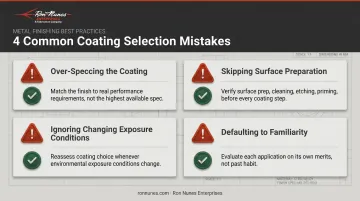
Each of these mistakes shares a common root: treating coating selection as an afterthought rather than an engineering decision made alongside part design and material choice.
Conclusion
Protective coatings do more than make steel look finished. They determine whether a part survives its service life, passes inspection, and avoids costly rework down the line.
There's no universal "best" coating. Hot-dip galvanizing, powder coating, liquid paint systems, and plating each solve different problems for different environments and budgets. The job is matching the coating to the application, not the reverse.
Getting that match right depends on when coating enters the conversation, ideally at the design stage rather than after the fact. Ron Nunes Enterprises has handled cutting, forming, welding, and finish coordination together since 1969, building coating decisions into the manufacturing process from day one rather than tacking them on as a last-minute fix.
Frequently Asked Questions
What is the best coating for metal?
There's no single best coating — it depends on the environment and use case. Hot-dip galvanizing suits outdoor structural steel, powder coating works well for durable industrial parts, and electroplating fits precision or functional needs.
What are the four types of coatings?
The four common categories are metallic/galvanized coatings, powder coatings, liquid/paint coatings, and electroplated or electroless coatings. Each serves distinct protective or functional purposes depending on the application.
What is the coating on metal called?
Coatings on metal are broadly called "finishes." Specific names depend on the process used, such as galvanizing, powder coat, or plating.
What is the difference between galvanizing and powder coating?
Galvanizing forms a metallurgically bonded zinc layer for long-term outdoor corrosion protection through sacrificial action. Powder coating cures a polymer layer onto the surface for durability, chip resistance, and a wide range of color and finish options.
How long do protective coatings on steel typically last?
It varies widely by coating type and environment. Hot-dip galvanizing can deliver multi-decade protection, with AGA data showing roughly 72 years in one industrial case. Liquid paint systems typically last 7 to 25+ years before first major maintenance, per ISO 12944 durability bands.
Does steel need surface preparation before coating?
Yes, surface preparation, including degreasing, blasting, and pickling, is mandatory for every coating type. Skipping it is one of the most common causes of premature coating failure.