Surface finishing has moved from an afterthought to a specification line item. Corrosion resistance, industry compliance, part longevity, and even how a product looks on a shelf all trace back to this last stage of fabrication. This article breaks down what metal surface finishing actually is, why it matters, the main categories you'll encounter, and how to pick the right one without overpaying or overengineering.
Key Takeaways
- Surface finishing uses mechanical, chemical, or coating processes to boost durability, appearance, and performance.
- Picking the wrong finish risks premature corrosion, part rejection, or costly rework down the line.
- Three categories cover nearly every application: mechanical, chemical/electrochemical, and coating/plating.
- The best finish depends on environment, material, budget, and compliance needs, not familiarity.
- Fabricators with in-house finishing cut vendor handoffs and shorten turnaround time.
What Is Metal Surface Finishing and Why It Matters
What Is Metal Surface Finishing?
Metal surface finishing is the group of processes applied to a metal part's surface, by adding, removing, or reshaping material, to improve its appearance, protection, or function. It happens after cutting, forming, and welding are done.
This is the step that turns a structurally sound part into a production-ready one. A bracket can be cut and welded perfectly, but without proper finishing, it's still vulnerable to corrosion, poor paint adhesion, or a rough surface that fails inspection.
Why It Matters in Manufacturing
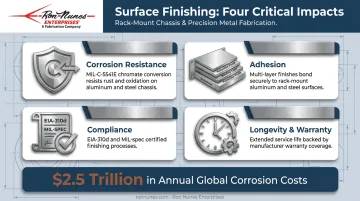
Finishing isn't cosmetic polish tacked on at the end. It directly affects:
- Corrosion resistance — how long a part survives in humid, salty, or chemically aggressive environments
- Adhesion — whether subsequent paint or coating layers bond properly instead of peeling
- Compliance — whether a part meets MIL-spec, aerospace, or medical certification requirements
- Longevity and warranty exposure — parts that fail early generate returns, rework, and reputational damage
A 2016 NACE International study puts the stakes in perspective: global corrosion costs run $2.5 trillion annually, roughly 3.4% of global GDP, with 15% to 35% of that cost potentially avoidable through better corrosion-management practices.
That's not a number specific to sheet metal fabrication, but it illustrates why skipping or under-specifying a finish is rarely a smart shortcut. Rejected parts and unplanned rework often trace back to a mismatched or missing finish, along with costly warranty claims. Understanding the different finishing categories is the first step toward avoiding those outcomes.
Types of Metal Surface Finishing
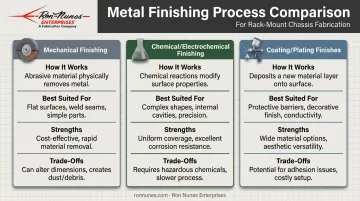
Surface finishing isn't one-size-fits-all. Different processes exist because different parts face different environments, budgets, and appearance requirements. Manufacturers generally choose from three broad categories, each with distinct mechanisms and trade-offs.
Mechanical Surface Finishing
Mechanical finishing physically alters a part's surface through abrasive or mechanical action, no chemistry involved. This includes grinding, polishing, buffing, blasting, and brushing.
How it works: Abrasive wheels, blasted media, or brushes remove imperfections, deburr edges, or create a specific texture. Grinding shapes and deburrs; polishing and buffing smooth and brighten; abrasive blasting cleans and profiles surfaces for paint adhesion; brushing refines edges without heavy material removal.
Mechanical finishing differs from other categories because it relies purely on physical abrasion. There's no oxide layer forming, no metal deposited, just material removed or reshaped.
Best suited for:
- Removing tooling marks and prepping surfaces before coating
- Achieving a specific look, from matte to mirror
- High-volume parts where speed and repeatability matter most
Strengths: Cost-effective, fast, works across most metals, and gives precise control over surface roughness.
Trade-offs: Labor-intensive on complex geometries, doesn't add corrosion protection by itself, and generates dust or debris that requires cleanup.
Chemical and Electrochemical Finishing
This category alters the metal's surface chemistry rather than just its physical shape. Processes include anodizing, electropolishing, passivation, and pickling.
How it works: Chemical baths or electrical current react with the metal surface to build or remove a controlled oxide or metal layer. Anodizing builds a protective aluminum oxide layer; passivation strips free iron from stainless steel; electropolishing removes surface metal electrochemically while smoothing and passivating; pickling clears oxide scale and contamination.
MIL-PRF-8625F, a military specification for anodic coatings, covers six types and two classes of electrolytically formed coatings on aluminum alloys alone, underscoring how specific and non-interchangeable these processes are.
Best suited for:
- Corrosion-critical applications like aerospace, medical, defense, and semiconductor components
- Parts that must pass strict audits, certifications, or cleanliness standards
- Stainless steel components needing passivation to remove free iron after machining
Strengths: Measurable, repeatable corrosion resistance and improved adhesion for later coatings.
Trade-offs: Requires specialized equipment and chemical handling, longer processing times, and added environmental or waste-disposal considerations.
These compliance demands show up directly on the shop floor. Ron Nunes Enterprises applies MIL-C-5541E Type I Class 3 chromate conversion coating to aluminum chassis components as a standard finish, producing the characteristic gold-to-pale-green protective layer used across defense, government, and telecommunications projects.
Coating and Plating Finishes
Coating and plating processes add an entirely new material layer onto the base metal rather than altering what's already there. Common examples include powder coating, wet painting, electroplating, and electroless plating.
How it works: A coating or plating material gets deposited electrostatically, chemically, or electrically, then cured or bonded to the surface. Powder coating fluidizes dry powder and electrostatically charges it onto a grounded part before curing. Electroplating deposits a thin metal layer, such as nickel, using electrical current.
Best suited for:
- Applications needing specific colors, branding, or an added protective barrier
- Parts using lower-cost or dissimilar base metals that need enhanced surface properties
- Chassis and panels requiring a uniform painted or plated finish across production runs
Strengths: Wide range of colors and textures, strong protective barrier, and the ability to combine looks with function.
Trade-offs: Coatings can chip or peel if applied poorly, they add thickness that may affect tight tolerances, and dimensional misses can force rework.
These finishing choices play out daily on production orders. Ron Nunes Enterprises applies a powder-coated black finish to chassis handles for aesthetic contrast and added durability, alongside a flat grey painted finish on blank front panels for laboratory installations. Their in-house finishing operations handle deburring and graining before parts move into powder coat, wet paint, plating, or passivation lines.
How to Choose the Right Metal Surface Finish
Choosing the right finish means matching it to the part's environment, material, and end-use requirements, rather than defaulting to the most advanced or expensive option.
Factors to Consider
- Application environment — Salt spray, chemical exposure, or humidity all change what's needed
- Base material compatibility — Aluminum, stainless steel, and mild steel each respond differently to finishing processes
- Aesthetic requirements — Color, texture, or branding specifications
- Budget and lead time — Mechanical finishes typically process faster than chemical or plating operations
- Compliance needs — Medical, defense, or aerospace certifications often dictate the finish, not just the process
Standard salt-fog testing (ASTM B117) defines a controlled test environment but doesn't specify pass/fail criteria or predict real-world service life on its own. Don't treat "passed X hours of salt spray" as a universal guarantee of field performance.
Common Mistakes to Avoid
- Overspecifying the finish — Choosing an aerospace-grade anodizing process when a simple mechanical finish would meet the actual requirement wastes budget and lead time.
- Ignoring trade-offs — Every finish adds some combination of thickness, processing time, or handling requirements. Skipping that math causes tolerance surprises late in production.
- Overlooking long-term costs — A cheaper finish upfront can mean higher maintenance, rework, or warranty costs later if it's mismatched to the environment.
Working with a full-service fabricator that handles finishing in-house alongside cutting, forming, and welding simplifies this decision. Ron Nunes Enterprises, for instance, coordinates finishing operations under one roof in its Livermore, California facility, letting manufacturers compare finish options without juggling multiple vendors or losing time to outside coordination.
Conclusion
Surface finishing shapes how a metal part performs, looks, and holds up over its service life, not just how it appears on day one. Mechanical, chemical/electrochemical, and coating/plating processes each solve different problems, and picking the right one means matching process to application rather than defaulting to what's familiar.
Manufacturers navigating this decision benefit from partnering with a full-service fabricator like Ron Nunes Enterprises. The company pairs in-house finishing, including chromate conversion, powder coating, plating, and passivation, with custom fabrication, keeping the whole process, from raw sheet to finished part, moving on one schedule.
Frequently Asked Questions
What are different types of metal finishes?
Metal finishes fall into three broad categories: mechanical (grinding, polishing, blasting), chemical/electrochemical (anodizing, passivation), and coating/plating (powder coat, electroplating). Each serves different durability, appearance, and compliance needs.
What is the difference between surface finishing and coating?
Surface finishing is the umbrella term covering all surface-improvement processes, including coating. Coating specifically refers to depositing a new protective or decorative layer, like paint or powder coat, onto the base metal.
Which metal finish offers the best corrosion resistance?
Chemical and electrochemical finishes like anodizing and passivation generally deliver the strongest, most consistent corrosion resistance because they alter the surface chemistry itself rather than just adding a layer on top.
Does metal surface finishing affect manufacturing cost and lead time?
Yes. Mechanical finishes are typically the fastest and least expensive since they involve straightforward abrasive processes. Chemical, electrochemical, and plating finishes typically require more processing steps and specialized handling, which can extend lead time.
Can surface finishing be done in-house or does it require outsourcing?
Many full-service fabricators, including Ron Nunes Enterprises, offer finishing capabilities in-house alongside cutting, forming, and welding. This reduces vendor handoffs and helps keep custom orders moving on a single production schedule.
What factors most affect the quality of a metal surface finish?
Equipment accuracy, material hardness, and consistent process control all influence finish quality. Even a well-chosen finish process can underperform if surface prep, bath chemistry, or equipment calibration isn't tightly managed.